

The ecosystem surrounding Polygon (POL), formerly known as MATIC, has reached a critical juncture. As Polygon Labs accelerates its transformation into a for-profit payments entity, a growing contingent of token holders is voicing deep-seated concerns regarding the disconnect between the company’s corporate ambitions and the economic reality of its native token.
With the asset suffering from a staggering 98% drawdown from its all-time high (ATH) and a 93% decline throughout 2026 alone, the community is no longer satisfied with vague promises of ecosystem growth. They are demanding a clear value proposition: How does the profitability of a private, for-profit entity translate into tangible gains for those holding the network’s governance token?
The Disconnect: Corporate Ambition vs. Token Utility
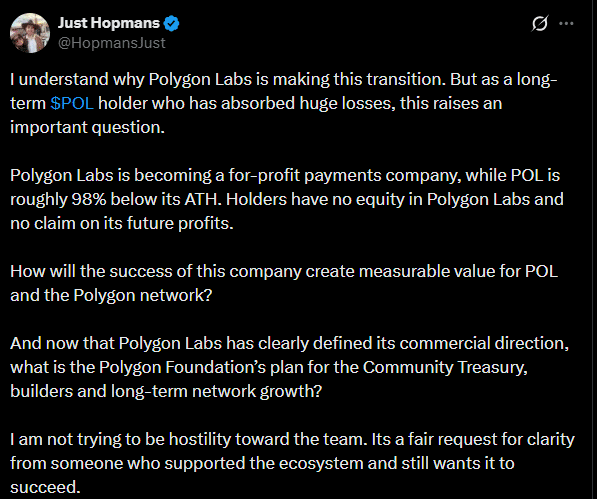
The core of the tension lies in the structural separation between Polygon Labs—the development powerhouse—and the decentralized network governed by the POL token. Just Hopmans, a vocal member of the community, recently crystallized the frustrations of many investors.
“Polygon Labs is becoming a for-profit payments company, while POL is roughly 98% below its ATH,” Hopmans remarked. “Holders have no equity in Polygon Labs and no claim on its future profits.”
This critique strikes at the heart of the "Web3 paradox." While many retail investors entered the Polygon ecosystem under the impression that their token holdings represented a stake in the network’s future success, the legal and operational reality is far more clinical. Polygon Labs, as a private corporation, operates under a fiduciary duty to its shareholders and investors, not the decentralized holders of its native token. Consequently, the value of POL, which relies on network usage and governance participation, has become decoupled from the commercial revenue streams generated by the Labs’ new business initiatives.
Chronology of a Rebrand and a Decline
To understand the current malaise, one must look at the recent history of the token. In late 2024, the ecosystem underwent a massive transition, moving from the legacy MATIC token to the new POL ticker. The move was framed as a strategic upgrade, designed to facilitate a multi-chain future and solidify Polygon’s standing as the "Value Layer of the Internet."
- Late 2024: The highly anticipated POL token launch occurs. Initial enthusiasm drives the price to the $1.00 psychological barrier, fueled by marketing efforts and hopes for a new era of network utility.
- Early 2025: Macroeconomic headwinds and shifting sentiment in the Layer 2 (L2) space begin to erode the early gains. The narrative surrounding the "Value Layer" struggles to gain traction in a market dominated by newer, faster-growing chains.
- H1 2026: Polygon Labs announces multiple rounds of layoffs, citing a strategic pivot toward becoming a lean, for-profit payments infrastructure company.
- Mid-2026: POL hits a nadir, trading near $0.06. Despite a 93% crash within the year, the number of wallet holders continues to swell, reaching over 245,000—a 78% increase in just one month.
This paradox—where user counts rise while price craters—suggests a massive influx of bottom-fishers hoping for a recovery, or perhaps a distribution of tokens to new users who are unaware of the governance and profitability concerns raised by long-term holders.
Governance and Transparency Concerns
The friction is not limited to price action; it extends to the management of the Polygon Foundation’s treasury. The community has raised alarms regarding the lack of transparency surrounding the movement of assets. Specifically, reports have surfaced claiming that the Foundation moved over 50 million POL tokens during the first half of 2026 without prior consultation or clear communication with the community.
For stakeholders, this lack of oversight is a red flag. If the foundation is offloading tokens to cover the operational expenses of a for-profit company, it arguably dilutes the value of the token for everyone else. The question remains: Are these funds being used to drive network adoption, or to fund the salaries and overhead of a company that does not share its profits with the token-holding community?
Supporting Data: The Stablecoin Settlement Battle
Polygon’s strategic shift into the payments sector is not happening in a vacuum. The L2 space is currently engaged in a brutal war for stablecoin dominance. Data provided by Visa and Allium highlights both the potential and the peril for the Polygon ecosystem.
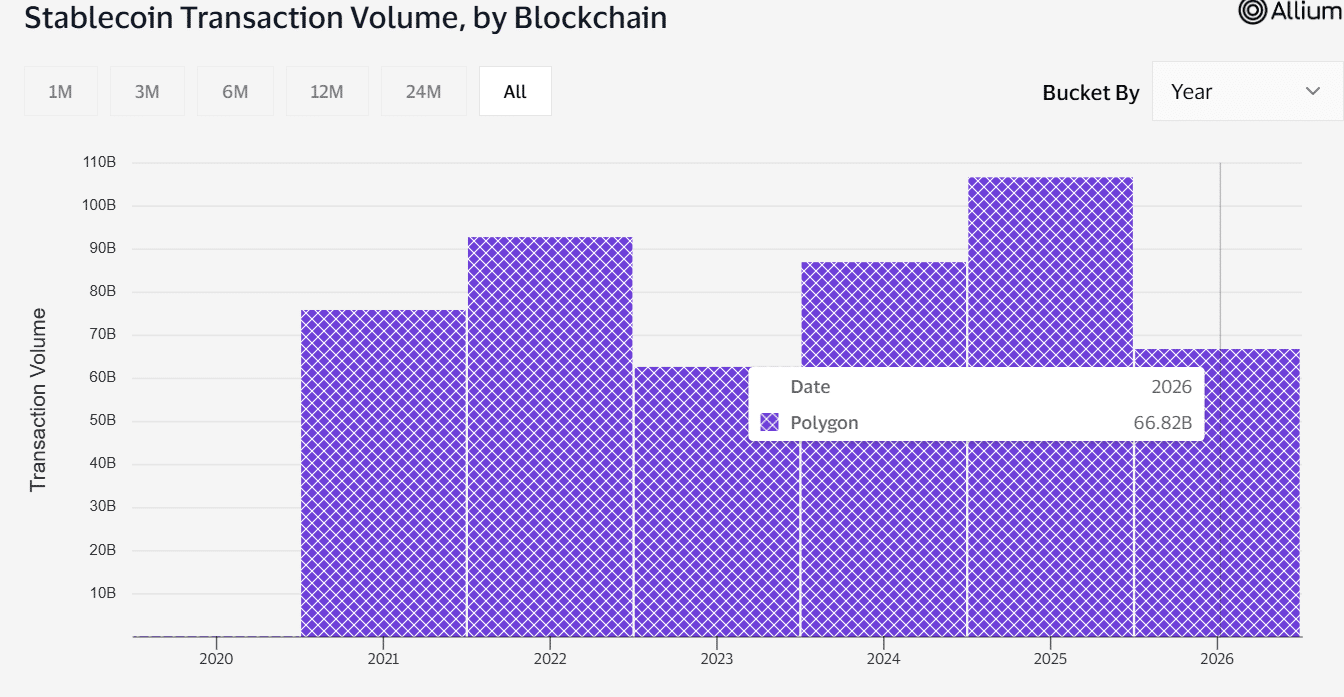
In 2025, Polygon saw a record $106 billion in annual stablecoin transfer volume. In 2026, the trajectory is on track to hit approximately $70 billion. While these numbers are objectively high, they mask a troubling trend: market share erosion.
- 2023: Polygon held roughly 1.54% of the stablecoin settlement market.
- 2026: That share has plummeted to 0.72%.
While Polygon is processing more volume, it is losing its comparative dominance at an alarming rate. The winners in this shift have been Solana (SOL) and the Coinbase-backed Base network. Solana has ascended from near-zero market share to over 22%, while Base has captured 16%.
The data indicates that while Polygon remains a "key settlement layer," it is being outmaneuvered by competitors that offer either superior speed, lower costs, or more seamless integration into major retail exchanges and consumer apps. The "for-profit payments" pivot by Polygon Labs appears to be a defensive maneuver—an attempt to reclaim this lost territory by aggressively courting enterprise-grade payment partnerships.
Official Responses and Corporate Strategy
Polygon Labs CEO Marc Boiron has been steadfast in his defense of the company’s direction. According to Boiron, the transition into a specialized blockchain payments firm is not just a tactical shift—it is a necessity for long-term viability. By focusing on profitability for the 2027 fiscal year, Labs aims to secure the financial independence of the development team, ensuring they do not need to rely on periodic token dumps to keep the lights on.
However, the "official" narrative often stops at the corporate perimeter. As of this writing, neither the Polygon Foundation nor Polygon Labs has issued a formal response to the specific inquiries posed by the community regarding profit-sharing or treasury transparency. This silence is often interpreted by the market as a lack of accountability, further exacerbating the tension between the "decentralized" nature of the network and the "centralized" nature of its lead development firm.
Implications: The Future of the POL Token
The situation presents several significant implications for the future of the Polygon ecosystem:
1. The Death of the "Community Equity" Myth
The current situation serves as a stark reminder to the broader crypto industry that holding a governance token is not equivalent to holding shares in a corporation. Unless a protocol explicitly embeds revenue-sharing mechanisms into its smart contracts, the profits generated by the founding team’s commercial ventures will likely remain isolated from the token holders.
2. The Competitive "Pivot" Risk
Polygon’s pivot to payments is a high-stakes gamble. If the company succeeds in capturing a large segment of the global payment market, it may drive massive transaction volume to the network, which could theoretically boost POL burn rates or staking demand. However, if the pivot fails to reverse the decline in stablecoin market share, the ecosystem risks becoming a "zombie chain"—technically functional but abandoned by the liquidity providers and developers that once fueled its growth.
3. The Need for Decentralized Governance
The outcry from holders like Hopmans highlights a failure in the current governance model. If the community does not have a formal mechanism to influence the actions of the Foundation, the network is effectively governed by a centralized entity disguised as a DAO (Decentralized Autonomous Organization). Future projects may need to adopt more rigorous, on-chain treasury controls if they hope to maintain the trust of long-term investors.
Conclusion
The community’s call for clarity is not merely a request for financial reporting; it is a fundamental challenge to the current power structure of the Polygon ecosystem. As the project enters a defining year, the leaders at Polygon Labs must decide whether to continue operating as an opaque, profit-driven entity or to pivot toward a more collaborative relationship with the token holders who provide the network’s base of support.
Without a clear link between the commercial success of the Labs and the utility of the POL token, the community may continue to vote with their feet, further accelerating the exodus of liquidity to more competitive and transparent ecosystems. The clock is ticking toward 2027, and for many POL holders, the price of silence may be too high to pay.
