

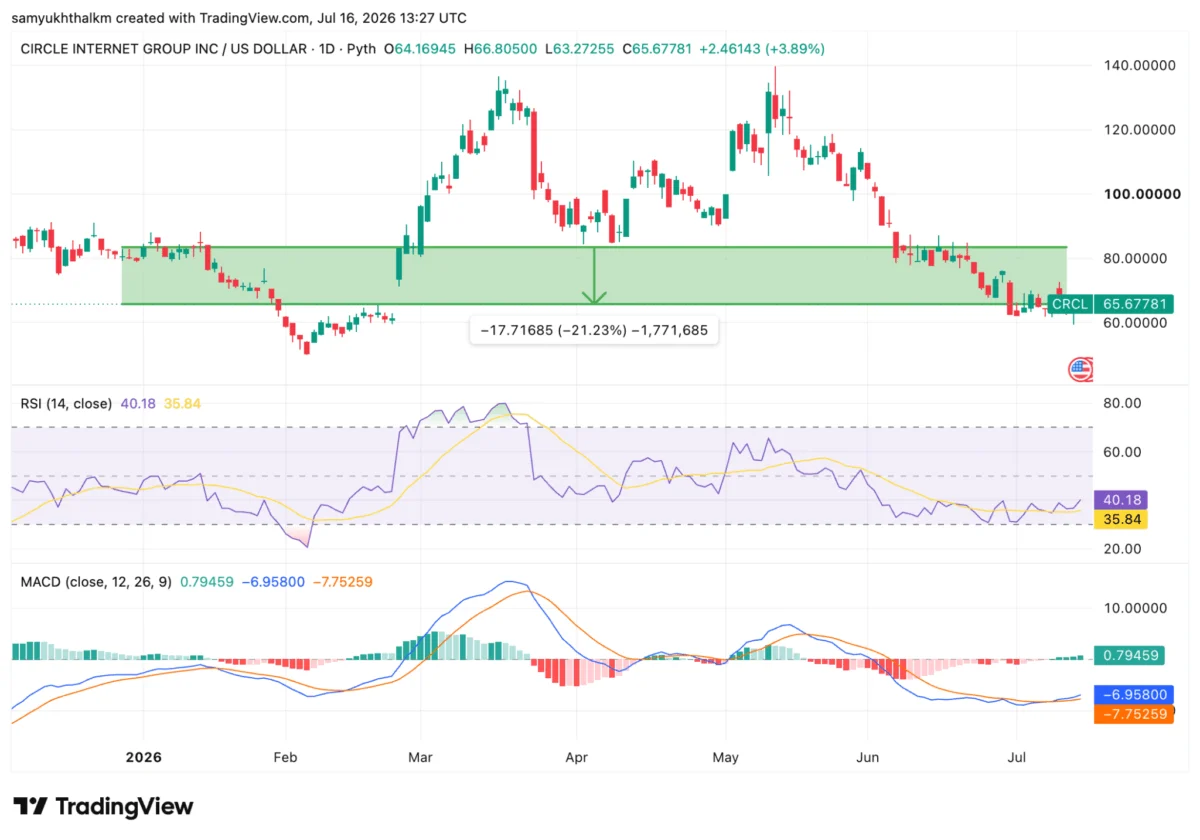
Circle Internet Group (CRCL) finds itself at a pivotal juncture in mid-2026. As the issuer of the USDC stablecoin, the company has long been a pillar of the digital asset ecosystem. However, recent market performance indicates that investors are increasingly cautious. While the stock has seen a modest rebound, trading at approximately $65.68—a 3.89% gain in recent sessions—the broader narrative for the year has been one of significant contraction.
With the stock down nearly 21% year-to-date and struggling to reclaim the heights of over $130 seen in the spring, the market is signaling that the era of "easy growth" for stablecoin issuers may be shifting toward a more complex, competitive landscape.
Main Facts: The Current Market State
The primary driver of the current investor sentiment is a reassessment of Circle’s long-term competitive moat. Historically, USDC benefited from its reputation for transparency and regulatory compliance. However, 2026 has introduced a new suite of challenges:
- Price Correction: After peaking above $130 in March and May, CRCL has undergone a sharp correction, mirroring broader cooling in the crypto-equity sector.
- Competitive Pressure: The emergence of OUSD and other yield-bearing stablecoin alternatives is challenging the traditional, non-yielding USDC model.
- Regulatory Hurdles: While regulatory clarity is generally good for the industry, the specific implementation of new frameworks is forcing Circle to adapt its distribution model, which has historically relied on heavy integration with centralized exchanges like Coinbase.
- Institutional Sentiment: Analyst downgrades have begun to pile up, with firms questioning whether the current revenue multiples are sustainable in an environment where competition is eroding market share.
A Chronology of the 2026 Struggle
To understand why CRCL is trading at current levels, one must look at the timeline of the past six months:
- Q1 2026 (The Peak): Optimism regarding institutional adoption and a favorable regulatory environment pushed CRCL to historic highs of $130+. During this period, the market priced in a "stablecoin supercycle."
- April 2026 (The Inflection Point): As the broader crypto market began to consolidate, questions regarding Circle’s reliance on banking partners and the potential for federal interest rate adjustments began to surface.
- June 2026 (The Emergence of OUSD): The market saw a significant shift toward OUSD and similar protocols. Investors began rotating out of traditional stablecoins in search of native yield, directly impacting the velocity of money within the USDC ecosystem.
- July 2026 (Current Consolidation): The stock found a support floor near the $60–$65 range. The recent 3.89% uptick represents a technical bounce, yet analysts remain skeptical of a V-shaped recovery without a catalyst.
Supporting Data: Why the Bearish Sentiment?
The data points to a cooling of the "stablecoin gold rush." When analyzing Circle’s performance, three key data sets emerge as the primary headwinds:
1. Market Share Contraction
While USDC remains a dominant force, its dominance as a percentage of total stablecoin supply has been incrementally chipped away by smaller, more agile competitors. These competitors are utilizing decentralized finance (DeFi) primitives to offer rewards that traditional USDC models—which prioritize reserve stability—cannot match.
2. Revenue Diversification Issues
Circle’s revenue is heavily tied to the interest income generated from the reserves backing USDC. With global interest rates showing signs of stabilization or potential decline, the "easy money" period for stablecoin issuers is coming to an end. Investors are now looking at Circle’s ability to generate revenue through services and infrastructure, rather than just the "float."
3. Distribution Model Bottlenecks
A significant portion of Circle’s growth has been linked to the growth of exchanges like Coinbase. If Coinbase or other major liquidity providers see a slowdown in retail trading volume, Circle feels that impact immediately. The market is currently punishing stocks that lack "distribution independence."
Official Responses and Market Perspectives
Circle management has largely maintained a stance of long-term optimism, focusing on the infrastructure side of the business. During recent investor briefings, the executive team emphasized that "the transition from speculative trading to real-world utility is the ultimate goal."
However, market analysts provide a more tempered view. "The valuation of CRCL was priced for perfection," noted a lead analyst from a major research firm. "When you trade at high multiples, any sign of competition—especially from something as disruptive as OUSD—is going to lead to a rapid repricing."

There is also the matter of the "Coinbase Factor." Circle’s tight-knit relationship with major exchanges is a double-edged sword. While it provides unparalleled distribution, it also creates a single point of failure risk. Recent talks regarding expanded partnerships are being watched closely, as investors are looking for signs that Circle can broaden its reach beyond the current exchange-heavy ecosystem.
Implications: What Lies Ahead?
The road ahead for Circle is paved with both risk and opportunity. To recover its former glory, the company must address several critical fronts:
The "OUSD Challenge"
The rise of OUSD suggests that the market is no longer satisfied with "stable" assets; it wants "productive" assets. Circle faces a choice: innovate its own product line to include yield-bearing mechanics, or double down on its institutional-grade, "safe-haven" branding. Both paths carry significant regulatory and execution risks.
Regulatory Catalyst
If upcoming legislation provides a definitive framework for stablecoin issuers, it could serve as the long-awaited catalyst for CRCL. A clear regulatory status would allow institutional investors—who have been sitting on the sidelines—to enter the market with more confidence. For Circle, being the most "compliant" player in the room is a long-term strategic advantage that may finally pay off if the regulatory landscape clears.
The Institutional Pivot
Circle is currently investing heavily in "Web3 Services," aiming to move beyond just being a token issuer. By positioning itself as an infrastructure provider for developers, Circle is attempting to decouple its stock price from the fluctuations of crypto trading volume. If these services gain traction, they could provide a more stable, recurring revenue stream that is less sensitive to market sentiment.
Conclusion
The $65 price level is a critical psychological and technical barrier. If the company can demonstrate through its next earnings cycle that it is successfully defending its market share against OUSD and that its revenue diversification strategy is bearing fruit, we may see a stabilization period.
However, until such evidence is provided, the stock remains in a "show me" phase. Investors are no longer buying the promise of stablecoins; they are buying the promise of a business model that can survive—and thrive—in a competitive, yield-hungry, and increasingly regulated digital asset economy. Circle has the tools and the pedigree to navigate this, but the margin for error has narrowed significantly. The months ahead will be defined by whether Circle can transform from a "crypto-native" asset into a foundational piece of the global financial architecture.
