


The decentralized finance (DeFi) ecosystem, a sector defined by its rapid innovation and permissionless nature, is once again finding itself under the microscope. After months of painstaking effort to rebuild user confidence and liquidity following the catastrophic security failures of the first and second quarters, the sector is grappling with a fresh wave of FUD (Fear, Uncertainty, and Doubt). A single, harrowing day of exploits has erased over $35 million in liquidity, casting a long shadow over the recent progress made by the broader market.
As analysts weigh the implications of these new breaches, the memory of earlier, more devastating hacks remains fresh. The industry is now left to grapple with a haunting question: Has the security of cross-chain infrastructure improved, or are we simply witnessing a cyclical return to the same vulnerabilities that have historically plagued the sector?
The Anatomy of the Latest Exploits: A Bridge Too Weak
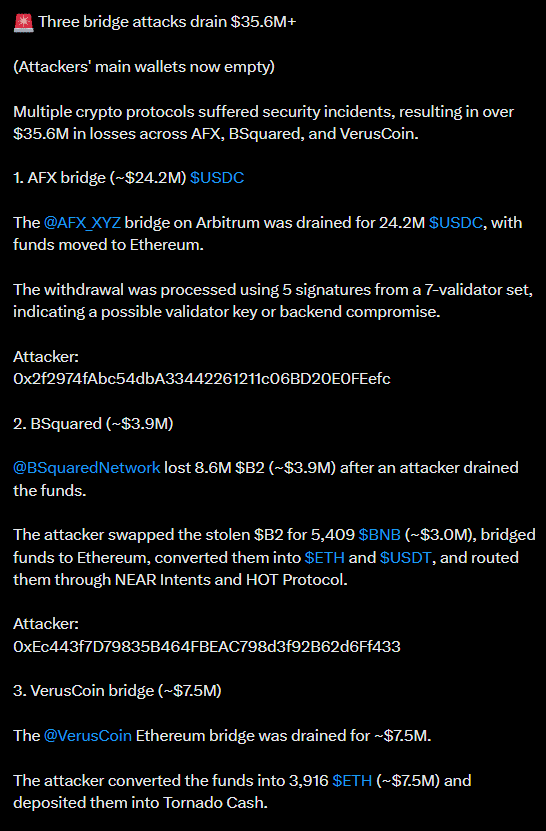
The recent security incidents—totaling approximately $35.55 million in losses—have highlighted a persistent and agonizingly familiar weakness: the vulnerability of cross-chain bridges. While the specific protocols involved in this latest wave operate across different chains, the underlying attack vectors appear identical, suggesting a systemic flaw in the design or implementation of bridge smart contracts.
A Breakdown of the Losses:
- AFX: The hardest-hit protocol, AFX, suffered a staggering loss of $24.2 million in USDC. The attackers successfully compromised the protocol’s Arbitrum bridge, facilitating a rapid outflow of funds that were subsequently bridged to the Ethereum mainnet.
- VerusCoin: This protocol faced a bridge exploit totaling roughly $7.5 million, marking another significant hit to liquidity that was intended to be secure within cross-chain ecosystems.
- BSquared Network: The third major victim saw 8.6 million B2 tokens drained, resulting in a loss of approximately $3.9 million.
The speed and precision of these attacks have led many security researchers to label this the “worst day for DeFi in months.” While the absolute dollar amount is lower than the massive hacks witnessed in Q1 and Q2, the psychological impact is magnified by the fact that these protocols were supposedly utilizing updated security protocols. The recurrence of bridge-centric attacks underscores a sobering reality: despite the billions of dollars flowing through these conduits, their security remains the "Achilles’ heel" of the decentralized web.
Flashback: The Q1-Q2 Crisis and the Liquidity Exodus
To understand the current anxiety, one must look back at the harrowing cycle of early 2024. During the first half of the year, the DeFi market was rocked by three back-to-back hacks that wiped out over $600 million in total value. The fallout was immediate and severe.
The liquidity flight was not limited to the compromised protocols; it caused a contagion effect that bled across the entire DeFi landscape. DeFi Total Value Locked (TVL) plummeted to Q2 2024 levels, hovering just above $65 billion. Ethereum, the primary hub for decentralized finance, bore the brunt of this exit, shedding over $10 billion in TVL in less than 48 hours. This period defined the "risk-off" sentiment that has hampered the industry’s growth for months.
The Ghost of the Drift Protocol: A Ticking Time Bomb?
The situation has been further complicated by the sudden movement of funds linked to the Drift Protocol hack. Earlier this year, Drift suffered a catastrophic exploit that resulted in the loss of $285 million, an event that served as a catalyst for the sector’s previous liquidity crisis.

For months, these stolen funds sat largely dormant, trapped in wallets monitored by security firms and blockchain analysts. However, according to real-time tracking from Onchain Lens, the attacker has recently begun funneling these funds through the Tornado Cash router. The methodology is highly methodical: the attacker is executing multiple transactions every minute, each moving 100 ETH at a time.
This activity is not merely a technical event; it is a signal. The movement of these funds suggests that the attackers are preparing to "clean" the assets for eventual liquidation or movement into the broader crypto economy. Coming on the heels of the recent $35 million in bridge exploits, the timing has sparked fears that a secondary selloff may be imminent, or that the hackers are attempting to exploit the current market volatility to obscure their tracks.
The Macro-Economic Context: A Recovery Interrupted
The irony of this week’s events is that they arrive exactly when DeFi was showing signs of a genuine, organic resurgence. Throughout July, the ecosystem experienced a period of relative stability and growth. DeFiLlama data indicates that the sector’s TVL climbed by over $10 billion in July alone—the strongest monthly recovery since the dark days of the Q1-Q2 hacks.
Market participants had begun to breathe a sigh of relief, interpreting this inflow of capital as a sign that the industry had finally matured and that security best practices were catching up to the sophistication of attackers. The recent $35 million in losses has effectively acted as a "circuit breaker" for this momentum.
Analysts at major research firms are now warning that if these exploits continue at this frequency, the market narrative will shift from "capital inflow" to "protocol security audit." This shift effectively stalls the growth of new protocols, as investors are once again demanding higher premiums for the risk of utilizing decentralized applications.
Official Responses and Industry Accountability
As of press time, the teams behind AFX, VerusCoin, and BSquared Network have issued statements acknowledging the breaches. Most have confirmed that they are working with cybersecurity firms to trace the stolen assets and engage with centralized exchanges to freeze any incoming deposits linked to the stolen funds.
However, the lack of a standardized recovery framework remains a glaring gap in the industry. While some protocols have proposed "white hat" bounty programs, the reality is that the vast majority of stolen funds are rarely recovered. The response from the community has been one of frustration, with many users demanding that bridge providers implement "circuit breakers"—automated mechanisms that pause transactions when an unusual volume or velocity of outflows is detected.
The incident has also reignited the debate surrounding decentralized governance. Should protocol DAOs be held legally responsible for the security failures of the code they vote to implement? While this is a complex legal issue, the market is beginning to vote with its feet, favoring protocols that provide proof of insurance or those that have undergone rigorous, multi-firm audits.
Implications for the Future of DeFi
The events of this week have broad implications for the trajectory of DeFi.
1. The Death of "Set and Forget" Liquidity
Investors are moving away from passive yield farming. The risk premium for providing liquidity to bridges is rising, and we are likely to see a trend where capital migrates toward more established, audited, and insured lending protocols.
2. Regulatory Scrutiny
With every $30 million+ hack, the argument for stricter regulatory oversight grows stronger. Policymakers are already eyeing the "shadowy" nature of bridge exploits as a reason to impose KYC requirements on DeFi protocols. This creates a dilemma: do we sacrifice the permissionless ethos of DeFi to gain the security provided by regulatory oversight?
3. Innovation in Security
If there is a silver lining, it is the accelerated development of "Security-First" DeFi. New projects are emerging that utilize ZK-proofs (Zero-Knowledge proofs) to verify the state of bridges, theoretically removing the reliance on centralized multi-sig wallets that have been the primary point of failure for bridge hacks.
Conclusion: A Critical Juncture
The DeFi sector is at a crossroads. The recent wave of exploits is a stark reminder that the technology remains in its infancy, and the "DeFi summer" of growth is only as strong as the security of its infrastructure. While the $35.55 million lost this week may seem manageable compared to previous disasters, the compounding effect of these hacks—combined with the unsettling movement of the Drift Protocol funds—threatens to undo months of progress.
For the market to regain its footing, the industry must pivot from rapid expansion to rigorous, foundational security. Until bridges are proven to be as robust as the chains they connect, the specter of "DeFi FUD" will continue to loom, ready to trigger a liquidity exodus at the first sign of a vulnerability. The coming weeks will be critical; they will determine whether this is merely a minor setback or the beginning of a larger, systemic reckoning.
