

In a significant development for the decentralized finance (DeFi) ecosystem, the company behind the prominent liquidity aggregator Odos has officially announced that it will permanently wind down its operations by the end of July. The decision marks the conclusion of a chapter for one of the sector’s notable tools for token swapping and liquidity routing. While the parent company is ceasing all support and development, the protocol’s underlying infrastructure, the ODOS token, and the Odos DAO are set to remain operational, albeit under a new, independent reality.
This transition comes as a stark reminder of the complexities inherent in decentralized projects, where the line between a corporate entity providing a frontend service and the autonomous protocol itself can become a point of friction during operational restructuring.
Chronology of the Wind-Down
The transition process has been structured with specific deadlines to ensure that users have a narrow window to secure their assets and manage their positions before the platform transitions into a limited state.
Immediate Limitations and "Read-Only" Transition
As of the announcement, the platform has already implemented several restrictions to prevent further operational complexity. New account registrations, the creation of new wallets, and the initiation of new limit orders have been officially disabled.
The timeline for the final shutdown is as follows:
- Ongoing (Pre-July 27): Existing users maintain the ability to swap tokens and close out active positions.
- July 27: The Odos application will transition into a "read-only" mode. During this phase, users will be unable to execute any new transactions or interact with the protocol’s swapping mechanics. The interface will serve strictly as a historical ledger, allowing users to view their transaction history and remaining balances.
- July 30: All Odos-operated services will be permanently deactivated. After this date, the company will cease all development, maintenance, and technical support.
Urgent Action Items for Users
The team behind Odos has issued a stern advisory for users who leveraged the platform’s social or email-based login features to create wallets. Because these wallets are tethered to the company’s infrastructure, users must export their private keys or transfer their assets to self-custodial wallets (such as MetaMask or hardware wallets) before the July 30 deadline. Failure to act before the final shutdown could result in significant difficulties in accessing funds, although the team noted that instructions for recovering wallet access will remain available on their support page post-shutdown.
Understanding the Non-Custodial Nature of Odos
A central pillar of the Odos announcement is the emphasis on its non-custodial architecture. In the DeFi space, "non-custodial" is a critical distinction: it means that the company never held the keys to user assets. Instead, all user funds remained strictly on-chain, controlled by the smart contracts the user interacted with directly via the Odos frontend.
By reiterating this, the team aims to reassure the community that the shutdown of the company does not equate to a "rug pull" or a loss of funds held in the protocol. Because the smart contracts themselves are immutable and decentralized, the assets remain under the full control of the wallet owners, regardless of whether the Odos website is online or offline.
The Future of the ODOS Token and DAO
One of the more nuanced aspects of this news is the survival of the ecosystem’s governance and economic components. The company has explicitly stated that the ODOS token and the Odos DAO will continue to function independently.
Independence from the Operating Company
In many DeFi projects, the "company" is merely a service provider that builds the frontend and provides maintenance for a protocol that is otherwise autonomous. In this case, the Odos DAO—the decentralized autonomous organization tasked with the governance of the protocol—will continue to operate. The DAO is expected to deliberate on the future direction of the protocol, including potential governance proposals or community-led initiatives that may arise in the wake of the company’s exit.
No Migrations or Airdrops: A Warning on Scams
In the wake of the announcement, the team has taken a proactive stance against opportunistic bad actors. They have explicitly stated that there will be no new product launches, no token migrations, no token claims, and no airdrops.
This warning is vital. In previous instances where major DeFi protocols have wound down or rebranded, scammers have frequently exploited the uncertainty by launching fake "migration" websites. These phishing sites often mimic the look and feel of the original platform, prompting users to connect their wallets and sign transactions that drain their balances. The Odos team has urged users to treat any social media direct messages, unofficial support accounts, or websites claiming to offer "new Odos tokens" as malicious scams.
Supporting Data and Market Reaction
Following the announcement, the market reaction was immediate, reflecting the uncertainty that typically accompanies the closure of a service provider in the crypto space.
Market Performance
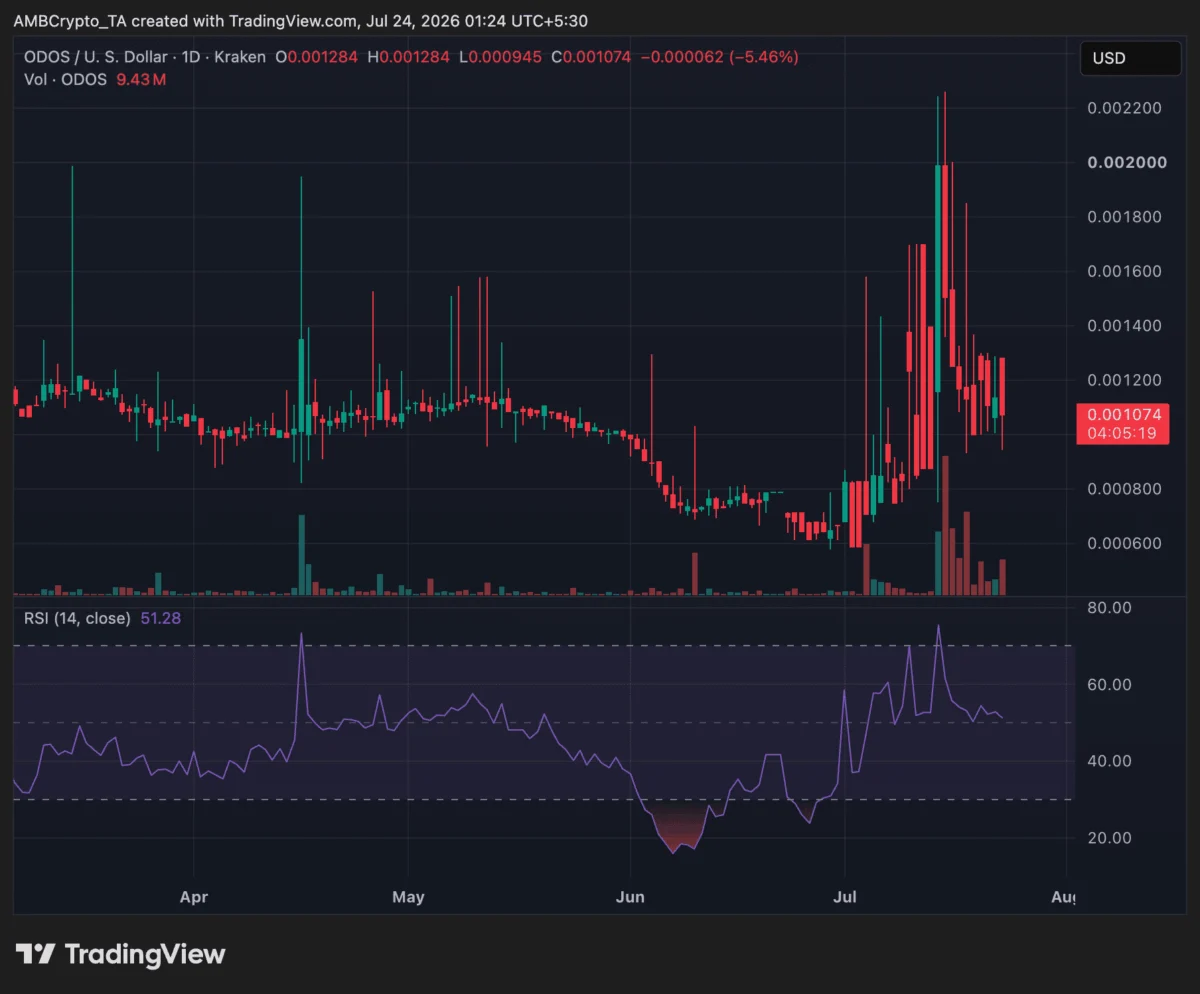
According to data from TradingView, the ODOS token experienced a decline of approximately 5.5% within the 24 hours following the news. At the time of press, the token was trading at roughly $0.00107. While this dip indicates a negative market sentiment, the volume of trading spiked, suggesting a high degree of activity as investors adjusted their positions in response to the news.
Interestingly, the token’s Relative Strength Index (RSI) remained near 51. In technical analysis, an RSI of 51 is considered neutral—neither suggesting that the asset is oversold (which would typically be below 30) nor overbought (above 70). This indicates that while the price drop was significant, the market is currently in a state of "wait and see," rather than a panic-driven liquidation event.
Implications for the DeFi Ecosystem
The wind-down of Odos offers several broader implications for the future of decentralized finance.
1. The Resilience of Decentralized Infrastructure
The fact that the protocol can continue to exist despite the closure of the corporate entity is a testament to the design principles of DeFi. It highlights the success of building truly decentralized, on-chain protocols where the "frontend" is just one potential access point among many. As the industry matures, users are becoming increasingly adept at using alternative interfaces or interacting directly with smart contracts when their preferred UI goes offline.
2. Governance Challenges
The separation of the DAO from the company raises questions about the future of Odos. Without the development team providing technical updates, the burden of maintenance and innovation falls entirely on the community. For a DAO to succeed in this environment, it requires active governance, treasury management, and potentially the hiring of independent developers or third-party firms to maintain the codebase. Whether the Odos DAO has the resources and the organizational maturity to sustain the protocol remains the central question for its future.
3. The Importance of Operational Transparency
The clear, step-by-step communication provided by the Odos team serves as a gold standard for how projects should exit the market. By providing clear deadlines, explaining the status of assets, and explicitly warning against scams, the team has minimized the potential for user panic and loss. This transparency stands in sharp contrast to past DeFi collapses, where poor communication led to chaos and significant asset loss.
Final Summary and Outlook
The shutdown of the company behind Odos is a significant transition for the project, but not necessarily the end of the protocol. By differentiating between the service provider and the underlying decentralized architecture, the team has provided a roadmap for a smooth exit.
For the average user, the priority over the next few days should be clear:
- Secure your assets: Move funds out of any social-login wallets before July 30.
- Verify your sources: Ignore all messages regarding "token migrations" or "airdrops," as these are confirmed to be scams.
- Monitor the DAO: Keep an eye on official DAO communication channels for any community-driven efforts to maintain the protocol moving forward.
As the DeFi industry continues to evolve, the Odos case will likely be cited as a case study in how to navigate the closure of a service provider while preserving the integrity of a decentralized, on-chain protocol. The success of the protocol’s next chapter will depend entirely on the ability of the Odos DAO to organize and sustain the ecosystem without the support of its founding company.
