

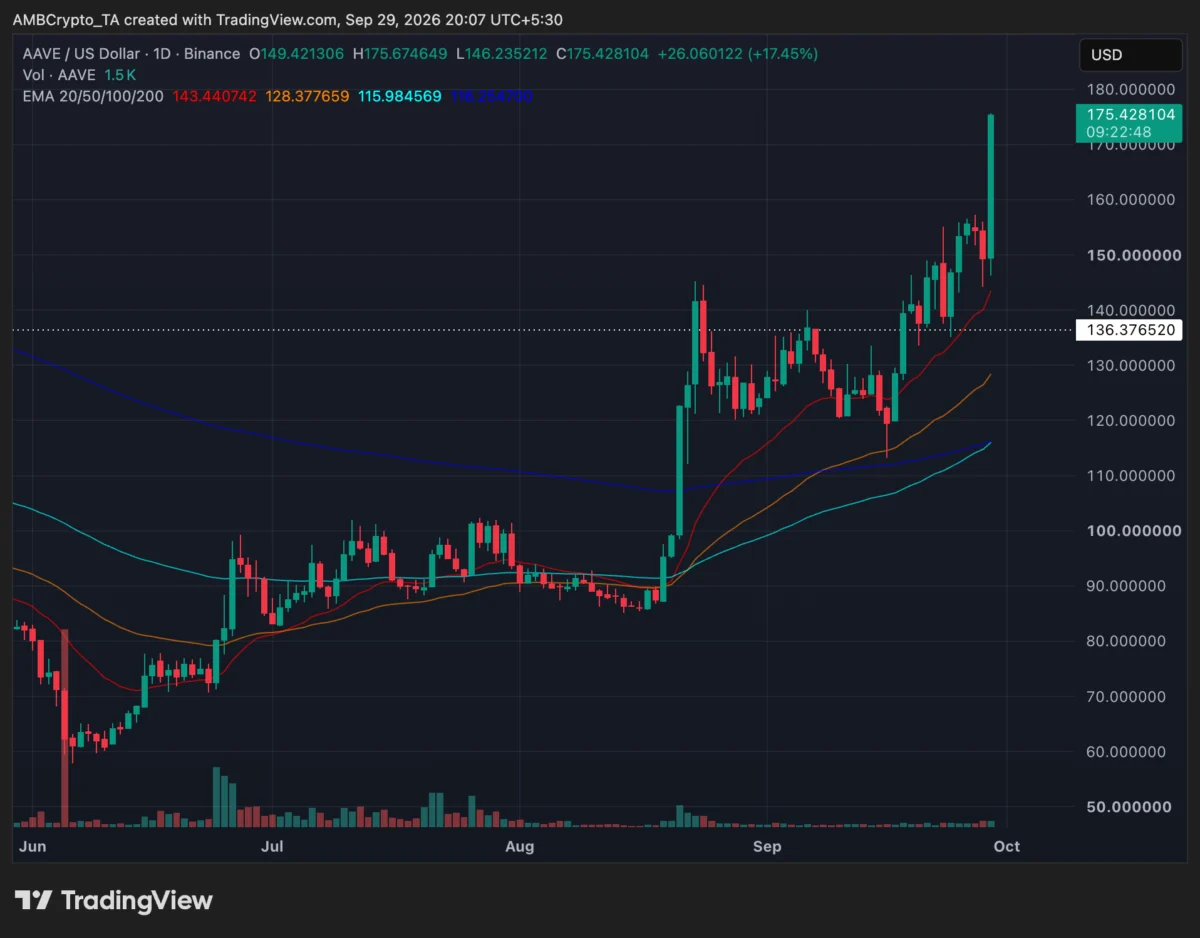
In a display of remarkable market strength, Aave (AAVE), the flagship decentralized finance (DeFi) lending protocol, experienced a significant breakout on September 29. The token surged over 17%, vaulting from a trading range of $149 to surpass the $175 milestone. This move represents more than just a momentary price spike; it signifies a decisive break from the restrictive price channels that governed the asset throughout much of September.
This rally is particularly noteworthy given the broader macroeconomic environment. With US Treasury yields consistently hovering above 5%—levels not observed since 2007—traditional finance (TradFi) assets have become increasingly attractive, posing a direct competitive threat to the yield-generating capabilities of the DeFi sector. Despite this "risk-free" competition, Aave’s recent performance suggests that market participants remain deeply committed to the utility and growth potential of decentralized liquidity protocols.
The Chronology of a Recovery: From Mid-August Slump to September Surge
The journey to the $175 mark was not an overnight phenomenon but the result of a sustained recovery phase that began in the dog days of summer.
The Mid-August Foundation
In mid-August, AAVE was struggling to maintain momentum, trading below the $90 support level. At the time, market sentiment was tepid, with many investors wary of the volatility plaguing the crypto-assets market. However, the protocol began to demonstrate resilience. By systematically climbing past the $120, $140, and $150 thresholds, AAVE signaled that its momentum was organic and structurally supported rather than driven by speculative "pump and dump" cycles.
The September Breakthrough
September served as a testing ground for Aave’s maturity. For much of the month, the $150 to $155 range acted as a stubborn ceiling, rejecting multiple attempts at a breakout. Technical analysts watched closely as the price repeatedly touched this resistance only to retreat.
On September 29, the narrative changed. With renewed buying pressure, AAVE not only pierced this resistance but effectively neutralized it, transforming a previous ceiling into a new, robust floor. Following this breakout, the asset accelerated toward the $175 mark, currently outperforming several of its major DeFi peers.
Technical Analysis: Assessing Strength and Future Resistance
The current price action of AAVE offers several indicators of a healthy, sustained trend.
Moving Averages and Momentum
AAVE is currently trading well above its major short-term and long-term price averages. In technical analysis, this alignment is a classic signal of bullish sentiment. When an asset sustains a position above its 50-day and 200-day moving averages, it confirms that the broader market trend has shifted from accumulation to growth.
The $180 Threshold and Profit-Taking
As the token eyes the $180 mark, market participants should anticipate a period of consolidation. Historically, $180 represents a major "round number" psychological resistance level. Traders often use these intervals to lock in profits, which can lead to localized volatility.
If a pullback occurs, the critical level to watch is the $150–$155 zone. If the market successfully holds this former ceiling as a support level, it will provide a strong foundation for the next leg up. Conversely, a failure to hold this support could suggest that the recent rally was perhaps overextended and may require further consolidation before attempting a new run at historical highs.
Macroeconomic Context: The 5% Treasury Yield Challenge
The most compelling aspect of Aave’s surge is the backdrop against which it is occurring.
The Return of the Bond King
The US Treasury market is currently offering yields in excess of 5% for ten-year notes. This is a significant factor in the global investment landscape. For years, low-interest rates forced investors to seek "yield farming" opportunities in DeFi to achieve returns that couldn’t be found in traditional savings accounts or bonds.
With 5% yields now available via US government debt—an asset class considered to have minimal risk—the value proposition of DeFi lending platforms has been challenged. Why lock funds into a smart contract with inherent technical risks when one can achieve a similar return with government-backed security?

The DeFi Advantage
Despite this, Aave’s rally proves that the DeFi ecosystem is evolving beyond simple yield-chasing. Investors are increasingly looking at Aave for its integration into the real-world asset (RWA) space, its governance utility, and its role as a core infrastructure layer for the burgeoning tokenized economy. The demand for Aave is no longer just about the interest rate; it is about the protocol’s status as a foundational pillar of on-chain finance.
Official Proposals and Governance: The Aave V3 Update
Adding to the complexity of the recent price action is the governance activity occurring within the Aave DAO. On September 28, a significant risk proposal was introduced regarding the Aave V3 protocol, specifically targeting borrowing conditions and risk management.
The USDe Borrowing Rate Adjustment
The proposal recommended an increase in the borrowing rate for USDe from 6.3% to 6.6%. This adjustment is part of Aave’s proactive risk management strategy, designed to ensure that the protocol remains solvent and liquid in light of changing market conditions.
The decision was driven by an analysis of:
- Borrowing Activity: Recent surges in demand for specific assets.
- Available Liquidity: The depth of pools to ensure low slippage for users.
- Open Position Health: The collateralization ratios of active loans.
While these administrative changes demonstrate the platform’s agility, market observers have noted that there is no direct, causal link between this specific proposal and the $175 price surge. The rally appears to be driven more by broad market demand for DeFi utility than by individual governance decisions. Nevertheless, the transparency and frequency of these updates reinforce investor confidence in the long-term viability of the protocol.
Implications: Where Does Aave Go From Here?
The recent performance of Aave raises several questions about the future of the DeFi sector.
Decentralization vs. Tradition
The current market dynamic creates a fascinating "tug-of-war." If Aave can continue to gain value while competing against 5% yields in the bond market, it suggests that DeFi has reached a level of maturity where it is no longer just a "fringe" alternative to TradFi. Instead, it is being treated as a distinct asset class with its own growth drivers, including increased institutional interest and the expansion of RWAs.
The RWA Footprint
Aave’s expansion into RWA—such as turning tokenized stocks into collateral for USDC loans—is a massive catalyst for growth. By bridging the gap between traditional assets and blockchain liquidity, Aave is creating a unique ecosystem that offers utility that Treasuries cannot match. The platform is becoming a gateway, not just for crypto-natives, but for a new wave of capital looking to leverage traditional assets on-chain.
Investor Sentiment and Strategy
For the retail and institutional investor, the message from the September 29 rally is clear: Aave remains a bellwether for the DeFi industry. The shift in market sentiment, moving from the bearish lows of August to the current levels, suggests that the market is beginning to price in the protocol’s utility rather than just its speculative potential.
Summary and Outlook
As we move deeper into the fourth quarter, Aave stands at a pivotal juncture. The technical breakout past $175 is a positive signal, provided the asset can maintain support at the $150–$155 levels.
The primary takeaway from this period is that Aave has demonstrated a surprising degree of resilience in the face of significant macroeconomic pressure. The competition from 5% Treasury yields has not deterred the market; rather, it has clarified that the value of decentralized lending platforms lies in their unique capacity to manage risk and provide utility in an increasingly digital financial world.
Looking ahead, market participants should keep a close eye on the $180 psychological resistance level. A successful breach of this mark could trigger further upward momentum, while a failure to hold would likely lead to a healthy correction. Regardless of the short-term price fluctuations, Aave’s ability to navigate governance challenges and macro headwinds simultaneously underscores its position as a dominant force in the decentralized finance revolution. As the protocol continues to refine its risk parameters and expand its integration of real-world assets, its long-term trajectory remains a key focus for those observing the intersection of traditional and decentralized finance.
