

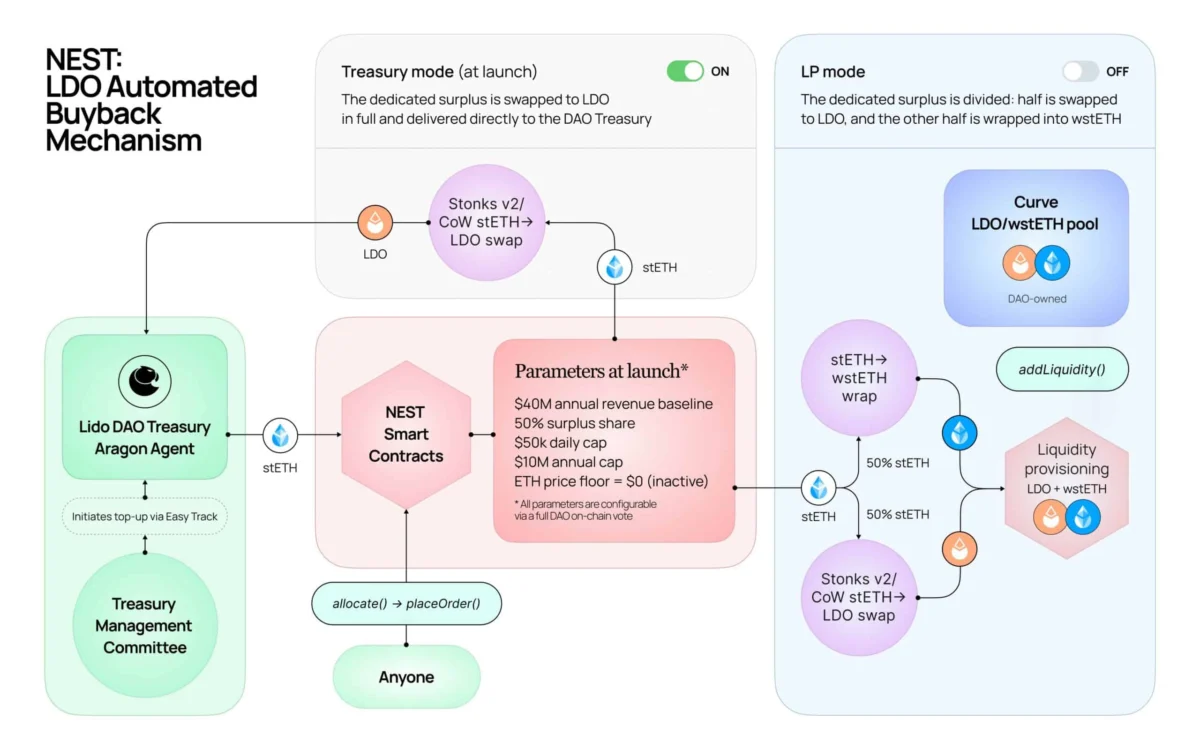
Lido Finance, the industry-leading liquid staking protocol, has officially transitioned into a new era of treasury management. After months of anticipation, the protocol has activated its "Network Economic Support Token" (NEST) program—a sophisticated, automated mechanism designed to manage LDO token buybacks. While the move represents a significant milestone in Lido’s governance maturity, it has sparked a broader industry debate regarding the efficacy of token buybacks, the optimal allocation of treasury capital, and the protocol’s long-term economic alignment.
The Mechanics of NEST: Precision-Engineered Treasury Support
The NEST program is not merely a standard buyback initiative; it is a highly calibrated, rule-based system designed to respond dynamically to the protocol’s financial health. By linking buybacks directly to revenue performance, Lido aims to ensure that treasury capital is deployed only when the protocol is generating sufficient excess liquidity.
Operational Parameters
The program, which is now live on the Ethereum mainnet, functions under a strict set of constraints:
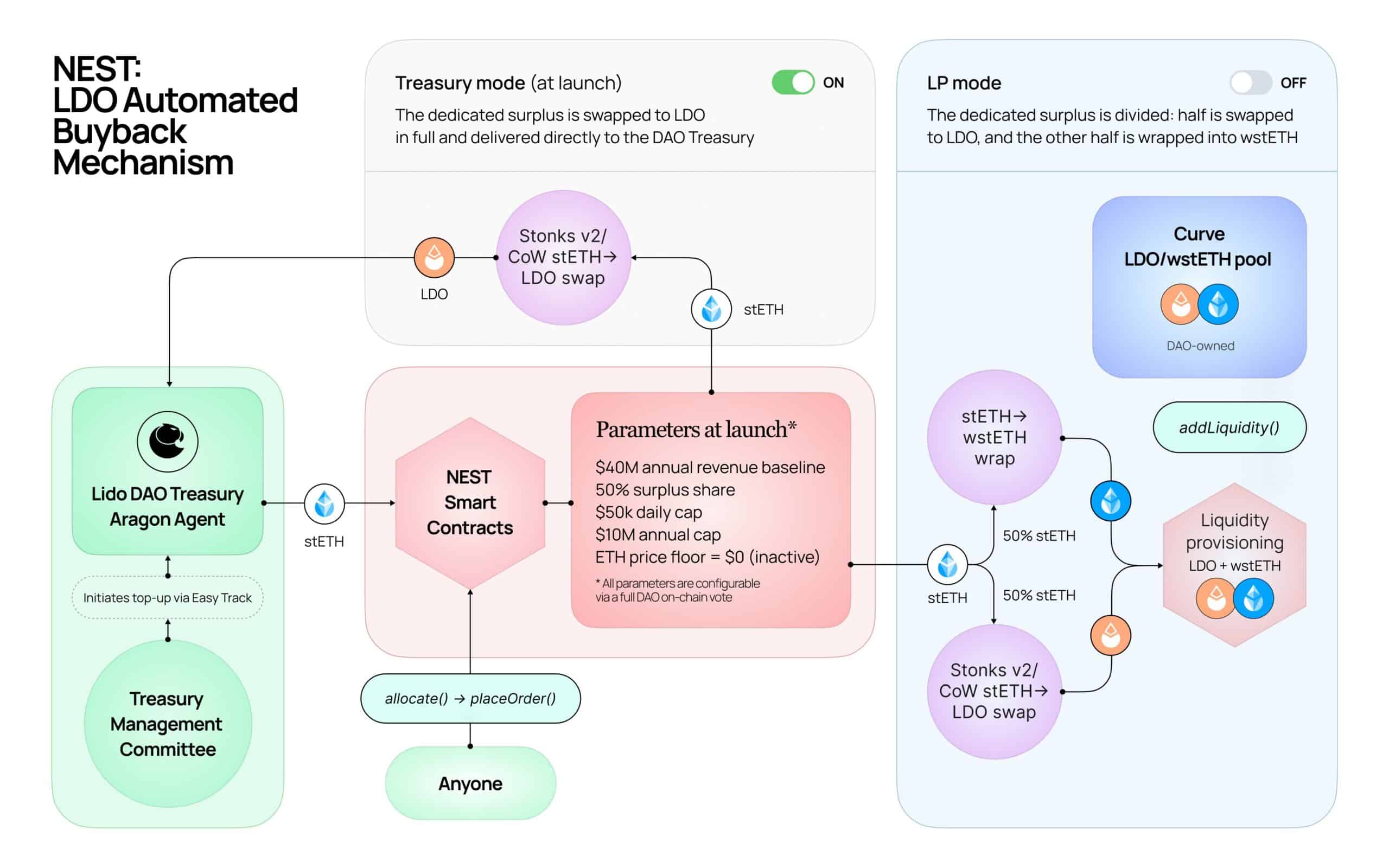
- Revenue Baseline: The buyback mechanism remains dormant unless the protocol exceeds $109,000 in daily staking revenue. This threshold effectively establishes a $40 million annual revenue baseline, ensuring that the DAO prioritizes operational sustainability before engaging in market-making activities.
- Dynamic Allocation: Once the $109,000 daily threshold is breached, 50% of the revenue exceeding that amount is automatically directed toward the purchase of LDO tokens.
- Capped Exposure: To prevent market volatility or excessive capital drainage, the program enforces a daily cap of $50,000 in purchases, with an annual ceiling set at $10 million.
Unlike some corporate buyback programs that burn tokens to create deflationary pressure, tokens acquired through NEST are retained within the Lido DAO treasury. This strategic decision provides the DAO with a deeper liquidity cushion and more versatility for future ecosystem incentives, partnerships, or governance-related initiatives.
A Chronology of the NEST Initiative
The journey to NEST was neither quick nor uncontroversial. It reflects the methodical, often slow-moving nature of decentralized governance.

- Early 2025 – The Proposal Phase: Initial discussions regarding treasury diversification and token utility began to circulate within the Lido community forums. Governance participants expressed concerns that the LDO token lacked sufficient demand-side pressure compared to other major DeFi protocols.
- Late 2025 – Refining the Model: The "NEST" concept was formally floated as a solution. It underwent multiple iterations, moving away from simple, arbitrary buyback schedules toward the current, revenue-indexed model.
- Q1-Q2 2026 – Market Volatility: As the broader crypto market faced fluctuations, the debate intensified. Supporters argued that a buyback program would instill confidence in LDO holders, while skeptics questioned whether $10 million was a meaningful enough commitment in a multi-billion dollar market.
- August 2026 – Mainnet Activation: Following final governance consensus, the smart contracts were deployed. However, the launch coincided with a period of compressed staking yields, meaning the program has yet to execute its first transaction, highlighting the sensitivity of the $109,000 daily revenue requirement.
Comparative Landscape: Is $10 Million Enough?
The announcement of the $10 million annual cap has met with mixed reviews. When placed against the backdrop of the wider decentralized finance (DeFi) ecosystem, some market analysts have suggested that the program is conservative—perhaps even "underpowered."
Current industry benchmarks reveal that aggressive buyback strategies are becoming increasingly common among top-tier protocols:
- Hyperliquid: Currently spearheading the market with an annual buyback capacity approaching $100 million.
- Aster and Uniswap: These protocols have established $40 million annual buyback programs, providing a much higher baseline of capital injection than Lido’s $10 million.
- PUMP: Targeting approximately $35 million in annual buyback volume.
Critics argue that Lido, as the dominant liquid staking provider, should be setting a higher standard. By committing only a fraction of the capital deployed by its peers, Lido may struggle to generate the "price floor" effect that many retail investors hope to see from buyback programs. However, proponents of the current model argue that Lido’s conservative approach protects the treasury from being depleted during "crypto winters," ensuring that funds remain available for security audits, development grants, and protocol upgrades—areas where Lido continues to lead the market.
Expert Perspectives and the "Buyback Debate"
The crypto community remains deeply divided on the philosophy of buybacks.
The Case for "Efficient Governance"
Proponents, including high-profile industry figures like attorney Gabriel Shapiro, have praised the move for its structural integrity. Shapiro’s comment, "How buybacks should be," suggests an appreciation for the automation and transparency of the NEST program. In a world where many projects engage in opaque treasury management, Lido’s rule-based approach provides a level of predictability that institutional stakeholders often demand.
The Skeptic’s View: Capital Allocation
Conversely, detractors—including those who have seen projects like Helium abandon similar programs—argue that buybacks are a "band-aid" solution. They contend that if a protocol has excess revenue, those funds should be reinvested into R&D, protocol security, or user acquisition. For them, a buyback is merely a form of capital recycling that does little to improve the actual utility or "product-market fit" of the token.
There is also the underlying concern that during periods of extreme market downturn, buybacks may be viewed as an attempt to "prop up" an asset price rather than focusing on building fundamental value.
Market Analysis: The Path to Recovery
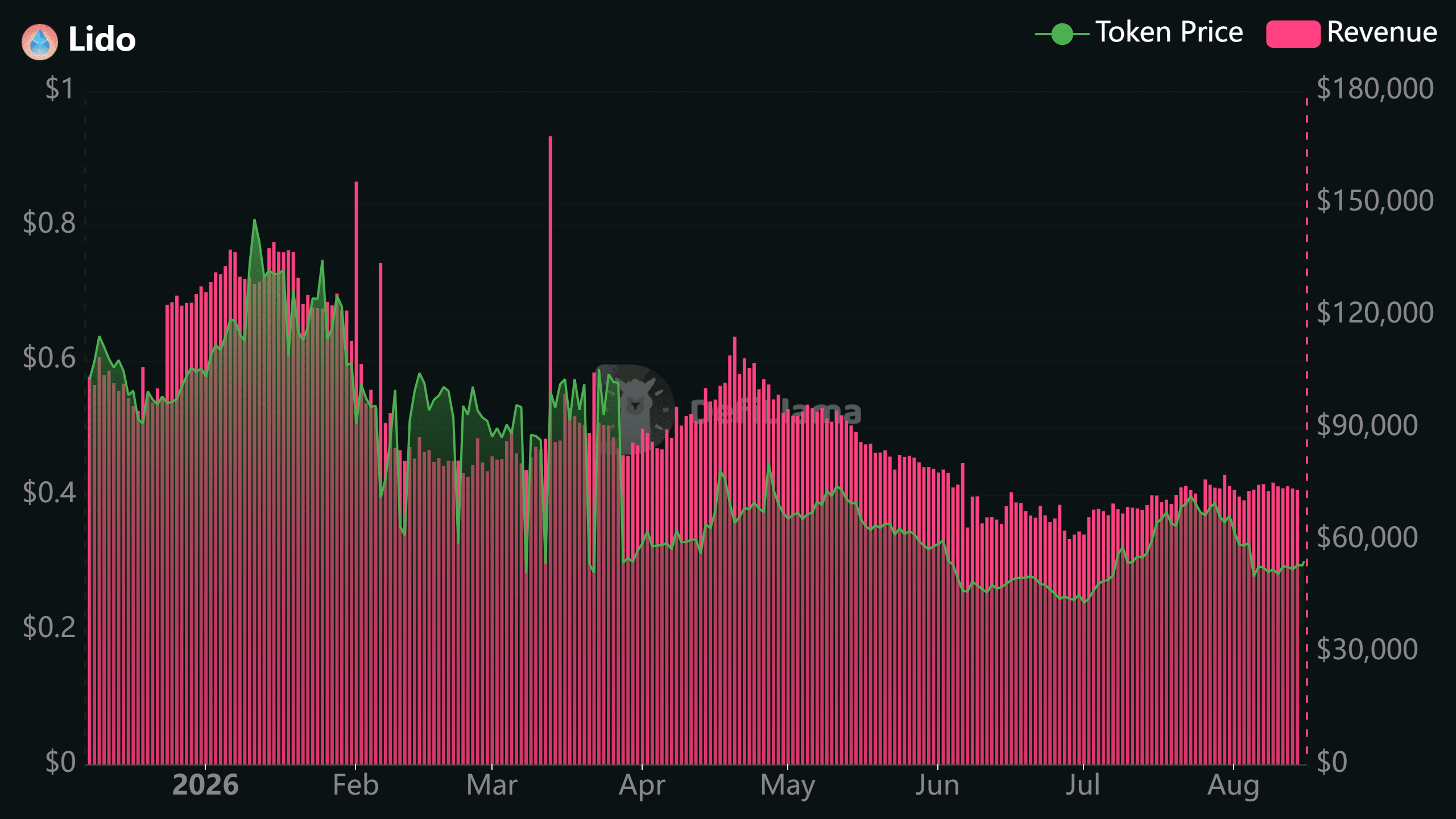
From a technical perspective, the LDO token has had a challenging summer. After hitting a local bottom and defending the $0.28 support level throughout August, the token has struggled to establish upward momentum.
The market sentiment, which has been dampened by broader economic factors, has kept LDO trading below its 50-day and 200-day Exponential Moving Averages (EMA). For traders and investors, the "NEST" program serves as a potential long-term catalyst. If the broader crypto market experiences a Q4 recovery, leading to increased activity in staking and higher protocol revenues, the NEST mechanism will naturally activate.
A breach of the $0.33 resistance level would be a key indicator of a trend reversal. If the program begins to execute buybacks while the price is trending upward, it could create a positive feedback loop of buying pressure. However, for now, the technicals suggest that the token remains in a consolidation phase, waiting for both a macroeconomic shift and a rise in protocol-generated revenue to trigger the buyback engine.
Implications for the Future of Lido
The activation of NEST represents a maturing of the Lido DAO. By codifying revenue-sharing and treasury management into smart contracts, the DAO is removing human error and emotional bias from the decision-making process.
1. Transparency and Trust
By making the buyback logic public and on-chain, Lido sets a new standard for transparency. Stakeholders no longer need to wonder if the DAO will support the token; they can simply monitor the revenue streams and the execution of the NEST smart contracts.
2. Economic Alignment
The program creates a direct, albeit modest, link between the success of the protocol (staking revenue) and the value of the governance token (LDO). This aligns the interests of the DAO treasury with those of the token holders.
3. Sustainability vs. Growth
The $109,000 threshold acts as a circuit breaker. While this prevents the treasury from being drained in times of low revenue, it also limits the "cushion" the program provides during market downturns. The ultimate success of NEST will be determined by whether the market views the $10 million cap as a sign of financial responsibility or as an indication of limited ambition.
Conclusion
Lido’s NEST program is a bold experiment in decentralized treasury management. While the $10 million annual cap may appear conservative to some, it reflects a calculated decision to prioritize long-term protocol viability over short-term market optics. As the protocol moves into the latter half of 2026, the success of this program will depend heavily on market conditions and the ability of the broader DeFi sector to return to higher revenue-generating levels. For now, the "buyback engine" is installed and ready—waiting only for the market tide to rise.
