

The decentralized finance (DeFi) sector has been rocked by fresh uncertainty as the AVICI network grapples with a significant operational failure. Reports of blocked withdrawals from customer card balances have triggered a wave of investor panic, causing the AVICI token to experience a dramatic valuation collapse. While the company maintains that it is actively collaborating with partners to rectify the technical bottlenecks, on-chain data suggests a more sinister reality: a potential security breach involving the movement of over $600,000 in user assets.
The Anatomy of the Incident: A Chronology of Events
The crisis unfolded rapidly on Friday, beginning with user reports on social media platforms regarding the inability to access or withdraw funds tied to their AVICI card balances. As the chatter intensified, the network officially acknowledged the existence of an "issue" affecting these specific withdrawal channels.
The Initial Discovery
Early Friday morning, community members began flagging discrepancies in their account balances. What initially appeared to be a standard liquidity delay quickly evolved into a full-blown liquidity crisis. By midday, market analysts tracking the Solana ecosystem—where AVICI operates—began to notice suspicious activity originating from a specific wallet address.
On-Chain Evidence
Blockchain analysis conducted via Solscan provided the most compelling evidence of foul play. The address linked to the incident showed a balance of approximately $604,818.97 at the height of the reported disruptions. The contents of this wallet were telling: roughly $570,410 in USDC, $34,188 in USDT, and $221 in SOL. Crucially, the wallet was associated with links to approximately 2,500 individual user accounts.
Within hours of the initial discovery, the funds were siphoned from the primary wallet. The address currently reflects a zero balance for stablecoins, with the remaining 886.94 SOL transferred to a secondary, untraced destination. This rapid disbursement of funds is consistent with typical exploit patterns, casting further doubt on the company’s initial refusal to label the incident as a "hack."
Official Responses and Corporate Messaging
The response from the AVICI leadership team has been characterized by caution and, according to many affected users, a lack of transparency. In a brief statement issued via their official X (formerly Twitter) account, AVICI acknowledged that they were "aware of an issue affecting card-balance withdrawals" and were working with third-party partners to resolve the situation.
The "Hack" vs. "System Error" Debate
Despite the overwhelming evidence of unauthorized fund movement, AVICI has refrained from using the term "hack" or "exploit" in their public communications. By framing the event as a generic "withdrawal problem," the company has attempted to maintain control over the narrative, potentially to prevent a total loss of investor confidence. However, this strategy has backfired. Investors and cybersecurity analysts have criticized the lack of a detailed post-mortem, pointing out that the speed with which the $600,000 was moved strongly suggests a malicious actor rather than a simple synchronization error with card issuers.
The company has yet to provide:
- A clear estimate of the total number of affected users.
- A definitive figure regarding the total value of compromised assets.
- A timeline for the restoration of full withdrawal services.
Market Impact: A Deep Dive into Price Volatility
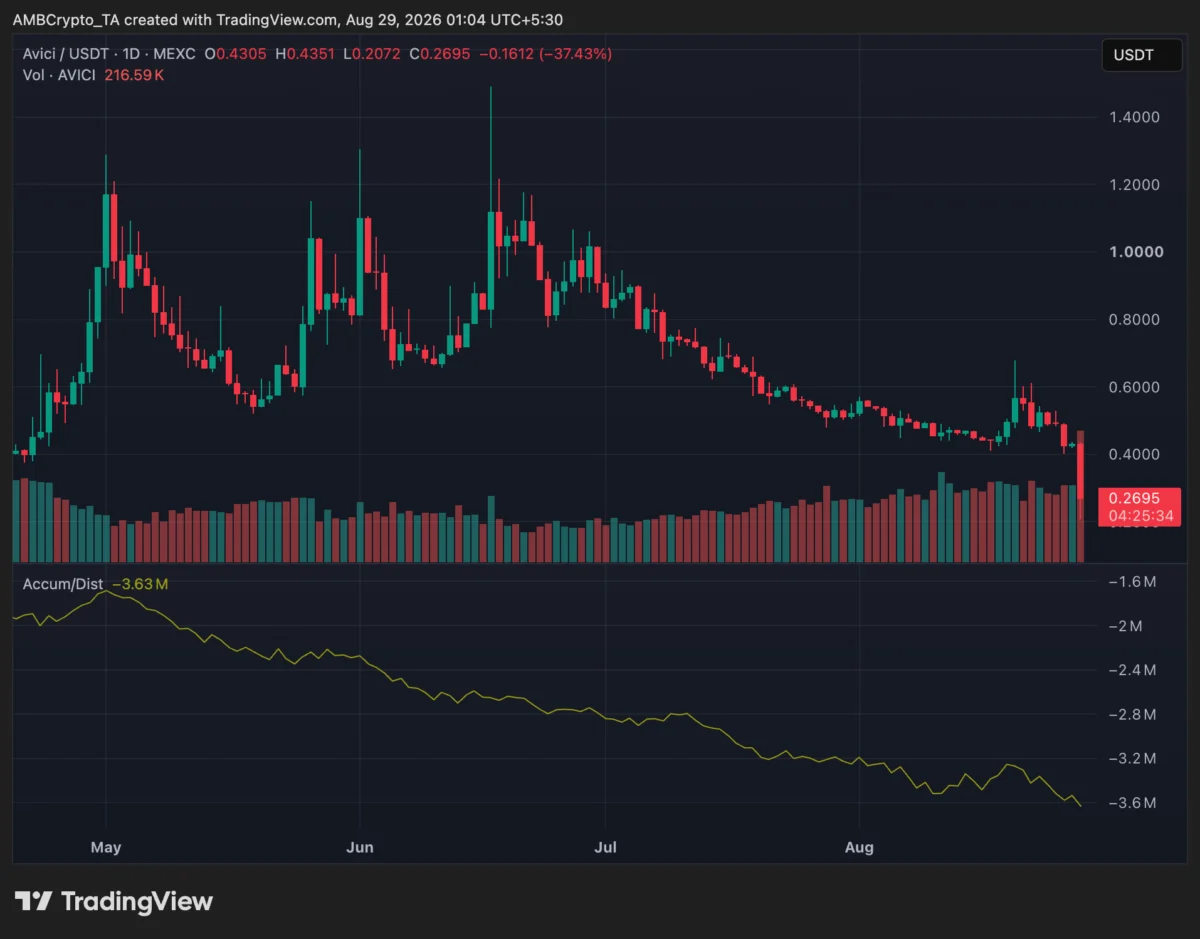
The market reaction to the news was immediate and severe. AVICI, which opened the trading day at $0.4305, saw its value plummet within hours, hitting a low of $0.2072—a decline of more than 50% from its daily high. While the token managed a minor recovery to trade around $0.2695, it closed the session significantly in the red, marking a 37% loss.
Contextualizing the Decline
It is essential to note that the AVICI token was already struggling prior to this incident. A technical analysis of the token’s performance over the preceding months reveals a consistent downward trend. The current crisis acted as an accelerant, exacerbating an existing decline rather than serving as the sole cause of the depreciation.

Furthermore, AVICI operates within a niche, low-liquidity market. In such environments, the "slippage" factor is high; even modest sell-offs can trigger outsized price swings. The panic-selling observed on Friday was amplified by the lack of depth in the order books, leaving the token highly susceptible to volatility. Whether the token can stabilize near the $0.20 support level remains the primary question for traders. Reclaiming the $0.40 psychological barrier is now the uphill task for the network to signal any semblance of a recovery.
Broader Implications for the AVICI Ecosystem
The current crisis at AVICI serves as a stark reminder of the inherent risks associated with decentralized finance and card-integrated crypto platforms.
Trust and Reputation
The most lasting damage to AVICI may not be the $600,000 loss, but the erosion of user trust. For a platform designed to bridge the gap between traditional finance and crypto, the failure to protect user withdrawals is a catastrophic blow. If users cannot rely on the platform to safeguard their assets, the utility of the AVICI card effectively drops to zero.
Security Vulnerabilities
The incident raises significant questions about the security architecture of the AVICI network. The fact that an address was able to consolidate funds from 2,500 disparate user accounts suggests a centralized vulnerability, likely within the backend integration between the AVICI network and their card issuing partners. If the exploit originated from a single point of failure within their infrastructure, the network may face significant regulatory scrutiny.
The Future of AVICI
As of this writing, trading remains active, and the network is still under pressure. The path forward for AVICI is narrow. To regain market confidence, the team must:
- Transparency: Release a full forensic report detailing how the funds were accessed.
- Accountability: Provide a roadmap for compensation for the 2,500 affected accounts.
- Technical Audit: Conduct an independent, third-party security audit of their entire withdrawal and card-linking infrastructure.
Without these steps, AVICI risks falling into the graveyard of failed DeFi projects. The crypto community is notoriously unforgiving, and the "wait-and-see" approach currently adopted by the project leadership may not be enough to prevent a further exodus of liquidity providers and long-term holders.
Final Summary: A Critical Juncture
The AVICI withdrawal incident is a microcosm of the risks inherent in the rapidly evolving crypto-payment landscape. While the network continues to work toward a resolution, the discrepancy between their "technical issue" narrative and the hard evidence provided by on-chain analysis remains a point of intense friction.
With the token down nearly 40% in a single day and significant questions regarding the security of user accounts remaining unanswered, the ball is firmly in AVICI’s court. Whether the project can survive this liquidity crunch and the resulting reputational damage will depend entirely on the transparency and efficacy of their next set of actions. For now, investors are advised to exercise extreme caution, as the combination of low market liquidity and the ongoing investigation makes AVICI a high-risk asset in the current environment.
The coming days will be decisive. If the network cannot prove that it has contained the threat and secured its users’ remaining funds, the market may continue to punish the AVICI token, potentially pushing it toward historic lows.
