

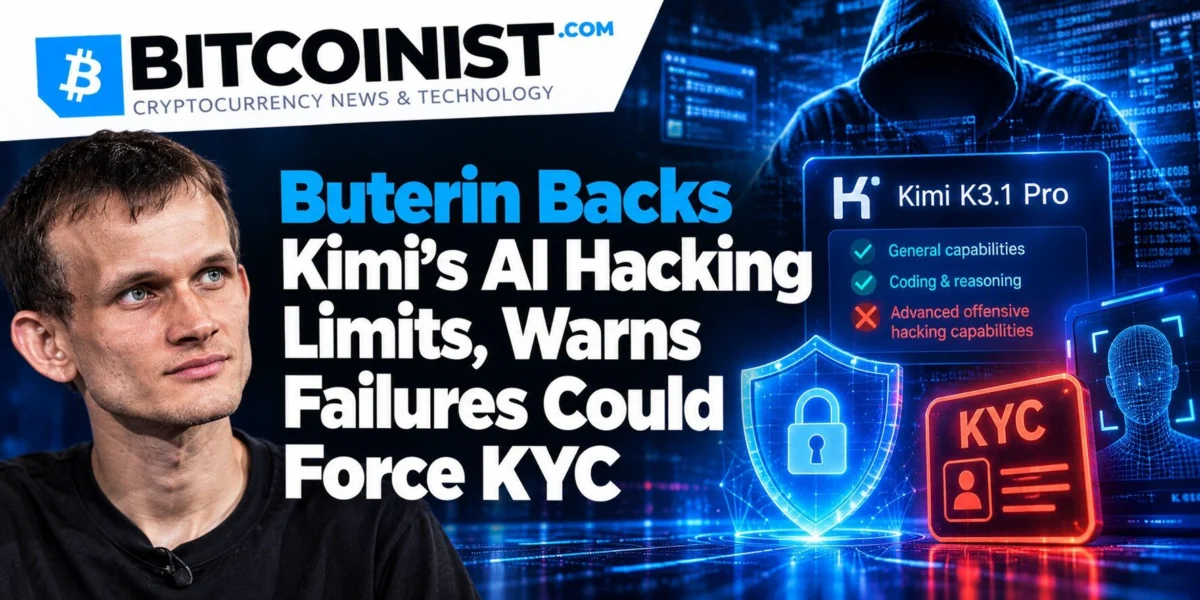
In a rapidly evolving landscape where artificial intelligence is increasingly capable of performing complex cognitive tasks, the boundary between defensive utility and offensive danger has become a focal point of intense global debate. Recently, Ethereum co-founder Vitalik Buterin threw his weight behind a controversial strategic decision by Chinese AI startup Moonshot AI. In the rollout of its latest model, Kimi K3.1 Pro, Moonshot developers made a deliberate choice: they intentionally omitted advanced offensive hacking data from the model’s training sets.
This endorsement by one of the tech industry’s most influential thinkers highlights a growing consensus among select researchers that, for now, "slowing down" the proliferation of AI-driven cyber-weaponry may be the only way to allow human infrastructure to catch up.
The Chronology of a Measured Release
The discourse surrounding Kimi K3.1 Pro began in earnest on October 23, when Moonshot AI announced the model’s arrival. Designed to be accessible via both company applications and a dedicated API, the model is slated for a full release of its weights by November 4.
The strategy employed by Moonshot is distinct in the current AI arms race. While many labs prioritize raw capability above all else, Moonshot disclosed that it had systematically purged cyberattack-related datasets from both the primary training phase and the subsequent reinforcement learning loops. Crucially, the company claims this was achieved without sacrificing the model’s general-purpose programming proficiency.
On October 26, Vitalik Buterin ignited a broader conversation on the social media platform X, providing his public validation for this approach. Buterin’s support is not rooted in the naive belief that such restraints will permanently solve the security dilemma; rather, he frames it as a temporal strategy. He argues that by withholding the "offensive" keys to the digital kingdom, the industry creates a window of time—a "hardening phase"—during which global systems can be fortified against the inevitable rise of automated, AI-assisted exploitation.
Supporting Data: The Cost of Restraint
Moonshot AI’s own internal benchmarking provides a fascinating look at the trade-offs involved in this safety-first approach. In its pursuit of a "cleaner" model, the company documented a measurable performance delta.
The Performance Gap
According to Moonshot’s internal exploit benchmark, the unrestricted version of the model—containing the full spectrum of cyber-related data—successfully completed 90.5% of assigned tasks. In contrast, the restricted Kimi K3.1 Pro shipped at 81%. This represents a 9.5-percentage-point sacrifice in raw offensive capability.
For industry analysts, this data point is the crux of the debate. Is a 9.5% reduction in efficacy a sufficient barrier to entry for malicious actors? The company’s previous iteration, the Kimi K3, scored a meager 33.3% on the same test, suggesting that even with these new restrictions, the K3.1 Pro represents a significant leap in underlying intelligence compared to its predecessor.
Terminal-Bench 4.0 and Competitive Landscape
In broader testing on Terminal-Bench 4.0—a standard for evaluating an AI’s ability to interact with computer systems—the Kimi K3.1 Pro achieved a score of 65.7%. For perspective, Moonshot’s internal data places the model ahead of GPT-6 Astra (58.2%) but behind Claude Opus 5.5 (66.4%). While these figures are self-reported and await independent verification, they suggest that Moonshot has managed to retain high-level utility while imposing artificial limits on its "hacking" dexterity. Furthermore, the introduction of a "Highspeed" variant, promising two to three times the velocity of the standard model, suggests that Moonshot is positioning the K3.1 Pro as a practical tool for enterprise developers rather than a weaponized research prototype.
The Philosophical Divide: Capability vs. Access
Vitalik Buterin’s support for Moonshot goes beyond the technical specifications of the model; it is rooted in a deep-seated apprehension regarding the societal response to AI-driven cyber threats.
The Threat of Surveillance and Centralization
Buterin has articulated a fear that a catastrophic AI-related security breach could trigger a draconian legislative reaction. He posits that if "AI-hacking" becomes a routine, high-profile threat, governments might move to implement rigid "Know Your Customer" (KYC) requirements for all advanced AI models.
This, in Buterin’s view, would be a catastrophic outcome for the open-source movement and individual digital sovereignty. Under such a regime, access to powerful computational tools would no longer be a right based on merit or open participation, but a privilege granted based on nationality, documentation, and government-approved credentials. This would effectively stratify the global population into "first-class" users with full access and "third-class" or "fourth-class" users relegated to the digital margins.
The Alternative: Privacy-Preserving AI
Buterin is not merely theorizing; he is actively building toward a future that prioritizes user autonomy. On October 16, just days before his comments on the Kimi model, he introduced a privacy-focused AI agent architecture. By integrating Tor routing, anonymous payments via zkAPI, and local prompt-rewriting, Buterin is demonstrating that the solution to AI risks may lie in decentralized infrastructure rather than centralized, state-mandated surveillance.
Implications for Global Cybersecurity
The implications of the Kimi K3.1 Pro release are manifold, touching on the intersection of geopolitics, software engineering, and formal verification.
The Role of Formal Verification
Buterin has long championed "formal verification"—a rigorous, mathematical process of proving that software code adheres to its specifications without hidden bugs. He argues that if AI can be used to attack, it can, with equal efficacy, be used to defend. By identifying and patching vulnerabilities through automated verification, the industry could theoretically create a "defensive wall" that renders the offensive capabilities of AI models less impactful.
His support for the Kimi model is an endorsement of this "defensive-first" mindset. If the world buys time by slowing down the deployment of offensive AI, we can prioritize the development of formal verification tools that make our underlying infrastructure inherently more resilient.
Independent Evaluation and Future Testing
While Moonshot’s internal numbers are promising, the tech community remains cautious. Independent evaluations of the previous Kimi K3 model, conducted in July by the US Center for AI Standards and Innovation and the UK AI Security Institute, showed that the model was still capable of executing sophisticated, multi-step cyberattacks, even with existing safeguards.
In a simulated corporate-network attack, the K3 model managed to complete 17 out of 32 steps. While this trailed the performance of the most advanced US models—which averaged 28.5 steps—it confirmed that safeguards are rarely absolute. The upcoming open-weight release of the K3.1 Pro on November 4 will be the true test. By allowing independent researchers to probe the model’s weights, the global community will finally be able to verify whether Moonshot’s "stripped" training data actually correlates to a meaningful reduction in real-world offensive risk.
The Bottom Line: A Necessary Pause
The debate surrounding Moonshot AI’s Kimi K3.1 Pro is a microcosm of the larger existential crisis facing the AI industry. We are currently in an era where the genie of "AI-driven hacking" is partially out of the bottle.
Vitalik Buterin’s stance is pragmatic: in the absence of a global agreement on AI safety, individual labs must exercise restraint to prevent a cycle of "catastrophe followed by over-regulation." Whether the 9.5% performance drop in the Kimi K3.1 Pro is a genuine security buffer or merely a marketing gesture remains to be seen. However, by choosing to limit the offensive potential of their creation, Moonshot AI and those who support them are signaling that the race to "smarter" AI should not come at the expense of our ability to defend the systems that keep society running.
As we move toward the November 4 release, the focus will shift from what the model cannot do to what it can achieve in the hands of the developers. The industry must now determine if the strategy of "selective restraint" is a viable long-term policy or if the march of progress will inevitably override even the most well-intentioned ethical safeguards. For now, the "Buterin approach"—focusing on system hardening, formal verification, and user privacy—stands as the most viable path forward in a world where the code we write is increasingly capable of rewriting itself.
