

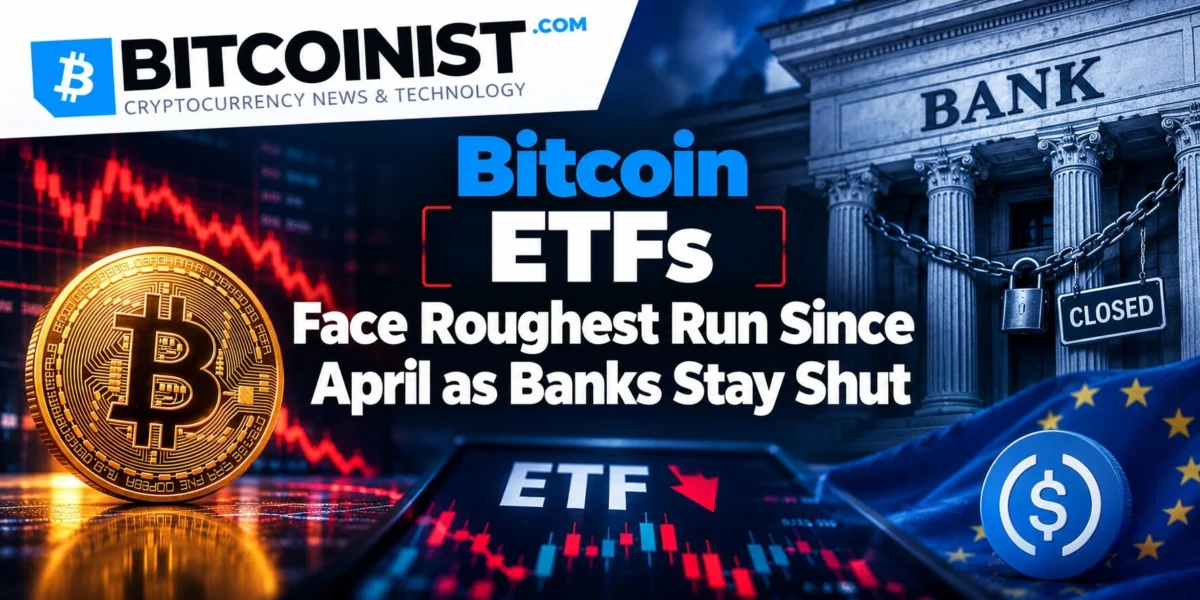
The cryptocurrency market is currently navigating a period of profound recalibration. As institutional enthusiasm shows signs of cooling and major regulatory milestones reshape the operational framework in Europe, the industry stands at a critical juncture. From the massive liquidity pullbacks in US-based Bitcoin ETFs to the European Union’s assertive stance on stablecoins, the ecosystem is grappling with the friction between traditional financial integration and the inherent volatility of digital assets.
The Institutional Retreat: A Look at Recent Outflows
For months, the narrative surrounding Bitcoin was defined by the relentless accumulation of capital via spot Bitcoin Exchange-Traded Funds (ETFs). However, the period between October 12 and October 16 signaled a sharp reversal in sentiment. Institutional investors, who had previously served as the bedrock of the 2024 price rally, began to pull back significantly.
Data indicates that US spot Bitcoin ETFs experienced net withdrawals totaling approximately $228 million during that week. This follows a staggering $681 million exodus the previous week, culminating in a two-week total outflow of $909 million—the most significant contraction observed since April.
The market’s reaction to these capital flows was immediate and visceral. Bitcoin, which had been testing higher resistance levels, slipped under the $82,000 threshold. The leverage-heavy nature of the current market exacerbated the decline, with approximately $771 million in long positions liquidated in a single day earlier in the week. The contagion spread across the board; on October 15, an additional $1 billion in positions were liquidated as Bitcoin, Ether, and XRP suffered a synchronized decline. By the close of the week, Bitcoin was struggling to maintain its footing near the $81,400 level.
Europe’s Regulatory Pivot: The USDC Milestone
While the US market grapples with volatility and mixed regulatory signals, the European Union has taken a decisive step toward formalizing the digital asset economy. The European Banking Authority (EBA) has officially designated Circle’s USDC as the first "significant" e-money token under the Markets in Crypto-Assets (MiCA) framework.
This classification is far from ceremonial. Effective November 12, USDC will transition from the oversight of national supervisors to direct supervision by the EBA. This elevation mandates adherence to significantly more rigorous capital requirements and stringent redemption duties, ensuring that the stablecoin maintains a level of financial integrity comparable to traditional electronic money institutions.
The strategic contrast between Circle and its primary competitor, Tether (USDT), is stark. While Circle proactively sought and secured the necessary EU licensing to operate within the MiCA framework, Tether has notably refrained from doing so. As a result, USDT remains outside the established EU regulatory perimeter. The European Securities and Markets Authority (ESMA) has already issued a directive giving EU-based platforms a three-month window to unwind exposure to non-compliant stablecoins. This puts major exchanges serving the European bloc in a precarious position: they must either integrate compliant assets like USDC or face the risk of cutting off access to the world’s largest non-compliant stablecoin.
The Institutional Paradox: Schwab vs. The Banking Giants
The integration of cryptocurrency into traditional brokerage accounts continues to be a story of two speeds. On one hand, Charles Schwab has officially rolled out "Schwab Crypto" to its broad base of eligible US clients. By offering Bitcoin and Ether at a competitive 0.75% fee per trade, Schwab is effectively bringing digital assets into the same ecosystem as stocks, bonds, and retirement accounts for its 35 million brokerage users. This represents a significant milestone in retail adoption, normalizing the presence of crypto alongside traditional wealth management tools.
Conversely, the institutional banking sector remains deeply entrenched in a defensive posture. A recent review by the Office of the Comptroller of the Currency (OCC) revealed that all nine of the largest national banks in the United States maintain internal policies that permit them to restrict or outright deny banking services to digital-asset issuers, exchanges, and administrators.
While the OCC’s report does not mandate immediate policy changes, its publication is a shot across the bow. By placing these restrictive policies on the public record, regulators have effectively created a paper trail that lawmakers can use to hold banks accountable if they continue to engage in "de-banking"—the systematic exclusion of crypto-related businesses from the financial system.
The MSCI Dilemma: When Traditional Metrics Clash with Digital Reality
The friction between traditional equity benchmarking and crypto-native business models has reached a boiling point with MSCI. The index provider has approved new criteria that could lead to the removal of firms like Strategy and Metaplanet from its equity benchmarks. The final roster of companies is scheduled for release on November 11, with any removals taking effect after the market close on November 30.
The core of the issue lies in valuation. Both Strategy and Metaplanet have tied their corporate valuations closely to the Bitcoin holdings on their balance sheets. For traditional index providers, this is an awkward fit. MSCI’s methodology is designed to judge companies based on traditional cash flows, dividends, and operational performance, not the speculative volatility of a digital reserve asset.
If these firms are removed from the benchmarks, the implications for their stock prices could be severe. Passive funds that track these indices would be forced to divest their holdings, potentially triggering a significant sell-off in the shares of companies that have otherwise pioneered the "Bitcoin treasury" model.
Policy Vacuums and the Future of Perpetuals
The regulatory landscape in the United States is currently complicated by a significant leadership gap. Patrick Witt, the final advisor steering the White House’s digital assets policy office, has departed his position. His departure leaves a vacuum at a time when the SEC, the CFTC, and the OCC are all simultaneously engaged in active, high-stakes rulemaking processes. Without a centralized voice in the executive branch, the industry is bracing for a period of potential regulatory fragmentation.
However, innovation continues to push forward in the derivatives market. SEC Trading and Markets Director Jamie Selway recently noted that five CFTC-registered exchanges have submitted applications to operate as security futures exchanges. At least four of these entities are expected to list "securities perpetual futures" before the end of the year.
Perpetual futures—contracts that allow traders to bet on the price of an asset without an expiration date—are a staple of offshore crypto exchanges but have remained largely inaccessible in a regulated US context. Their introduction into the domestic market would signify a major maturation of US financial infrastructure, providing traders with the hedging tools they currently seek in unregulated, high-risk environments.
Implications and Future Outlook
The events of the past week demonstrate that the crypto industry is no longer an isolated experiment. It is deeply intertwined with the broader macroeconomic environment, subject to the whims of institutional capital flows and the slow, deliberate grind of regulatory oversight.
The "institutional pullback" serves as a reminder that Bitcoin, despite its maturation, remains a high-beta asset susceptible to liquidity shocks. Meanwhile, the EU’s firm stance on MiCA compliance forces the industry to prioritize transparency and regulatory adherence, potentially setting a global standard for how stablecoins should be governed.
As we look toward the end of the year, the tension between the "crypto-friendly" retail brokerage initiatives of firms like Schwab and the persistent, systemic gatekeeping by major national banks will remain a central theme. The industry is currently in a "wait-and-see" mode regarding the impact of the upcoming regulatory changes and the potential for a new wave of derivatives products to stabilize—or further complicate—the market.
For investors, the current climate demands a higher degree of vigilance. As the regulatory perimeter expands and the tools for participation become more sophisticated, the distinction between compliant, sustainable projects and those operating on the fringes of the law will become increasingly vital. The coming months will likely define the long-term trajectory of digital assets as they attempt to reconcile their revolutionary origins with the demands of a traditional, regulated global financial system.
