

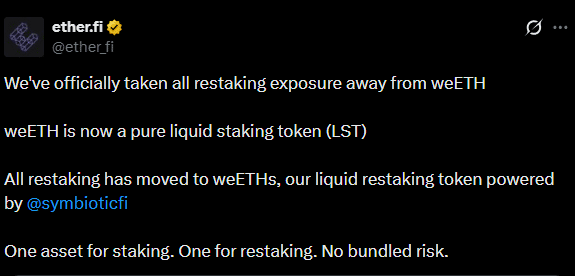
In a move that has sent shockwaves through the Decentralized Finance (DeFi) ecosystem, Ether.fi, the dominant player in the liquid restaking sector, has officially announced a major structural overhaul of its flagship asset, weETH. As of August 7, the platform has effectively stripped all restaking exposure from the token, transforming weETH from a complex liquid restaking token (LRT) into a "pure" liquid staking token (LST).
This strategic retreat from EigenLayer and the subsequent migration of restaking activities to Symbiotic marks a pivotal moment for Ethereum’s secondary yield markets. As the industry grapples with security concerns, regulatory pressures, and a cooling market, Ether.fi’s decision serves as a bellwether for the future of "looping" strategies and yield-optimization protocols.
The Core Transformation: Moving Away from Bundled Risk
The fundamental shift announced by Ether.fi involves decoupling the weETH token from the multi-layered restaking infrastructure that previously defined it. By removing the underlying EigenLayer restaking exposure, the project is moving toward a more conservative model.
Understanding the Shift
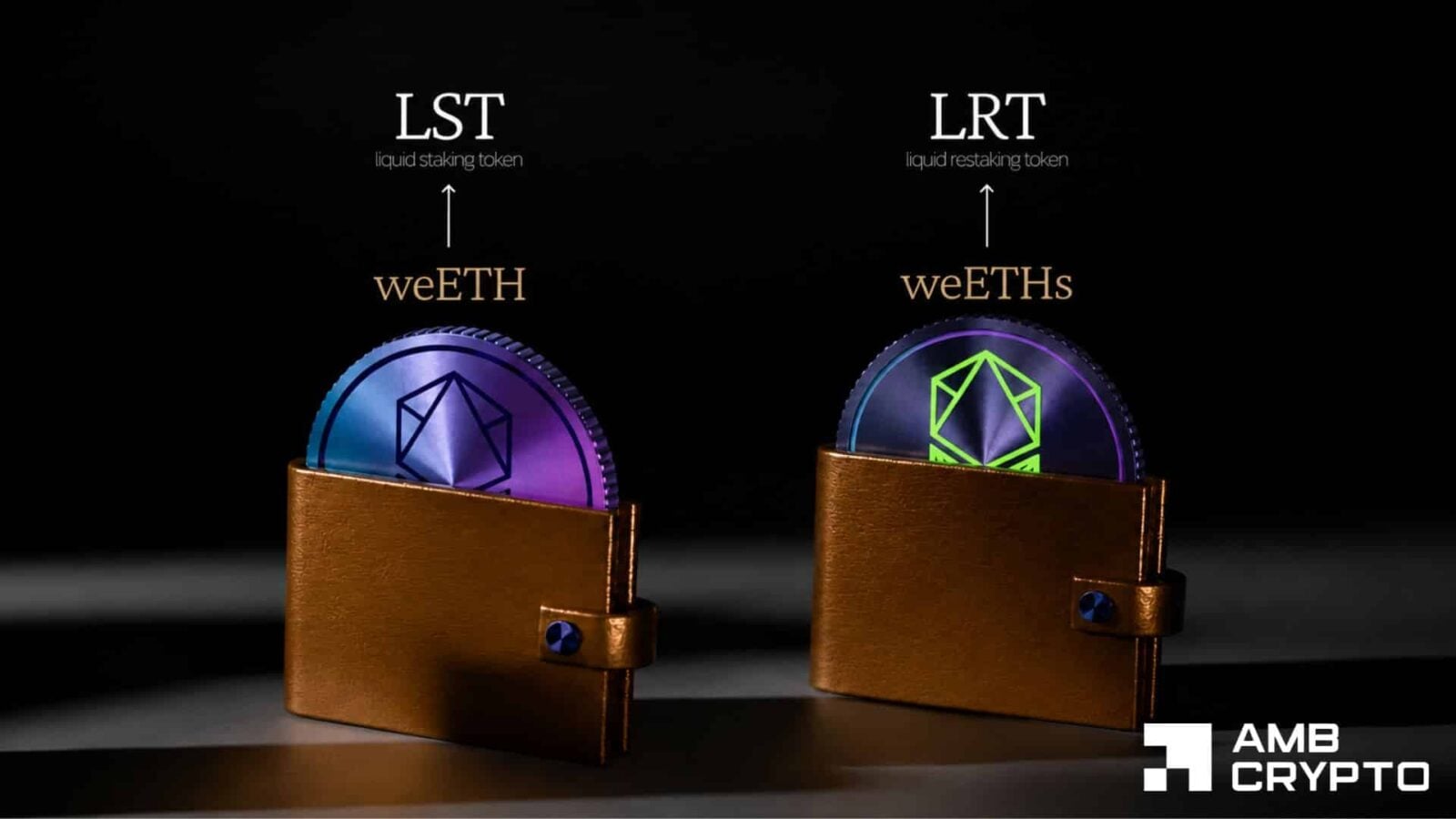
To appreciate the significance of this move, one must distinguish between the two assets:
- Liquid Staking Tokens (LST): These allow users to deposit ETH into a staking pool, receiving a token in return that represents their stake plus accrued rewards. This provides liquidity to an otherwise locked asset.
- Liquid Restaking Tokens (LRT): These are built on top of LSTs. They take the staked ETH and redeploy it into various yield-generation strategies, such as securing Actively Validated Services (AVSs) or engaging in complex DeFi loops.
Ether.fi’s decision to transition weETH back to a pure LST is an explicit attempt to mitigate "bundled risk"—a phenomenon where a single token’s value becomes inextricably tied to the performance and security of multiple, often opaque, downstream protocols. By exiting EigenLayer for its primary token, the team is prioritizing capital preservation and asset simplicity over the high-risk, high-reward yields that fueled the initial restaking boom.
Chronology: The Rise and Retrenchment of Restaking
The journey of liquid restaking has been one of meteoric growth followed by a sobering period of introspection.
- Late 2023 – Early 2024: The "Restaking Summer" began. Protocols like Ether.fi and EigenLayer revolutionized the market by allowing users to double-dip on yields. Billions of dollars flooded into these protocols as users sought to maximize the utility of their ETH.
- Q2 2024: Concerns regarding security began to surface. As DeFi protocols increasingly relied on complex, recursive looping strategies, the attack surface expanded significantly. High-profile exploits, such as the KelpDAO hack, highlighted the fragility of these interconnected systems.
- July 2024: Aave, the largest lending protocol in the ecosystem, launched an aggressive risk management framework. The protocol moved to deprecate various risky assets and loop-heavy positions, signaling a shift toward institutional-grade risk assessment.
- August 7, 2024: Ether.fi officially announced the stripping of restaking exposure from weETH, confirming the transition to a pure LST model and shifting its restaking operations to Symbiotic.
Supporting Data: A Market in Contraction
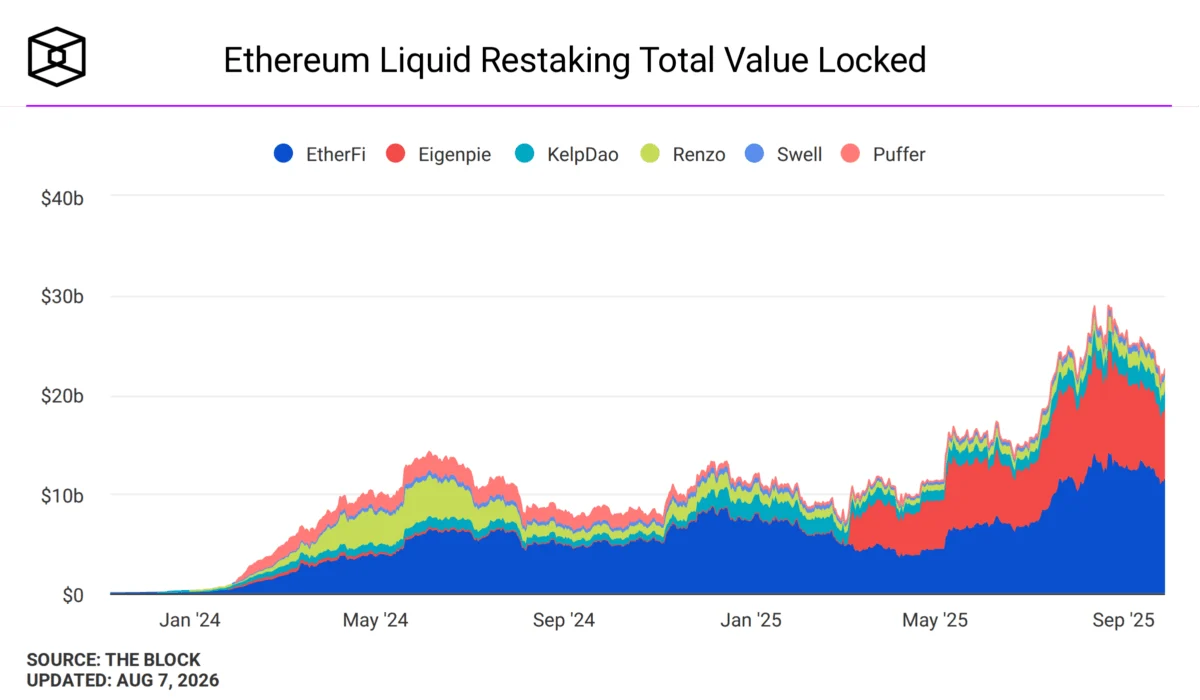
The narrative that "the restaking era is ending" is backed by stark quantitative data. Since its peak in October of the previous year, the total value locked (TVL) in the liquid restaking market has seen a notable decline, retreating from approximately $29 billion to $22 billion.
Market Dynamics
Despite a record-breaking surge in native Ethereum staking—which saw an increase of 1.4 million ETH staked in the same timeframe—the restaking sub-sector has struggled to maintain its momentum. This divergence suggests that while investors remain bullish on the long-term prospects of Ethereum, they are becoming increasingly risk-averse regarding "yield-chasing" protocols.
Even with this contraction, Ether.fi remains a behemoth, holding roughly 50% of the market share with a TVL of $11.4 billion. However, this dominance has not shielded the platform from the necessity of structural adaptation. Analysts from Entropy Advisors, including Tom Wan, have noted that Ether.fi and EigenLayer were the primary architects behind the ETH looping strategies on Aave and the Pendle PT trades. When those loops were effectively neutralized by Aave’s risk management overhaul, the ripple effects were felt immediately by the restaking sector, forcing a change in strategy.
Official Responses and the "End of an Era"
The leadership at Ether.fi has been remarkably candid about the pivot. CEO Mike Silagadze’s reaction on social media platform X captured the sentiment of a sector in transition:
"End of an era. Sad. I still think restaking will come back in one form or another; I think it was just a bit too early."
This statement underscores a realization that the market was perhaps too aggressive in its pursuit of yield, failing to account for the systemic risks inherent in the early, experimental phase of restaking. The transition to Symbiotic—a permissionless, more flexible staking infrastructure—is viewed by many as the "next iteration" of the technology, albeit one that is being approached with greater caution than the previous iteration.
Implications: The Ripple Effect on DeFi
Ether.fi’s move is not an isolated event; it is a symptom of a broader "de-risking" trend sweeping through the decentralized financial landscape.
1. The Aave Effect
Aave’s decision to scrub $98 million worth of risky assets serves as a template for other major lending protocols. As the DeFi space matures, lending platforms are moving away from the "deploy everywhere" philosophy. This puts massive pressure on yield-aggregation protocols to prove the safety and sustainability of their underlying assets.
2. A Shift Toward Sustainability
The era of hyper-inflated yields generated by recursive looping appears to be ending. Future growth in the sector will likely be driven by organic, protocol-native rewards rather than speculative strategies that rely on the interplay between three or four different layers of risk.
3. The Future of Institutional DeFi
For institutional investors, the "bundled risk" associated with early LRTs was a significant barrier to entry. By simplifying weETH, Ether.fi may be positioning itself to better attract institutional capital that prioritizes transparency and risk mitigation over the volatile yields offered by experimental restaking.
4. Regulatory Foreshadowing
The contraction of the restaking market is also a response to looming regulatory scrutiny. As DeFi protocols become more systemic, they are increasingly viewed by regulators as quasi-financial institutions. By stripping away complex, high-risk layers, Ether.fi is arguably future-proofing its operations against potential regulatory crackdowns on "shadow" banking practices within the crypto ecosystem.
Final Summary: A Mature Pivot
Ether.fi’s decision to move weETH back to a "pure" liquid staking token represents a significant maturation of the DeFi market. While the move is being framed by some as a retreat, it is more accurately characterized as a strategic realignment. By separating the foundational LST from the experimental restaking layer, Ether.fi is acknowledging that the current market environment demands a higher standard of security and transparency.
As the industry moves forward, the lessons learned from the "restaking loop" era will likely inform the next generation of DeFi protocols. The era of unchecked yield hunting is giving way to an era of disciplined risk management, and in this new chapter, the platforms that survive will be those that can successfully navigate the tension between innovation and institutional-grade safety. For now, the focus shifts to how Symbiotic will handle the restaking load and whether the broader market will follow Ether.fi’s lead in simplifying its risk profiles.
