

Global Cryptography & Market Analysis — A fundamental structural shift is quietly altering the plumbing of the digital asset economy. While the headline figures suggest that the total valuation of stablecoins is thriving at historic highs, a deeper dive into exchange mechanics reveals a startling divergence.
Centralized cryptocurrency exchanges are experiencing a severe drain of immediately deployable dry powder, reducing their spot-buying capacity significantly compared to late-2025 market peaks. At the same time, market dominance has concentrated heavily within a single institutional titan: Binance.
For market participants, traders, and institutional investors, understanding this decoupling between broader on-chain wealth and centralized exchange liquidity is no longer optional—it is critical for anticipating the next major market move.
Main Facts: The Great Liquidity Drain on Centralized Venues
The crypto market is currently defined by a paradox: record-high overall stablecoin supplies coexisting with a shrinking pool of deployable capital on centralized trading platforms.
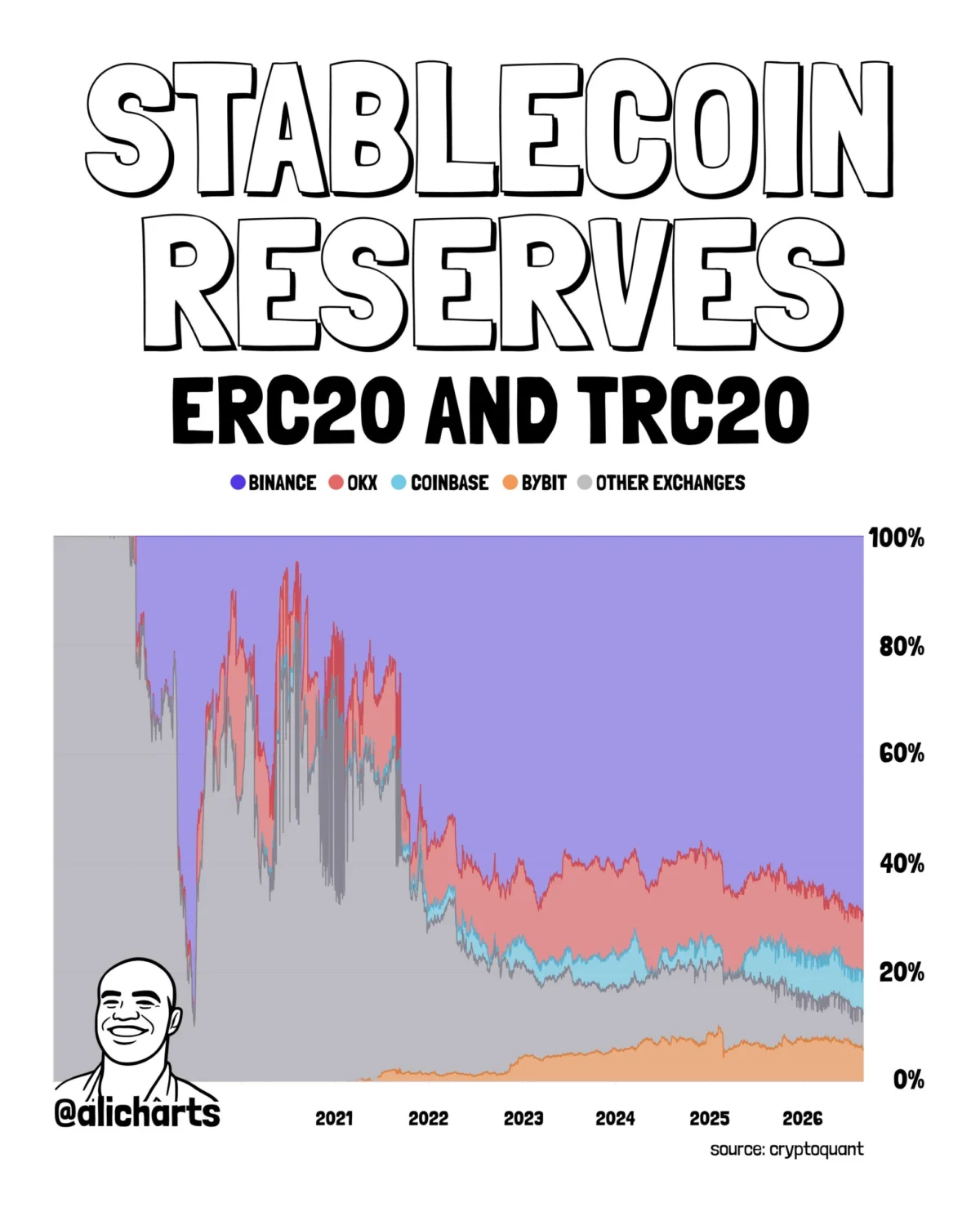
According to comprehensive on-chain data, total stablecoin reserves sitting across centralized exchanges have plummeted from a robust $80 billion down to roughly $64 billion. This steep drop translates to a 20% contraction in immediately available exchange liquidity in a relatively short window. Consequently, centralized venues possess considerably less "dry powder" to fuel aggressive spot-buying sprees than they did during the market peaks of late 2025.
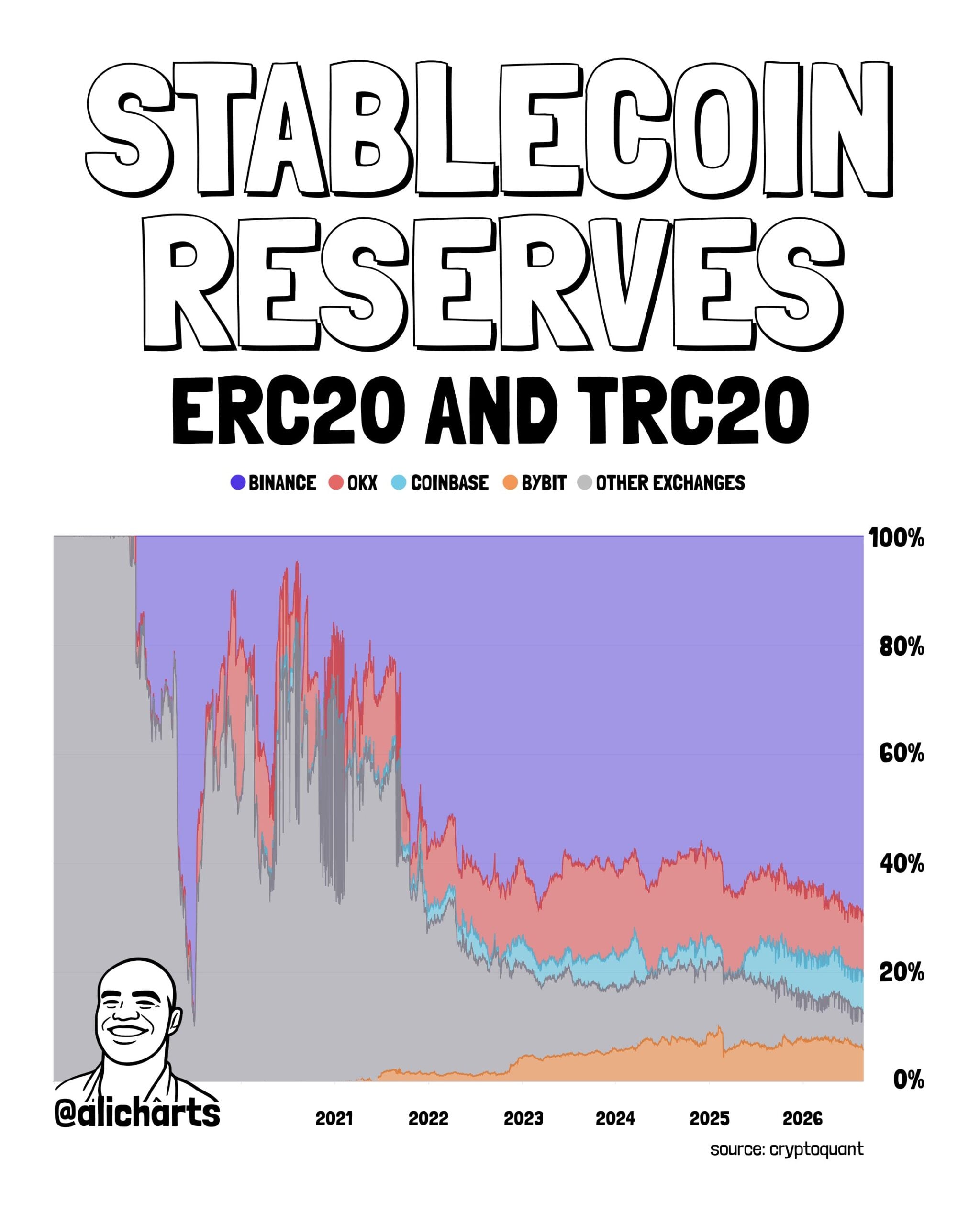
However, the contraction has not been felt equally across the board. While smaller and mid-tier exchanges have seen their liquid reserves evaporate, Binance has managed to consolidate its footprint. Binance’s share of total exchange stablecoin reserves has climbed from nearly 60% to a commanding 68.5%.

This asymmetry grants Binance unprecedented leverage over which liquidity pools remain deployable to the broader market. As a result, market analysts increasingly advise traders to monitor Binance’s internal stablecoin flow indicators as a primary proxy for future central venue liquidity deployments.
Chronology: The Evolution of the 2025–2026 Liquidity Landscape
To understand how the crypto market arrived at this juncture, it is helpful to trace the chronological evolution of stablecoin dynamics leading up to the present day:
- Late 2025 Market Peak: Centralized exchange reserves peaked at approximately $80 billion. Spot-buying power was widely distributed across multiple major global exchanges, supporting high-velocity trading volumes and bullish market momentum.
- Early 2026 Shift in On-Chain Utility: A gradual migration began as capital started flowing away from centralized order books. On-chain ecosystems—spurred by advancements in decentralized finance (DeFi), cross-chain payments, and self-custody solutions—began absorbing record amounts of newly minted stablecoins.
- Mid-2026 Contraction Phase: Total exchange reserves dropped systematically to the $64 billion mark, registering a 20% decline in tradable liquidity. Concurrently, overall stablecoin market capitalization surged past $310 billion, highlighting the widening chasm between total supply and exchange availability.
- August 2026 Consolidation: Binance’s dominance over exchange-held reserves peaked at 68.5%, while its monthly reserve values hovered flat at an average of $42.92 billion. Cross-chain migrations—such as capital moving away from Ethereum toward TRON—further complicated internal exchange dynamics without injecting net-new purchasing power.
Supporting Data: Dissecting the Numbers
A rigorous examination of data from analytics heavyweights like DeFiLlama and CryptoQuant paints a vivid picture of this liquidity redistribution.
Ecosystem Wealth vs. Exchange Poverty
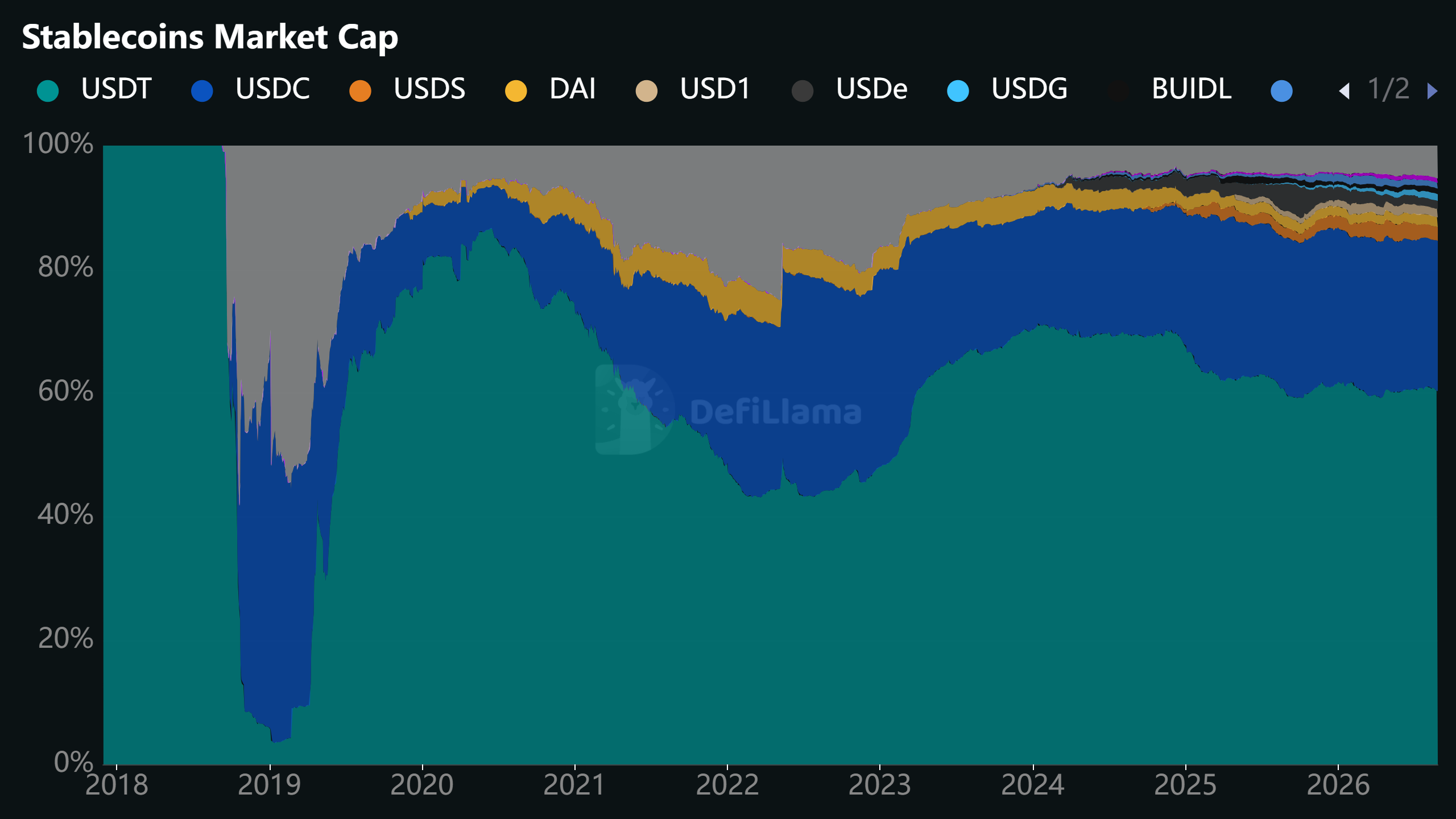
While centralized exchanges hold a combined $64 billion, the broader stablecoin ecosystem is richer than ever. Total stablecoin supply is averaging a record-shattering $310 billion. This colossal figure highlights that capital is far from leaving the cryptocurrency asset class entirely; rather, it is changing its destination.
The market remains heavily consolidated around two primary stablecoin giants, which together control roughly 83% of the entire sector:
- Tether (USDT): Maintains a towering market capitalization of approximately $183 billion, serving as the primary liquidity backbone for global crypto trading.
- USD Coin (USDC): Trails as the second-largest stablecoin, holding between $73 billion and $74 billion in total supply.
Binance’s Flat Reserves and Cross-Chain Migrations
Despite expanding its market share of reserves to 68.5%, Binance’s actual fiat-equivalent purchasing power has remained relatively range-bound. Its average reserve value sits at approximately $42.92 billion per month, reflecting a modest monthly growth rate of just 0.44%. This marginal growth indicates that Binance’s rising dominance is largely a result of competitors losing capital faster than Binance is acquiring it, rather than an influx of fresh capital.
Furthermore, internal asset composition is shifting. Daily USDC inflows to Binance recently rose to an average of $125.4 million, altering the platform’s reserve composition. At the same time, chain-specific preferences became starkly apparent: $929 million in USDT entered Binance via the TRON (TRX) network, while $765 million departed via the Ethereum (ETH) blockchain.
Despite these high-volume cross-chain shifts, USDC’s supply ratio on Binance recovered to 0.0986, still trailing below its six-month average of 0.1128. Industry models suggest that for Binance to kickstart a genuine expansion in its spot-buying capabilities, its total reserves must break past the $48.17 billion threshold while its USDC ratio climbs back above historical averages.
Official Perspectives and Market Commentary
Market makers, liquidity providers, and analytics firms have increasingly spoken out about this structural decoupling. In private notes to institutional clients, quantitative research desks have emphasized that standard metrics tracking total stablecoin market cap are no longer reliable indicators of near-term buying pressure.
"For years, analysts looked at total USDT and USDC issuance as a direct proxy for impending crypto bull runs," noted one senior derivatives trader based in Singapore. "Today, that relationship is broken. A massive portion of newly issued stablecoins sits in native smart contracts, yield-bearing vaults, or non-custodial wallets. Treating total supply as exchange ‘dry powder’ is a dangerous analytical error."
Exchange executives have similarly pointed to the efficiency gains of cross-chain routing. The migration of stablecoin volume from congested, high-fee networks to faster, lower-cost layer-1s and layer-2s has altered how market makers rebalance their books, prioritizing operational speed over monolithic reserve hoarding on single chains.
Implications: What This Means for Traders and Investors
The divergence between ecosystem-wide stablecoin wealth and centralized exchange dryness carries profound implications for the immediate and medium-term trajectory of the cryptocurrency markets.
1. The Redefinition of Liquidity Signals
Traders must adjust their analytical frameworks. Looking solely at aggregate stablecoin metrics will yield false bullish signals. Instead, exchange netflows have become the ultimate litmus test. Only rising net deposits of stablecoins onto centralized platforms will signal that capital is moving closer to executing spot purchases. Persistent outflows indicate that wealth is remaining sequestered in DeFi, payments, and self-custody.
2. Binance as a Systemic Bellwether
Because Binance now controls over two-thirds of all exchange-held stablecoin reserves (68.5%), its internal metrics dictate market reality. A stagnation in Binance’s reserves—coupled with flat USDC supply ratios—points to a market constrained in its ability to mount aggressive, sustained spot rallies. Conversely, a sharp breakout in Binance’s reserve values toward the $48 billion marker would serve as an early warning system for a major liquidity-driven market expansion.
3. Fragmentation and Volatility Risk
With less total "dry powder" distributed across secondary and tertiary centralized exchanges, the market is more susceptible to localized liquidity crunches. Thin order books on smaller platforms mean that sudden spikes in buying or selling pressure can trigger amplified price volatility.
Conclusion
The current crypto landscape is characterized by a structural migration of capital. While on-chain networks are more robust and heavily capitalized than ever with $310 billion in stablecoins, the fuel for centralized exchange spot markets has grown leaner. As Binance tightens its grip on the remaining exchange-based liquidity pool, market participants must navigate a more centralized, highly regulated, and structurally nuanced trading environment. Keeping a close eye on exchange netflows and Binance’s internal reserve ratios will remain the defining edge for traders seeking to master the next phase of the cycle.
