


By Global Financial Correspondent
Main Facts
The Bank for International Settlements (BIS)—often referred to as the "central bank for central banks"—has escalated its stance on privately issued cryptocurrencies, taking direct aim at USD-pegged stablecoins. Speaking on the sidelines of the high-profile Jackson Hole economic symposium, BIS official Pablo Hernández de Cos delivered a stark warning: dollar-denominated stablecoins are not a credible payment method at scale and pose a profound, systemic threat to global monetary sovereignty.
While heavyweights like Tether (USDT) and Circle (USDC) dominate more than 90% of the stablecoin market, their rapid expansion across emerging markets experiencing high inflation or unstable local currencies has triggered deep anxieties among global regulators. According to the BIS, the unchecked proliferation of these digital assets threatens to induce "digital dollarization," effectively stripping sovereign nations of their ability to execute independent domestic monetary policies.
In place of stablecoins, the BIS has thrown its weight behind bank-led, institutional alternatives known as "tokenized deposits." Traditional financial institutions, including Wall Street giant JPMorgan Chase and central bank bodies like the European Central Bank (ECB), are already racing to build and test on-chain financial frameworks. Despite a recent summer slump that saw stablecoin transaction volumes drop 37% from June to August, private stablecoins remain deeply entrenched, setting up a high-stakes clash between decentralized, tech-driven digital currencies and legacy state-controlled banking infrastructure.
Chronology: The Rise of Stablecoins and the Regulatory Counter-Offensive
The friction between decentralized digital assets and central banking authorities has evolved rapidly over the past decade.
- 2014–2018 (The Genesis): Privately issued stablecoins emerge as a crypto-native workaround to the high volatility of assets like Bitcoin. Pegged 1:1 to the U.S. dollar, instruments like Tether provide traders with a reliable digital medium of exchange to park capital on crypto exchanges without converting back to traditional fiat banking systems.
- 2019–2021 (Mainstream Penetration): Stablecoins transition from niche crypto-trading tools to broader retail and cross-border payment instruments. As emerging markets experience acute macroeconomic stress, capital flight accelerates toward USD-backed digital tokens. Concurrently, regulatory bodies begin noticing systemic risks, prompting early whitepapers and warnings from the G7, Financial Stability Board (FSB), and the BIS.
- 2022–2023 (Institutional Awakening & Failures): The collapse of algorithmic stablecoins like TerraUSD highlights the severe vulnerabilities within unbacked token models. Meanwhile, fully reserved fiat-backed stablecoins prove resilient, capturing massive market share. In response, global commercial banks and central banks accelerate research into central bank digital currencies (CBDCs) and tokenized deposits to capture the efficiency of blockchain technology without losing control of the ledger.
- Summer 2024 (The Volume Shift): Visa data reveals a temporary contraction in stablecoin transactional velocity, with monthly volumes falling sharply from $1.8 trillion at the end of June to $1.13 trillion by August.
- Late August 2024 (Jackson Hole Showdown): At the Jackson Hole economic symposium, Pablo Hernández de Cos officially draws a hard line in the sand, dismissing stablecoins as commercially limited and financially hazardous, while officially anointing tokenized deposits as the preferred vehicle for future financial tokenization.
Supporting Data: Market Dominance, Volume Contractions, and Adoption Realities
To understand why global institutions are rattled, one must examine the sheer scale and geographic penetration of USD-pegged stablecoins.
Market Concentration
The stablecoin ecosystem is heavily concentrated. Tether and Circle collectively command upwards of 90% of the total market supply. Tether’s USDT, in particular, acts as the de facto financial lifeline in multiple South American and African economies grappling with hyperinflation and stringent capital controls. In Bolivia, where local currency stability has deteriorated, lawmakers and financial authorities have actively weighed integrating USDT directly into official payment systems.
The Summer 2024 Volume Correction
Despite their long-term growth trajectory, stablecoin adoption is not entirely linear. Data compiled by payments giant Visa highlights a significant cool-down during the summer months. Transaction volumes, which peaked at an astonishing $1.8 trillion at the close of June, plummeted by 37% to settle at $1.13 trillion by August. Analysts attribute this pullback to shifting macroeconomic conditions, seasonal liquidity dips in traditional markets, and increasing regulatory friction across key jurisdictions.

The Macroeconomic Threat
The underlying worry for central banks is the velocity of "digital dollarization." When citizens in countries with volatile fiat currencies (such as Argentina, Venezuela, or Nigeria) bypass their local banking systems to hold digital U.S. dollars via smartphone apps, domestic central banks lose control over money supply, interest rate transmission, and credit creation.
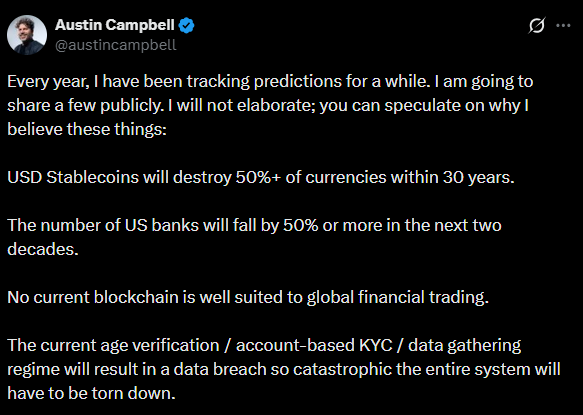
Austin Campbell, an adjunct professor at Columbia Business School and a prominent voice in digital asset analytics, painted a terrifying picture for traditional fiat regimes, bluntly noting:
"USD stablecoins will destroy 50%+ of currencies within 30 years."
Official Responses and Institutional Positioning
The institutional war room is sharply divided between private-sector crypto innovators and public-sector monetary architects.
The BIS Perspective
The Bank for International Settlements views private stablecoins as an unstable bridge to nowhere. In his Jackson Hole address, Pablo Hernández de Cos emphasized that while tokenization—the representation of real-world assets and currency on distributed ledgers—is undeniably the future of finance, the vehicle matters immensely.
The BIS argues that stablecoins introduce settlement risks, run risks, and regulatory arbitrage that threaten the stability of the global financial architecture. Instead, the BIS advocates for tokenized deposits—digital representations of traditional commercial bank money. According to de Cos:
"Tokenised deposits offer a more direct path to harness tokenisation while preserving the monetary system’s foundations."
Commercial Banks and Central Banks Mobilize
Traditional finance is not sitting idly by. Mega-banks are aggressively developing their own proprietary tokenization frameworks to capture institutional volume. JPMorgan Chase has expanded its blockchain initiatives, testing enterprise-grade tokenized deposit solutions designed to handle multi-billion-dollar corporate settlements instantaneously.
Simultaneously, the European Central Bank (ECB) has intensified its push to integrate central bank money onto distributed ledgers, as highlighted in recent Bloomberg reports. By building native on-chain alternatives, institutional banking aims to offer the speed, programmability, and 24/7 settlement capabilities of crypto without sacrificing regulatory compliance or sovereign monetary oversight.
Implications: A Bifurcated Financial Future
The hardening stance of the BIS toward stablecoins carries sweeping implications for the global economy, the cryptocurrency industry, and everyday consumers.
1. Increased Regulatory Scrutiny on Issuers
As central banks realize that USD stablecoins function as an unlegislated, exportable extension of U.S. monetary policy—while simultaneously undermining foreign central banks—regulatory pressure on issuers like Tether and Circle will intensify. Expect harsher demands for reserve transparency, offshore banking restrictions, and potential limits on non-U.S. citizen access.
2. The Battle for the Corporate Ledger
The commercial viability of stablecoins versus tokenized deposits will be decided in the corporate sector. While retail users and crypto traders heavily favor permissionless stablecoins for speed and accessibility, institutional treasuries, multinational corporations, and legacy financial institutions will likely gravitate toward tokenized deposits backed by insured commercial banks and regulated by central authorities.
3. The Fate of Emerging Market Currencies
If predictions like those of Austin Campbell hold true, emerging market central banks face an existential crisis. To prevent their domestic populations from entirely migrating to digital dollars, central banks in fragile economies may be forced to radically reform their monetary policies, adopt aggressive digital currencies of their own (CBDCs), or impose draconhaian capital controls on internet-enabled crypto wallets.
Conclusion
The debate at Jackson Hole marks a definitive turning point. The global financial establishment has acknowledged that tokenization is inevitable, but it has declared open war on the decentralized, private-sector mechanisms that pioneered it. Whether state-sanctioned tokenized deposits can successfully dethrone the entrenched, highly liquid empire of USD-stablecoins remains one of the defining financial questions of the 21st century.
