

Main Facts
The cryptocurrency landscape is undergoing a fascinating structural shift, characterized by a return to a "risk-on" market sentiment. Amid this broader macro recovery, Ripple’s native stablecoin, RLUSD, has emerged as a dominant force in introducing fresh capital and liquidity into the market. While major competing stablecoins—including Tether (USDT)—have experienced stagnant or declining supply metrics over recent monthly cycles, RLUSD has charted a completely independent trajectory.
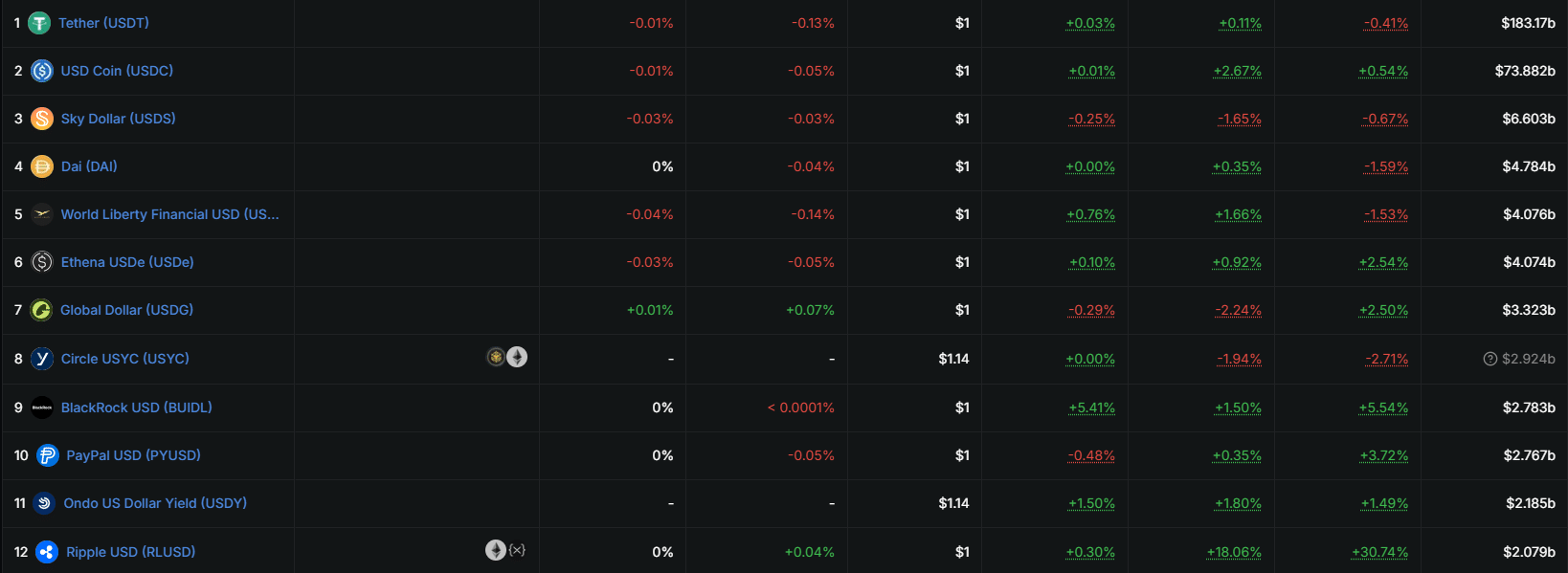
According to the latest comprehensive data analytics from DeFiLlama, RLUSD’s aggregate market capitalization has officially smashed past the $2 billion threshold, propelled by a staggering monthly supply growth of over 30%. This rapid expansion dramatically outpaces not only the legacy market leader USDT (which witnessed a 0.4% contraction over the same period) but also outstrips the capital inflows of the remaining top eleven stablecoins combined.
This localized liquidity surge has translated into a massive concentration of capital on the XRP Ledger (XRPL). DeFiLlama metrics reveal that over 90% of the entire circulating RLUSD supply is currently housed on the XRPL ecosystem, with its network-specific supply climbing above $950 million (representing an 8% gain over a single 7-day window). Conversely, RLUSD holds a negligible footprint on competing networks like Ethereum, accounting for a mere 0.7% of stablecoins on that chain.
Simultaneously, this native liquidity boom has catalyzed explosive price action for XRP. The token recently registered a monumental weekly rally of over 53%, shattering major psychological barriers and piercing the formidable $1.50 resistance zone. Although a subsequent 6% weekly correction triggered a wave of leveraged liquidations—clearing out over $1.18 billion in XRP long positions on platforms like Bitfinex—market analysts increasingly view this pullback as a healthy technical reset rather than a bearish trend reversal.
As the XRP/ETH ratio posts its strongest weekly performance since early 2025, market observers are asking a critical question: Can RLUSD’s unparalleled liquidity engine serve as the fundamental backbone that permanently redefines XRP’s valuation relative to Ethereum and other high-cap assets?
Chronology: The Anatomy of a Liquidity Surge
To fully understand the weight of the current market setup, it is vital to trace the chronological sequence of events leading up to this structural convergence between RLUSD’s adoption and XRP’s price action:
- Early Q1 2025 Cycle: XRP and the broader high-cap altcoin market begin exhibiting signs of macro consolidation. During this period, the XRP/ETH trading pair struggles to find sustained upward momentum, laboring under constrained on-chain liquidity relative to Ethereum-native decentralized finance (DeFi) ecosystems.
- Mid-2026 Expansion Phase: Ripple accelerates the deployment and integration of its USD-pegged stablecoin, RLUSD. Rather than spreading thin across multichain environments immediately, adoption heavily concentrates within the XRP Ledger (XRPL), sparking exponential on-chain activity.
- August 2026 (The Inflection Point): DeFiLlama tracking data highlights an unprecedented divergence. While USDT and other top-tier stablecoins experience flat or negative growth rates due to macro profit-taking, RLUSD surges by over 30% month-over-month. Its total market cap officially breaks the $2 billion barrier.
- Late August 2026 (The Breakout): Benefiting from the localized liquidity injection on XRPL, XRP embarks on a historic weekly surge, climbing more than 53% to smash through the heavy $1.50 resistance ceiling. This performance crowns XRP as the leading high-cap asset of the week.
- The Immediate Aftermath & Leverage Flush: Following the multi-year high breakout, a natural market correction takes place. XRP experiences a 6% pullback, which acts as a catalyst to wipe out over $1.18 billion in overheated long leverage on exchanges like Bitfinex. Despite the flush, the underlying RLUSD liquidity metrics refuse to slow down, setting the stage for the current macro consolidation phase.
Supporting Data and Analytics
An analytical breakdown of the underlying metrics provides a clearer picture of why market participants are closely monitoring RLUSD’s current trajectory. The interplay between stablecoin supply dynamics and derivatives market health reveals several key takeaways:
1. Stablecoin Supply Growth Divergence
- RLUSD Growth: Up over 30% on a monthly basis, driving total market capitalization past $2 billion.
- USDT Performance: Contracted by approximately 0.4% over the corresponding timeframe.
- Peer Comparison: RLUSD outperforms all other top 12 stablecoins in relative capital inflows, demonstrating independent demand that is entirely decoupled from broader market stagnation.
2. Network Distribution Breakdown
- XRP Ledger (XRPL): Hosts over 90% of total RLUSD supply, with local volume scaling past $950 million (showing an 8% increase over a single 7-day period).
- Ethereum Network: Accounts for just 0.7% of RLUSD distribution, proving that the stablecoin’s utility is currently hyper-focused on bolstering the XRPL native economy rather than operating as a generic multichain asset.
3. Derivatives and Leverage Metrics
- XRP Price Action: Scaled past the $1.50 resistance zone following a 53% weekly expansion.
- Liquidation Event: A sharp 6% technical correction purged excess market froth, resulting in the liquidation of more than $1.18 billion in XRP long positions on Bitfinex.
- XRP/ETH Performance: The XRP/ETH relative strength ratio closed out the prior week with a 17% gain, marking its most impressive weekly performance since the opening phase of the Q1 2025 cycle.
Official Responses and Industry Perspectives
The rapid ascent of RLUSD and its symbiotic relationship with XRP’s market mechanics have drawn extensive commentary from institutional analysts, on-chain researchers, and market commentators.
Market strategists tracking the DeFiLlama data feeds have emphasized that the timing of RLUSD’s liquidity injection could not be more opportune. In traditional crypto market cycles, a shift back to "risk-on" sentiment typically triggers aggressive leverage accumulation, followed by inevitable corrections when prices hit structural overhead resistance. Analysts note that RLUSD acts as a stabilizing structural shock-absorber for the XRPL ecosystem. By providing fresh, native capital that does not rely on cross-chain bridging or external liquidity pools, RLUSD mitigates the severity of local sell-offs.
Furthermore, prominent voices within the XRP community have pointed out the significance of the XRP/ETH ratio’s recent performance. For years, critics argued that the lack of a robust, native stablecoin infrastructure hindered XRPL’s ability to compete with Ethereum’s multi-billion-dollar DeFi and liquidity engines. With RLUSD now commanding a dominant sub-ecospray on the ledger and pushing total supplies near the billion-dollar mark on XRPL alone, those long-standing structural critiques are beginning to lose validity.
While official statements from Ripple leadership continue to emphasize compliance, institutional utility, and cross-border payment efficiency, the decentralized developer community is increasingly treating RLUSD as the foundational monetary layer required to unlock true native yield generation, automated market maker (AMM) depth, and lending protocols on the XRP Ledger.
Implications for the Broader Market and XRP’s Future
The convergence of record-breaking stablecoin inflows and aggressive technical price discovery carries profound implications for the immediate and long-term future of XRP.
Absorbing Selling Pressure and Rewriting Market Structure
In a standard crypto market cycle, when a major asset like XRP breaks a multi-month resistance level—such as the $1.50 threshold—profit-taking is swift and often violent. The recent liquidation of over $1.18 billion in long positions demonstrates that retail and institutional speculators alike were heavily over-leveraged heading into the breakout.
However, the simultaneous 30% expansion in RLUSD supply provides a vital counterweight. Unlike speculative capital that enters via leveraged derivatives contracts, stablecoin supply growth represents genuine, sidelined dry powder entering the ecosystem. As this capital rests on the XRPL (representing over 90% of RLUSD’s total issuance), it creates a localized liquidity buffer. This liquidity can absorb sudden spot selling pressure, stabilize order books, and provide a sturdier foundation for the next leg up.
The XRP vs. Ethereum Dynamics
For years, the performance of the XRP/ETH ratio has been a barometer of relative altcoin market sentiment. Ethereum’s dominance has historically rested upon its sprawling stablecoin ecosystem and vibrant decentralized finance architecture. By capturing significant liquidity inflows while established giants like USDT experience minor contractions, RLUSD is beginning to narrow this fundamental gap.
The 17% weekly surge in the XRP/ETH ratio—its strongest showing since early 2025—signals that sophisticated market participants are beginning to price in the structural advantages of a native, highly regulated stablecoin operating seamlessly on the XRPL.
Conclusion: A Macro Reset or a Paradigm Shift?
As the market digests the recent 6% pullback from local highs, the overarching narrative remains clear. If RLUSD’s on-chain liquidity growth rate maintains its current trajectory, the recent price correction will likely be remembered not as a bearish trend reversal, but as a necessary technical reset. Supported by nearly a billion dollars in native stablecoin liquidity on its home ledger, XRP appears well-positioned to retest the $1.50 resistance zone, consolidate its gains, and cement its renewed strength in the upper echelons of the digital asset economy.
