


The European Union’s flagship Markets in Crypto-Assets (MiCA) regulation, long hailed as the gold standard for digital asset oversight, is facing a significant expansionary push. In a landmark policy review, the European Banking Authority (EBA)—the body responsible for safeguarding the stability of the EU banking sector—has signaled its intent to bring decentralized finance (DeFi) lending and borrowing firmly within the regulatory perimeter.
This move represents a fundamental shift in how the EU approaches the borderless, autonomous nature of DeFi. By targeting the mechanisms that allow crypto assets to earn yield, the EBA aims to eliminate "regulatory arbitrage," where market participants exploit the gap between traditional finance and blockchain-based protocols to circumvent rules originally designed for centralized entities.
Main Facts: The EBA’s Strategic Pivot
At the core of the EBA’s initiative is the concern that crypto lending—whether facilitated through centralized interfaces known as Crypto Asset Service Providers (CASPs) or via automated, permissionless DeFi protocols—poses systemic risks to financial stability and consumer protection.
The EBA has identified four critical risk vectors that demand immediate regulatory intervention:
- Over-leverage: The ease with which users can borrow against volatile assets can create cascading liquidation events.
- Contagion Risks: The interconnected nature of DeFi protocols means that a failure in one liquidity pool can rapidly infect others.
- Hacks and Smart Contract Vulnerabilities: The reliance on code means that systemic bugs can lead to total loss of user funds.
- Fraud: The anonymity and lack of oversight in certain protocols provide fertile ground for bad actors.
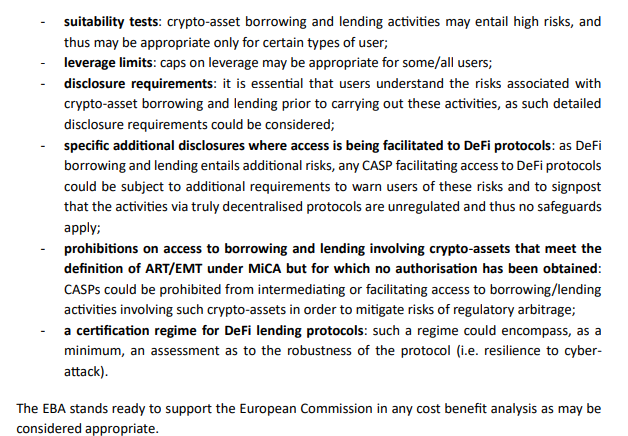
To address these, the EBA has proposed a suite of mitigation tools, including mandatory leverage caps, strict disclosure requirements, and the implementation of cyber-resilience certifications for DeFi protocols. Furthermore, the proposals suggest that unlicensed stablecoins—most notably Tether (USDT)—could be effectively barred from DeFi lending markets within the EU, a move that would fundamentally alter the liquidity landscape of European crypto platforms.
Chronology: The Evolution of European Crypto Oversight
The trajectory of European crypto regulation has been rapid and iterative.
- Early 2023: The EU officially adopts the MiCA framework, establishing clear licensing requirements for issuers of asset-referenced tokens and CASPs.
- Late 2023–Early 2024: As the MiCA implementation phase begins, regulators notice that while MiCA successfully bans direct stablecoin yield-bearing products, users are migrating to DeFi strategies to capture the same returns.
- Mid-2024: The EBA and ESMA (European Securities and Markets Authority) begin a joint review, acknowledging that the "decentralized" nature of these platforms is often a veil for centralized curation.
- September 2026: The EBA issues its formal policy review, explicitly naming DeFi lending as a priority for the next phase of regulatory expansion. The industry, led by giants like Aave and Morpho, enters a period of intense debate regarding the legal classification of "vaults."
Supporting Data: The Scale of the DeFi Lending Market
The stakes are high. The DeFi lending sector is a cornerstone of the broader digital asset economy, managing significant capital that remains largely outside the scope of traditional banking safeguards.

Currently, the segment of the market utilizing "vaults"—automated pools that deploy user assets across various lending opportunities—holds roughly $10 billion in total value locked (TVL). These assets are distributed across more than 4,000 unique, deployed vaults. When viewed against the wider $54 billion DeFi lending market, it becomes clear that vault-based strategies are not a fringe activity; they are the primary engine for yield generation for institutional and retail liquidity providers alike.
These vaults generally fall into two categories: those that follow preset, immutable rules and those that grant "curators" the discretion to actively manage the assets to maximize yield. It is this second category that has drawn the sharpest scrutiny from global regulators, including the U.S. Securities and Exchange Commission (SEC) and now the EBA.
Official Responses: The Clash of Industry Titans
The push for regulation has sparked a rare and public ideological battle between two of the most prominent players in the DeFi space: Aave and Morpho.
The Morpho Perspective
Morpho CEO Paul Frambot has proposed a bifurcated regulatory model, arguing that not all vaults are created equal. Frambot suggests that regulators should distinguish between "non-custodial" and "discretionary" vaults.
- Non-custodial vaults: These would feature limited curator roles and built-in user protections, such as exit capacity or time-locked withdrawals.
- Discretionary vaults: These would be managed by active asset managers, and Frambot concedes that these should be treated as investment products subject to securities laws.
The Aave Critique
Stani Kulechov, founder of Aave, has publicly challenged this framework, labeling it "self-serving." Kulechov argues that the classification is fundamentally flawed because any vault with a "manager" is, by definition, not truly decentralized.
"Vaults that could reasonably be considered non-custodial are those without a manager," Kulechov stated in a recent discourse. He emphasized that there is no inherent moral or legal failing in a discretionary vault; rather, the industry should focus on building a sustainable, transparent regulatory path for such products rather than creating arbitrary categories to avoid oversight.
Implications: A Divergent Global Landscape
The European approach is increasingly diverging from that of the United States. While the U.S. SEC has largely relied on enforcement actions—arguing that the active management of yield-bearing vaults constitutes an "investment contract" under the Howey Test—the EU is attempting to codify these expectations into law via MiCA.
The implications of this move are threefold:
1. Market Consolidation
Should the EU mandate cyber-resilience certifications and strict disclosure requirements, the cost of compliance will skyrocket. This will likely lead to the consolidation of the DeFi lending market, as smaller, under-capitalized protocols fail to meet the rigorous standards, leaving only well-funded, institutional-grade players to dominate the space.
2. The "Stablecoin Squeeze"
The potential exclusion of unlicensed stablecoins like USDT from EU-regulated DeFi protocols could lead to a liquidity crunch. If European platforms are forced to rely solely on MiCA-compliant assets, the yield differentials between EU-based DeFi and the rest of the world could widen, potentially pushing European liquidity toward offshore, non-compliant platforms—the very outcome the EBA is trying to prevent.
3. The Definition of "Decentralized"
Perhaps the most lasting implication is the legal definition of decentralization. By attempting to regulate DeFi, the EU is forcing the industry to define what it means to be truly decentralized. If a protocol requires a human curator to manage risk, the EU is signaling that it will treat that protocol as a traditional financial intermediary. This creates a powerful incentive for developers to strip away human intervention in favor of pure, immutable code, though this transition carries its own risks regarding protocol upgrades and emergency responses.
Conclusion: The Long Road to Integration
As the EU moves forward with its plans, the crypto industry stands at a crossroads. The EBA’s review is not merely a technical update; it is a declaration that the "Wild West" era of DeFi is coming to a close within European borders.
While the debate between industry leaders like Aave and Morpho highlights the lack of consensus on how to handle the nuances of vault management, the regulatory direction is clear: transparency, consumer protection, and financial stability will no longer be optional add-ons for DeFi—they will be prerequisites for operation. Whether this will stifle innovation or provide the necessary legitimacy for mass adoption remains the central, unresolved question of the coming decade.
