


Is the Decentralized Finance (DeFi) sector bracing for another wave of Fear, Uncertainty, and Doubt (FUD)? After a period of cautious optimism, the narrative has taken a dark turn as a sudden cluster of exploits has cast a long shadow over the ecosystem’s recent recovery. For many investors, the current landscape feels like a haunting echo of the volatile Q1–Q2 cycle, a period characterized by systemic vulnerability and massive capital flight.
As of this writing, the DeFi sector is reeling from a coordinated string of attacks that have drained $35.55 million in assets. While this figure pales in comparison to the cataclysmic $600 million lost during the earlier quarterly cycle, the psychological impact on the market is disproportionately severe. Traders and liquidity providers are once again asking the uncomfortable question: Has the security infrastructure of DeFi truly improved, or are we simply waiting for the next inevitable failure?
The Anatomy of the Triple Breach
The recent wave of exploits is notable not just for the total dollar value, but for the specific targeting of cross-chain bridge infrastructure. In a single 24-hour window, three separate protocols were compromised, each utilizing similar technical attack vectors that have historically plagued the DeFi space.
AFX: The Primary Target
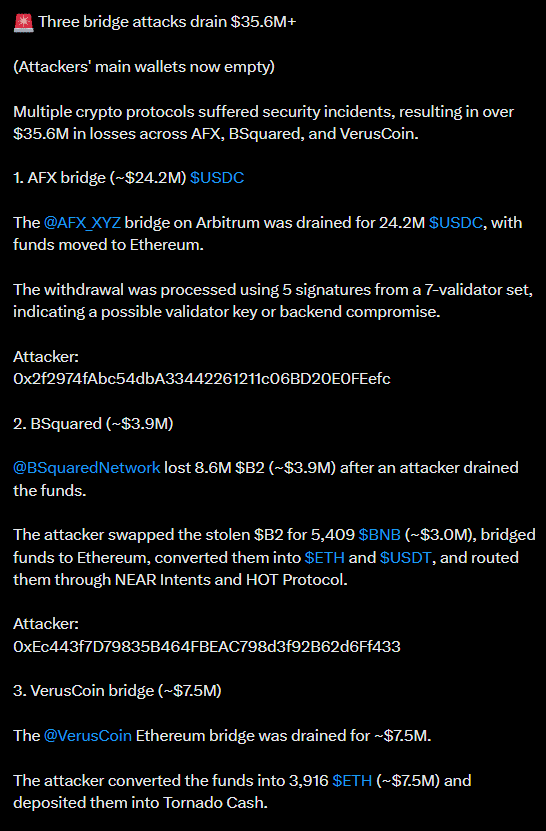
The most significant impact came from the breach of AFX, which suffered a devastating loss of $24.2 million in USDC. Attackers successfully targeted the protocol’s Arbitrum bridge, siphoning the stablecoin reserves before routing the illicit funds toward the Ethereum mainnet. This maneuver highlights the persistent danger inherent in bridge smart contracts, which act as high-value honeypots for malicious actors.
BSquared Network and VerusCoin
The assault extended beyond a single protocol. The BSquared Network fell victim to an exploit that drained approximately 8.6 million B2 tokens, valued at roughly $3.9 million. Simultaneously, VerusCoin reported a bridge exploit totaling $7.5 million. When aggregated, these three distinct breaches brought the daily loss total to $35.55 million, marking what analysts are describing as the most damaging day for DeFi security in several months.
A Chronology of Vulnerability: From Q1 to the Present
To understand the current market anxiety, one must look back at the harrowing events of the first half of the year. During the Q1–Q2 cycle, the DeFi sector was besieged by three back-to-back high-profile hacks. The cumulative result was a massive liquidity exodus that saw Total Value Locked (TVL) plummet to levels not seen since mid-2024, hovering just above the $65 billion mark.
The contagion effect was immediate. When confidence in protocol security wavered, the selling pressure was swift and brutal. Ethereum, the backbone of the DeFi ecosystem, witnessed a staggering outflow of over $10 billion in TVL within a mere 48-hour window. This period served as a painful reminder of the interconnected nature of crypto-assets, where a failure in one protocol can trigger a cascade of liquidations and panic-selling across the entire sector.

The recent $35.55 million exploit wave has reopened these wounds. For market participants who had only recently regained their appetite for risk, these incidents serve as a stark reminder that bridge infrastructure remains the "Achilles’ heel" of the blockchain industry.
The Drift Protocol Haunting
Compounding the anxiety caused by the latest bridge hacks is the sudden, unexplained movement of funds from a much older wound: the Drift Protocol exploit. Earlier this year, the industry was rocked by an attack on the Drift Protocol that resulted in the theft of $285 million.
According to data provided by Onchain Lens, the perpetrator behind this massive heist has begun moving the stolen assets after a period of dormancy. The hacker is currently funneling ETH through the Tornado Cash Router, utilizing a strategy of repeated 100 ETH batches. The rapid-fire nature of these transactions—executing several times every minute—has signaled to security researchers and the broader market that the funds are being laundered in anticipation of a potential liquidation or off-ramping.
While the movement of these funds does not technically prove an immediate market selloff, the timing is deeply concerning. The re-emergence of the Drift hacker has served to amplify the existing FUD, forcing the market to focus on past failures exactly when it should have been celebrating recent growth.
Supporting Data: A Recovery Interrupted
The irony of these hacks lies in the timing. Prior to the recent security breaches, the DeFi sector had actually been demonstrating robust signs of a comeback. Throughout July, DeFi TVL had climbed by more than $10 billion, marking the most significant monthly recovery since the disastrous Q1–Q2 hack cycle.
Investors had begun to rotate capital back into yield-generating protocols, and sentiment indicators were flashing signs of a "risk-on" environment. However, the $35.55 million in combined losses has acted as a circuit breaker for this momentum.
Key Metrics:
- Monthly TVL Growth (July): +$10 Billion (The strongest recovery in months).
- Immediate Impact: $35.55 million in combined losses across three protocols.
- Primary Attack Vector: Cross-chain bridge vulnerabilities.
- Secondary Market Pressure: Resumption of ETH laundering by the Drift Protocol exploiter.
The correlation between protocol security and capital inflows is undeniable. If the frequency of these exploits continues to trend upward, the market will almost certainly shift its focus away from yield and toward risk mitigation, potentially reversing the hard-won gains achieved during the month of July.
Implications for the DeFi Ecosystem
The recurring nature of these exploits suggests that the industry’s approach to bridge security is fundamentally flawed. While protocols continue to innovate in terms of user experience and financial complexity, the underlying security audits and infrastructure hardening are failing to keep pace.
1. The "Bridge" Problem
Cross-chain bridges are inherently complex. They require the wrapping and unwrapping of assets, maintaining liquidity pools on multiple chains, and securing multisig or validator sets. This complexity creates a massive attack surface. As long as developers prioritize speed-to-market over rigorous, multi-layered security audits, bridges will remain the primary target for sophisticated hackers.
2. The Shift in Institutional Sentiment
Institutional investors, who are increasingly looking toward DeFi for yield, are highly sensitive to "black swan" events. A series of high-profile hacks does more than just drain money—it erodes the credibility of the entire sector. If institutional players conclude that the risk of total loss due to an exploit outweighs the potential for 5-10% APY, the long-term growth of DeFi will be permanently capped.
3. The Need for Decentralized Insurance
The current landscape underscores the urgent need for robust, decentralized insurance protocols. Currently, when a hack occurs, the burden of loss falls entirely on the users and the protocol developers. A more mature ecosystem would require decentralized insurance covers that can compensate users in the event of a breach, thereby stabilizing the ecosystem and preventing the "bank run" mentality that currently dominates post-hack environments.
Conclusion: A Critical Crossroads
The DeFi industry stands at a precarious crossroads. The recent bridge exploits and the movement of stolen funds from the Drift hack have injected a level of uncertainty that the market is struggling to process. While $35 million is not a system-breaking amount for an industry with tens of billions in TVL, the pattern is what matters.
The market has proven it can recover from a single exploit, but it is far more sensitive to a string of failures. If developers and security firms cannot secure bridge infrastructure, the current "DeFi FUD" may prove to be a self-fulfilling prophecy. Investors are watching the charts, but they are watching the security logs with even greater intensity. Whether the sector continues its recovery or slides back into a period of stagnation depends entirely on its ability to stop the bleed and demonstrate that, despite these setbacks, the promise of decentralized finance remains secure.
