

Global Markets — In the modern corporate landscape, a company’s strategic ambitions are often revealed long before any official press release hits the wire. More frequently, the true roadmap of a multi-trillion-dollar enterprise can be decoded straight from its human resources department. Recent recruitment drives by two of the world’s most influential technology giants—Google and Apple—have sent a resounding signal of confidence to the digital asset sector.
As both corporations quietly recruit high-level talent with expertise in financial technology, blockchain, and digital ledger systems, analysts are asking a crucial question: What does this mean for the future of stablecoins, real-world asset (RWA) tokenization, and the broader digital asset economy?
1. Main Facts: The Silent Pivot Toward Digital Assets
The intersection of Big Tech and decentralized finance (DeFi) has reached a critical inflection point. Recent job listings indicate that both Google and Apple are actively expanding their footprints in advanced financial infrastructure, hinting at a future where traditional tech ecosystems and blockchain technology deeply intersect.
Google Cloud has initiated a targeted search for an Industry Principal Architect based in Hong Kong. According to the official job posting, the successful candidate’s core mandate will be to assist major financial institutions—including commercial banks, cryptocurrency exchanges, and institutional custodians—with the tokenization of Real-World Assets (RWAs) across the entire Asia-Pacific (APAC) region.
The listing explicitly demands deep, hands-on experience with decentralized blockchain networks, smart contract execution, stablecoin infrastructure, and enterprise-grade custody technology. For Google Cloud, this hire represents a foundational pillar in scaling its burgeoning Web3 infrastructure roadmap, positioning the cloud computing titan as a primary technical partner for institutional finance.
Simultaneously, Apple is ramping up its fintech talent pool. The Cupertino-based giant is searching for an Apple Pay Financial Product Strategy Lead to oversee critical consumer financial products such as Apple Card, Apple Cash, and peer-to-peer (P2P) payment systems. While Apple’s job description does not explicitly feature buzzwords like "blockchain" or "cryptocurrency," industry insiders note that the strategic direction of modern payment ecosystems is heavily leaning toward instant, low-cost settlement rails—capabilities that stablecoins and tokenized deposits are uniquely engineered to provide.
2. Chronology: How Big Tech and TradFi Converged on Blockchain
To understand the weight of these recent developments, one must look at the rapid sequence of events that has pulled stablecoins and tokenized assets from the fringes of finance into the boardrooms of Wall Street and Silicon Valley.
- March 2025: Google Cloud takes a monumental step into capital markets by partnering with the CME Group. The collaboration is designed to test advanced tokenization technology and streamline blockchain-based payments, proving that Google’s interest in distributed ledger technology (DLT) extends far beyond theoretical research.
- Late 2025 – Early 2026: Samsung announces a major hardware-level integration, revealing that upcoming Galaxy smartphones will feature native stablecoin capabilities embedded directly within the Samsung Wallet. This move bridges the gap between everyday consumer hardware and digital currencies.
- Mid-2026: The European Central Bank (ECB) launches "Pontes," an institutional settlement platform aimed at bringing central bank money to tokenized markets. Designed for legacy banking giants like Deutsche Bank and Santander, Pontes highlights the central banking sector’s race to control digital settlement layers.
- Present Day (September 2026): Google and Apple post high-profile digital asset and payment strategy positions within weeks of each other, signaling that the private sector’s adoption of blockchain infrastructure is accelerating from experimental pilots to core business operations.
3. Supporting Data & Ecosystem Dynamics: Stablecoins, RWAs, and Institutional Adoption
The push by Google and Apple does not occur in a vacuum. Stablecoins—cryptocurrencies typically pegged 1:1 to fiat currencies like the US dollar—have evolved from speculative trading tools into the primary settlement rails of the internet economy.
Global trading volume and cross-border remittances utilizing stablecoins have routinely rivaled or exceeded traditional legacy payment networks. Meanwhile, Real-World Asset (RWA) tokenization has emerged as the fastest-growing sector in enterprise blockchain. Financial titans view tokenized bonds, real estate, and government securities as the holy grail of liquidity, enabling 24/7 trading, instant settlement, and drastically reduced operational overhead.
However, this rapid growth has drawn the scrutiny of central authorities. The ECB has repeatedly issued warnings regarding the dominance of dollar-backed stablecoins, expressing concern that privately issued digital currencies could drain valuable commercial bank deposits and weaken the transmission of monetary policy.
Despite these regulatory warnings, the private sector is voting with its feet. Samsung’s wallet integration and Google Cloud’s APAC tokenization push demonstrate that consumer and institutional demand for seamless, crypto-powered financial tools is simply too strong to ignore.
4. Official Responses and Industry Perspectives
While neither Google nor Apple has issued formal press releases heralding a pivot into cryptocurrency, corporate actions speak louder than marketing campaigns.
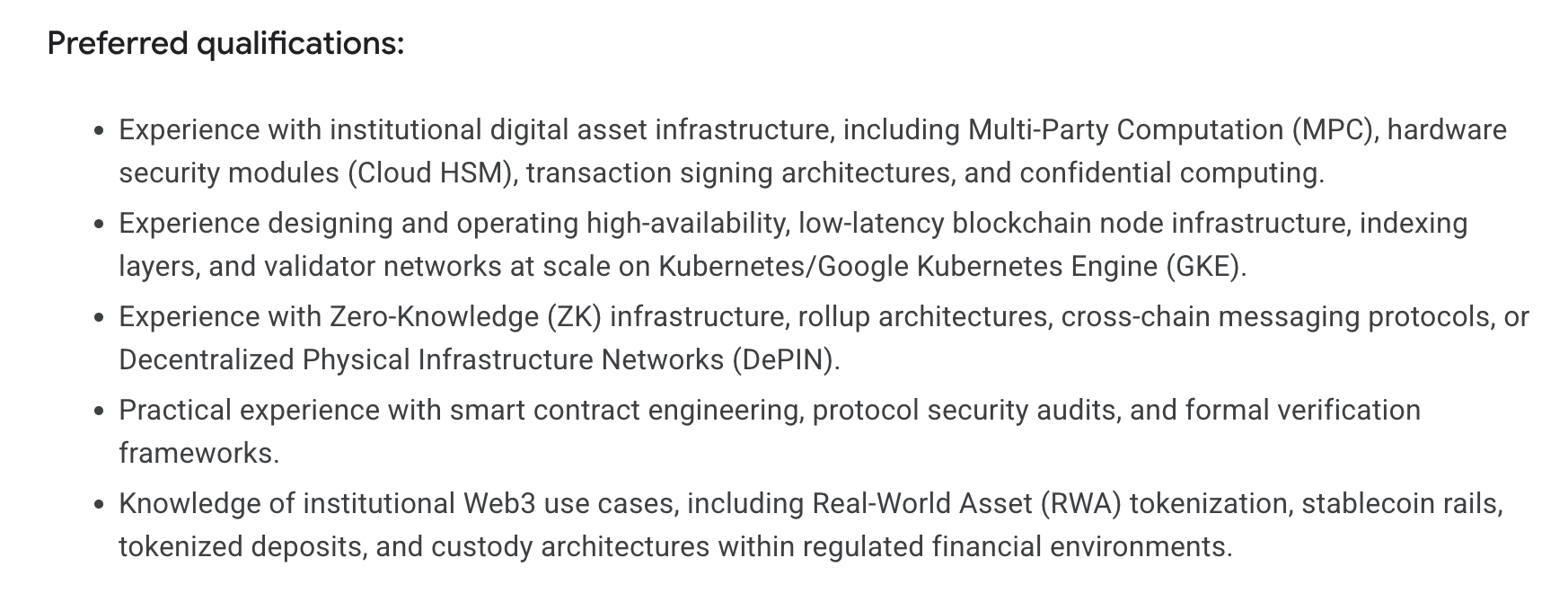
Tech analysts point out that modern conglomerates rarely invest in niche architectural talent without a clear commercial objective. By placing a specialized RWA and stablecoin infrastructure architect in Hong Kong—a jurisdiction actively striving to become a global virtual asset hub—Google Cloud is aligning itself directly with regulatory-compliant digital asset frameworks.
Conversely, Apple’s strategy remains characteristically tight-lipped. The company has historically preferred to let consumer experience dictate its technology adoption rather than leaning into industry hype cycles. By strengthening its Apple Pay and Apple Cash strategy teams with forward-thinking financial product leaders, Apple is quietly future-proofing its payment stack against a rapidly digitizing global economy.
Meanwhile, institutional reactions to the broader trend have been mixed. Traditional commercial banks view the rise of stablecoins with a mixture of anxiety and FOMO (fear of missing out). While central banks like the ECB attempt to counter the private sector’s momentum by launching proprietary institutional platforms like Pontes, commercial entities are forging ahead with flexible, consumer-friendly architectures.
5. Implications: What This Means for the Future of Asset Classes
The quiet recruitment drives by Google and Apple carry profound implications for the digital asset class moving forward:
- Validation and Legitimacy: When trillion-dollar entities build infrastructure tailored to stablecoins and tokenized assets, the lingering stigma of "fringe technology" evaporates. It signals to institutional investors that blockchain rails are now considered core enterprise technology.
- Mainstream Consumer Integration: If Apple and Samsung incorporate stablecoin-adjacent capabilities into their massive hardware and software ecosystems, billions of consumers could interact with blockchain-based settlement layers without ever realizing it.
- The Battle for Settlement Rails: A fierce competition is shaping up between private tech giants deploying stablecoins, commercial banks adopting tokenized deposits, and central banks rolling out Central Bank Digital Currencies (CBDCs).
- Regional Shifts in Web3 Innovation: Google Cloud’s choice of Hong Kong for its digital asset architecture role underscores the shifting geographic center of gravity for blockchain innovation toward Asia-Pacific markets with progressive, clear regulatory frameworks.
Final Summary
While official product launches remain unconfirmed, the writing is on the wall. Stablecoins and tokenized assets are no longer speculative experiments; they are essential technical skills required by the world’s most valuable companies. As Big Tech builds out the rails for the next generation of finance, the asset class stands on the precipice of unprecedented mainstream integration.
