

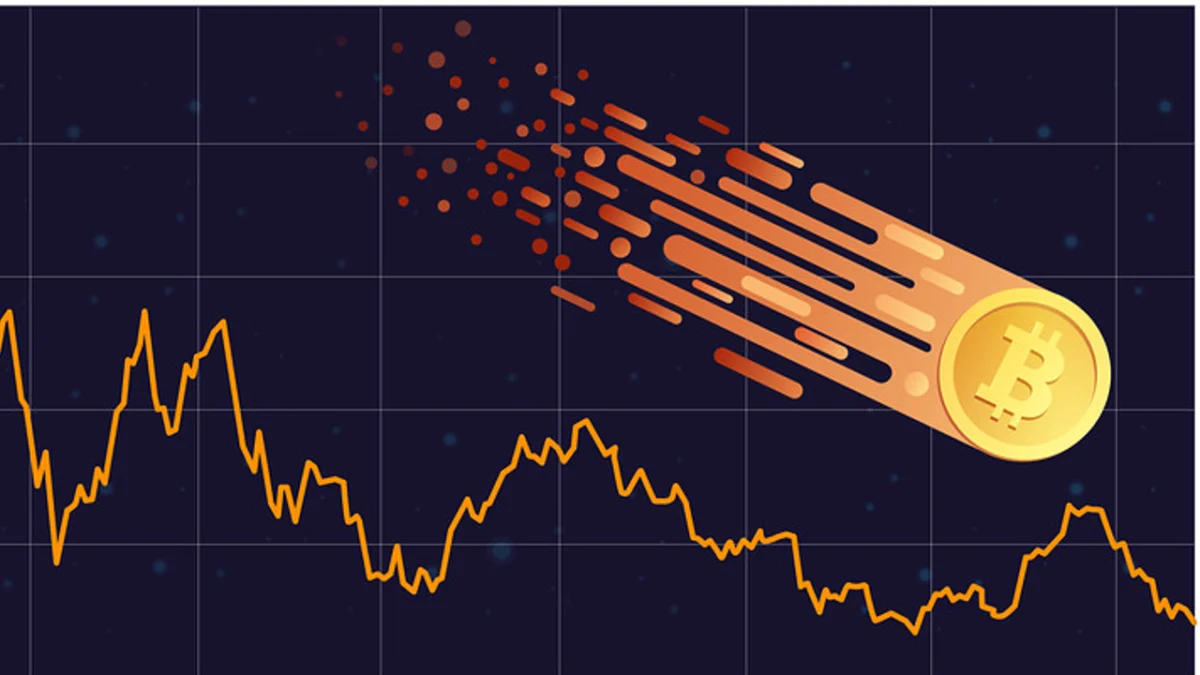
The global cryptocurrency market is currently grappling with a severe liquidity crunch and mounting investor anxiety. Bitcoin (BTC), the industry’s bellwether, has extended its losing streak to six consecutive days, marking a significant retracement from its weekend highs. As geopolitical tensions between Russia and Ukraine reach a boiling point, investors are aggressively offloading "risky" assets, leaving digital currencies in a precarious position.
Main Facts: A Six-Day Slide
The current bearish sentiment has wiped out a significant portion of the gains seen earlier this month. On Tuesday, Bitcoin plummeted by approximately 12% compared to the same time last week. After reaching a local high of $39,394.44 on Sunday, the asset entered a sharp downward trajectory, hitting an intraday low of $37,358.00 as the new trading week commenced.
This decline marks the lowest price point for Bitcoin since February 4. The asset is now hovering precariously near a critical long-term support level of $37,200. Should this support fail to hold, technical analysts warn of a potential deeper correction toward the $35,000 threshold. Currently, the 14-day Relative Strength Index (RSI)—a key momentum indicator—is tracking at 39, signaling that the asset is firmly in "oversold" territory, its lowest level in over three weeks.
Chronology of the Recent Market Volatility
The volatility began in earnest as the weekend concluded. While a surprise late-night bounce on Monday provided a temporary reprieve, pushing the price to $38,607, the momentum proved short-lived. By Tuesday, the market surrendered those gains, with BTC trading at $37,792.12—a 1.57% decline within the session alone.
The week’s downward trend can be categorized by three distinct phases:
- The Weekend High: BTC maintained a level near $39,400 as market participants anticipated a breakout.
- The Monday Correction: Increasing geopolitical fears catalyzed a sell-off that threatened the $37,000 floor.
- Tuesday’s Stagnation: Despite efforts to recover, the market remains "tepid," characterized by low demand and high liquidation pressure.
Supporting Data: Liquidity and Network Health
The current price action is mirrored by a concerning lack of on-chain activity. Market statistics indicate that daily active entities on the Bitcoin network have fallen to approximately 275,000. This figure is a far cry from the peaks observed during the height of the bull market, suggesting that new institutional and retail interest is currently sidelined.
Furthermore, the price decline has been exacerbated by aggressive long liquidations. In a single hour on Tuesday, over $30 million in long positions were liquidated—the second-highest hourly total in four days and the third-highest in nearly a month. These "forced sales" create a negative feedback loop: as prices fall, traders are liquidated, which in turn drives the price lower, triggering further liquidations.
Bitcoin is currently trading roughly 45% below its all-time high, a statistic that continues to weigh on investor sentiment. With the total market capitalization of Bitcoin resting at approximately $713 billion, the lack of buying volume suggests that the "smart money" is waiting for further macro-economic clarity before re-entering the market.
The Ethereum Conundrum: A Bearish Week for Altcoins
The contagion has spread beyond Bitcoin, with Ethereum (ETH) experiencing a similarly difficult week. As the world’s second-largest cryptocurrency, ETH fell over 9% compared to its Monday valuations. Hitting an intraday low of $2,585.95, Ethereum has effectively erased the progress made since early February.
Technical indicators for ETH are equally grim. The asset was on the verge of a "golden cross" regarding its 10-day and 25-day moving averages, which would have signaled renewed upward momentum. However, this week’s price action has delayed this technical recovery. Analysts are now watching the $2,680 resistance level closely; should Ethereum fail to reclaim this zone, the downward trend could accelerate toward $2,500.
Geopolitical Implications: The Russia-Ukraine Crisis
The primary driver behind this week’s "risk-off" environment is undoubtedly the escalating conflict between Russia and Ukraine. As of Tuesday, Russian President Vladimir Putin’s decision to authorize forces to enter separatist-held regions in Ukraine has sent shockwaves through global financial markets.
In times of extreme geopolitical uncertainty, investors typically flee to "safe-haven" assets like gold, U.S. Treasuries, or the U.S. dollar, while abandoning speculative assets. Cryptocurrency, which many proponents once touted as "digital gold," is currently being treated as a high-beta tech stock—highly sensitive to geopolitical instability and inflationary pressures.
The fear gripping the crypto market is palpable. As the West prepares to impose stricter sanctions on Russia, the broader financial community is bracing for increased volatility. For crypto investors, the current environment is a test of conviction. The decision to "unload" digital assets to safeguard portfolios has become a dominant trend, as market participants look to preserve capital in the face of an unpredictable European conflict.
Analysis: Future Resistance and Support Zones
Looking ahead, the road to recovery for Bitcoin remains steep. On the upside, BTC must clear the immediate resistance at $37,800. A successful break above this level could lead to a test of the $38,200 mark. If the market finds enough volume to push past that, $39,500 remains the next major hurdle before a return to the $40,000 range can be contemplated.
Conversely, Ethereum’s path requires overcoming resistance at $2,680, followed by a critical zone at $2,750. If the bearish momentum holds, Ethereum may look to retest support levels around $2,400.
Conclusion: A Market at a Crossroads
The cryptocurrency sector is currently facing a "perfect storm" of technical exhaustion and macroeconomic fear. With Bitcoin’s RSI at an oversold level and network activity showing signs of cooling, the market is clearly in a period of consolidation—or perhaps, a deeper correction.
While some market participants may see these low prices as a "buy the dip" opportunity, the broader sentiment remains cautious. Macro-economic factors, such as the potential for interest rate hikes by the Federal Reserve and the ongoing developments in Eastern Europe, will likely dictate the next major move for digital assets. Until a clearer picture emerges, investors should expect continued volatility, with both Bitcoin and Ethereum tethered to the whims of global geopolitical developments.
As we look toward the remainder of the week, the primary metric to watch will be the volume of long liquidations and whether Bitcoin can maintain its support above the $37,000 floor. If the current trend of risk-aversion continues, the crypto market may need to prepare for further downside before finding a sustainable bottom.
