

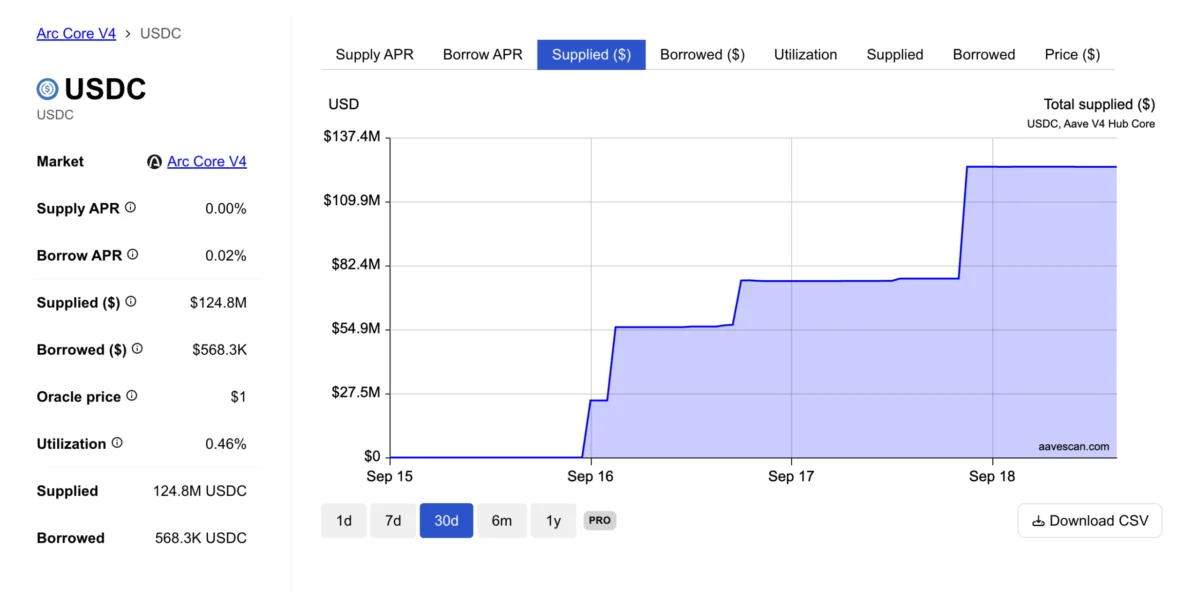
The decentralized finance (DeFi) landscape is witnessing a curious phenomenon within the Aave ecosystem. As the protocol pushes forward with its latest iteration, Aave V4, the specialized Arc market has experienced a meteoric rise in liquidity. However, this surge in capital has revealed a significant imbalance: while depositors are flooding the market with USDC, borrowers remain conspicuously absent. This discrepancy highlights the perennial "chicken-and-egg" dilemma inherent in new lending markets, where the existence of capital does not automatically equate to economic activity.
The Core Facts: A Market Flush with Cash, Starved for Demand
As of September 18, 2026, data from Aavescan confirms that the Aave V4 Arc market has attracted approximately $124.8 million in USDC deposits. This figure represents a massive influx of capital into a nascent environment, signaling strong trust from liquidity providers in the Aave brand. Yet, the flip side of the coin is sobering: total outstanding loans in this specific market are hovering just under $600,000.
This means that roughly 99.5% of the supplied liquidity remains idle. In a traditional financial institution, such a ratio would be considered a crisis of capital efficiency. In the DeFi world, it serves as a litmus test for market maturity. The central question for Aave developers and stakeholders is no longer about attracting liquidity, but rather about catalyzing the demand-side utility that justifies the existence of this new lending infrastructure.
A Chronology of Capital Influx
The rapid escalation of deposits within the Arc market has occurred at a blistering pace, reflecting the agility of capital in decentralized markets.
- September 16, 2026: The market began its recent phase of expansion with approximately $24.5 million in excess reserves. At this stage, the market was still in its embryonic form, with minimal engagement from either side of the ledger.
- September 17, 2026: Within 24 hours, the narrative shifted significantly. Deposits surged to approximately $75.8 million. Despite this threefold increase in total value locked (TVL), borrowing activity remained largely stagnant, signaling that the supply side was moving significantly faster than the borrowing side.
- September 18, 2026: By the end of the reporting period, deposits had hit the $124.8 million mark—a 65% increase in a single day and more than a fivefold increase in less than 72 hours.
While borrowing activity did show a slight upward tick—moving from a negligible $73,400 at midnight on September 18 to approximately $568,300 later that day—the growth in lending volume is dwarfed by the sheer velocity of incoming capital.
Deconstructing the Data: The Efficiency Gap
To understand why this gap matters, one must look at the mechanics of the Aave protocol. Aave operates on a supply-and-demand interest rate model. Borrowers pay interest to lenders, and in a healthy, balanced market, those rates fluctuate based on the "utilization ratio"—the percentage of supplied assets that are currently borrowed.
Currently, the Arc market displays a supply return of 0.00%, reflecting the reality that with so little being borrowed, there is no revenue being generated to distribute to liquidity providers. Conversely, the borrowing rate sits at a nominal 0.02%. This creates a stagnant ecosystem where the incentive to supply liquidity is purely speculative or based on anticipation of future yield, rather than current earnings.
The Utilization Metric
The utilization rate is the heartbeat of any lending protocol. With a current utilization of roughly 0.46%, the Aave Arc market is effectively running at a near-idle capacity. While early-stage volatility is expected, sustaining this level of imbalance could lead to "liquidity fatigue," where depositors eventually withdraw their capital to seek higher yields elsewhere, potentially destabilizing the market before it has a chance to take root.
Why Unused Deposits Signal a Strategic Challenge
The influx of $125 million is a double-edged sword. On one hand, it proves that Aave maintains massive brand equity; users are willing to move substantial capital into new, unproven markets at a moment’s notice. On the other hand, the idle capital represents an opportunity cost for those providers.
In the broader context of Aave’s dominance—where it commands roughly 48% of the total DeFi lending market—the Arc market represents a strategic push into regulated or permissioned liquidity. The challenge here is fundamentally different from the permissionless pools that made Aave famous. Arc markets often cater to institutional players who require specific compliance standards. The delay in borrowing might not be a failure of the protocol, but rather a reflection of the longer lead times required for institutional borrowers to onboard, pass KYC/AML checks, and deploy capital within a regulated-friendly framework.

Implications for the Future of Aave V4
The current state of the Arc market serves as a diagnostic tool for the broader V4 rollout. Several key implications arise from these data points:
1. The Onboarding Bottleneck
If the supply side is ready but the demand side is lagging, the bottleneck is likely not the protocol itself, but the "bridge" between traditional financial actors and the DeFi interface. Aave’s ability to foster partnerships with institutions that can actually utilize this liquidity will be the deciding factor in the success of the Arc expansion.
2. The Yield Prospectus
For the market to remain viable, Aave must facilitate an environment where borrowing becomes attractive. This could involve incentive programs for borrowers or the integration of more collateral types that allow for leveraged positions. Without a path to a meaningful yield, the $125 million currently sitting in the pool is "hot money" that may evaporate as quickly as it arrived.
3. Proof of Concept
The next 30 to 60 days will be critical. If the utilization rate remains below 1%, the market may be labeled a "ghost town" by skeptical observers. However, if the borrowing rate begins to climb in tandem with the supply, it will validate the thesis that Arc is a necessary evolution for the protocol.
Expert Perspective: Balancing the Ledger
While no official response from the Aave DAO has been issued regarding this specific liquidity imbalance, market analysts suggest that this is a classic "bootstrap" phase. In the world of decentralized finance, liquidity is the foundation. By providing a deep pool of capital, Aave is essentially "priming the pump."
The logic is simple: borrowers are unlikely to enter a market that has no depth, as the risk of slippage or inability to execute large trades is too high. By accumulating $125 million first, Aave has created a "deep" market. Now, the burden of proof shifts to the business development side of the protocol to ensure that the necessary borrowers—whether they be institutional desks or sophisticated yield farmers—find their way to the platform.
Conclusion: A Marathon, Not a Sprint
The current statistics regarding the Aave V4 Arc market should not be interpreted as a failure, but rather as a snapshot of a market in its infancy. The massive disparity between the $125 million in supply and the sub-$600,000 in borrowing is an indicator of a system that is currently over-capitalized and under-utilized.
For Aave, the objective remains clear: the expansion into the Arc network is a long-term play. The protocol has successfully cleared the first hurdle by attracting substantial liquidity. The true test—and the true measure of V4’s success—will be its ability to translate this passive capital into active lending demand. As the market matures, observers should monitor the utilization rate as the primary indicator of success. If that number begins to creep upward, it will signal that the seeds of adoption have taken root, and that Aave’s newest venture is well on its way to becoming a cornerstone of the next generation of DeFi lending.
For now, the protocol waits. The liquidity is ready; the market is waiting for the borrowers to arrive.
