

The landscape of decentralized finance (DeFi) in Europe is bracing for a significant transformation. The European Banking Authority (EBA), the continent’s premier financial watchdog tasked with maintaining banking stability and protecting consumers, has officially signaled its intent to bring crypto lending and borrowing activities within the regulatory perimeter of the Markets in Crypto-Assets (MiCA) framework. This move marks a pivotal shift in the EU’s approach to digital assets, moving beyond initial asset-level regulation toward the oversight of complex financial activities.
Main Facts: The EBA’s Strategic Pivot
At the heart of this regulatory push is a concern over "regulatory arbitrage." The EBA, alongside the European Securities and Markets Authority (ESMA), has identified that crypto lending—whether facilitated through centralized Crypto-Asset Service Providers (CASPs) or autonomous DeFi protocols—is creating pathways to bypass existing restrictions.
While MiCA effectively banned the offering of yield on stablecoins to protect retail investors, the reality of the market has proven more porous. Assets such as Circle’s USDC and EURC continue to generate yields through sophisticated DeFi strategies. The EBA contends that these activities pose systemic risks, including over-leverage, potential contagion between the crypto and traditional financial sectors, and the ever-present threats of cyber-hacks and protocol fraud.
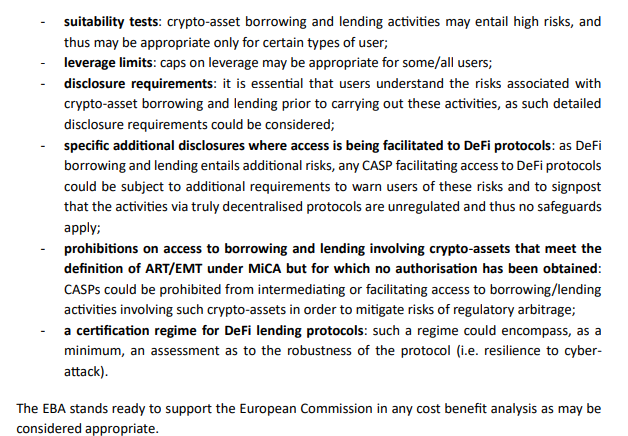
The proposed regulatory roadmap includes stringent measures:
- Leverage Caps: Limiting the amount of debt-based exposure available to users.
- Disclosure Requirements: Mandating transparent reporting on protocol risks and asset management strategies.
- Cyber Resilience Certification: Establishing mandatory security audits and technical standards for DeFi protocols to operate within EU jurisdictions.
Furthermore, the proposal suggests a hard line against unlicensed stablecoins, such as Tether (USDT). If implemented, these regulations could effectively bar non-compliant stablecoins from participating in the EU’s DeFi lending ecosystems, forcing a massive restructuring of liquidity pools.
A Chronology of Escalating Scrutiny
The journey toward this regulatory stance has been iterative. Following the initial implementation of MiCA, European regulators spent the last year observing how market participants adapted to the new rules.
- Early Implementation: Initial MiCA discussions focused on issuers and CASPs, leaving pure DeFi as a "grey area" under the assumption of decentralization.
- Market Observation: Regulators noted that while centralized platforms were becoming compliant, "DeFi interfaces" were acting as de facto financial intermediaries, providing yield-generating services that looked and acted like traditional banking products.
- The 2026 Review: In a recent policy review, the EBA formally acknowledged that the distinction between "centralized" and "decentralized" is increasingly blurred. This realization triggered the current push to extend MiCA’s reach to cover the lending and borrowing activities themselves, rather than just the service providers.
- The Emerging Conflict: As of late 2026, the industry has begun to splinter on how to define these "vaults"—the mechanisms that pool user assets to generate yield—leading to a public debate between major protocols like Aave and Morpho.
Supporting Data: The Scale of the DeFi Lending Market
The stakes of this regulatory intervention are significant. Currently, the DeFi lending sector commands approximately $54 billion in total value locked (TVL). Within this, "vaults"—automated pools that deploy capital across various lending strategies—account for roughly $10 billion in assets spread across more than 4,000 individual deployments.
This $10 billion segment is the primary target of the EBA’s scrutiny. These vaults range from highly automated, rule-based systems to discretionary models where a "curator" decides where to allocate capital to maximize yield. Regulators view the discretionary model as functionally equivalent to an investment fund, which necessitates a different, stricter level of legal classification.
The Global Context: EU vs. SEC
The European approach stands in stark contrast to the United States. In the U.S., the Securities and Exchange Commission (SEC) has adopted an enforcement-led strategy. The SEC has repeatedly warned that if a protocol involves active management by curators to generate yield, it likely crosses the threshold into an "investment contract" under the Howey Test, thereby triggering strict securities law compliance.
However, the SEC remains ambiguous regarding "fully non-custodial" vaults where no human curator manages the funds. The EU’s approach, by contrast, seeks to codify these definitions within the MiCA framework, aiming for a "rules-based" rather than "enforcement-based" environment. By creating specific categories for DeFi protocols, the EU hopes to provide more legal certainty than the current U.S. landscape, even if those rules impose a higher barrier to entry.
Official Responses and Industry Disagreement
The industry is far from a consensus on how to categorize these financial instruments. The debate has coalesced around the business models of two giants: Morpho and Aave.
The Morpho Perspective
Morpho CEO Paul Frambot has proposed a bifurcated classification system:
- Non-Custodial Vaults: These would limit the role of the curator, emphasizing user flexibility, such as the ability to withdraw funds at any time or through defined time-locks. Frambot argues these should face lighter regulatory touch.
- Discretionary Vaults: These involve active management and, in his view, should be regulated as investment vehicles, triggering standard securities law requirements.
The Aave Critique
Stani Kulechov, founder of Aave, has publicly challenged this framework, labeling it "self-serving." Kulechov argues that Morpho’s classification is technically flawed. According to his assessment, a vault is only truly "non-custodial" if it lacks a manager entirely. He believes that the industry should not be afraid of the "discretionary" label, suggesting that if a protocol offers discretionary management, it should simply embrace the necessary regulatory path rather than attempting to redefine the terminology to avoid it.
This public disagreement highlights a deeper existential question for the DeFi sector: Can "decentralized" finance truly exist if it is forced to adopt the labels and structural requirements of traditional banking?
Implications: The Future of European DeFi
The move to bring lending under MiCA has profound implications for the ecosystem:
1. The Death of Unlicensed Liquidity
If regulators successfully mandate that only licensed stablecoins can be used in these protocols, the liquidity available to EU-based DeFi users will likely shrink in the short term. USDT, currently the most liquid asset in crypto, would likely be excluded from regulated European lending pools, potentially driving a wedge between European DeFi markets and the rest of the world.
2. A "Compliance-First" Development Culture
The requirement for "cyber resilience-based certification" will change how DeFi protocols are built. Developers will no longer be able to prioritize speed-to-market over security. Instead, the roadmap for a new protocol will likely involve an extensive period of auditing and certification before a single dollar of user capital is accepted. This will likely favor established, well-funded protocols over smaller, more experimental startups.
3. Institutional Integration
While these rules may stifle "degens" and high-risk experimental platforms, they provide the regulatory clarity that large institutional investors have been waiting for. By bringing DeFi lending into the fold of MiCA, the EU is essentially creating a "safe harbor" for institutional capital to enter the DeFi space. The trade-off for the industry is a loss of pure autonomy in exchange for a massive influx of traditional liquidity.
4. The Potential for Innovation Flight
Critics of the proposal warn that overly stringent requirements could lead to a "brain drain," where developers and protocols move their operations to more permissive jurisdictions outside the EU. If the compliance costs for running a lending vault in the EU become too high, the European market risks becoming a walled garden—safe, regulated, and stable, but potentially disconnected from the cutting-edge innovation occurring in more flexible regulatory environments.
Conclusion
The European Union is at a crossroads. By extending MiCA to cover DeFi lending, the EBA is asserting that there is no such thing as a "lawless" financial sector, regardless of the technology used to underpin it. While the proposed rules regarding leverage, disclosures, and certification are aimed at protecting the retail consumer from the volatility of the crypto market, they also fundamentally alter the nature of DeFi.
As the industry debates the classification of vaults and the role of curators, the message from Brussels is clear: the era of DeFi as a regulatory "Wild West" is drawing to a close. The future of the sector in Europe will be built on a foundation of transparency, accountability, and legal compliance—a change that will likely define the next decade of digital finance on the continent.
