

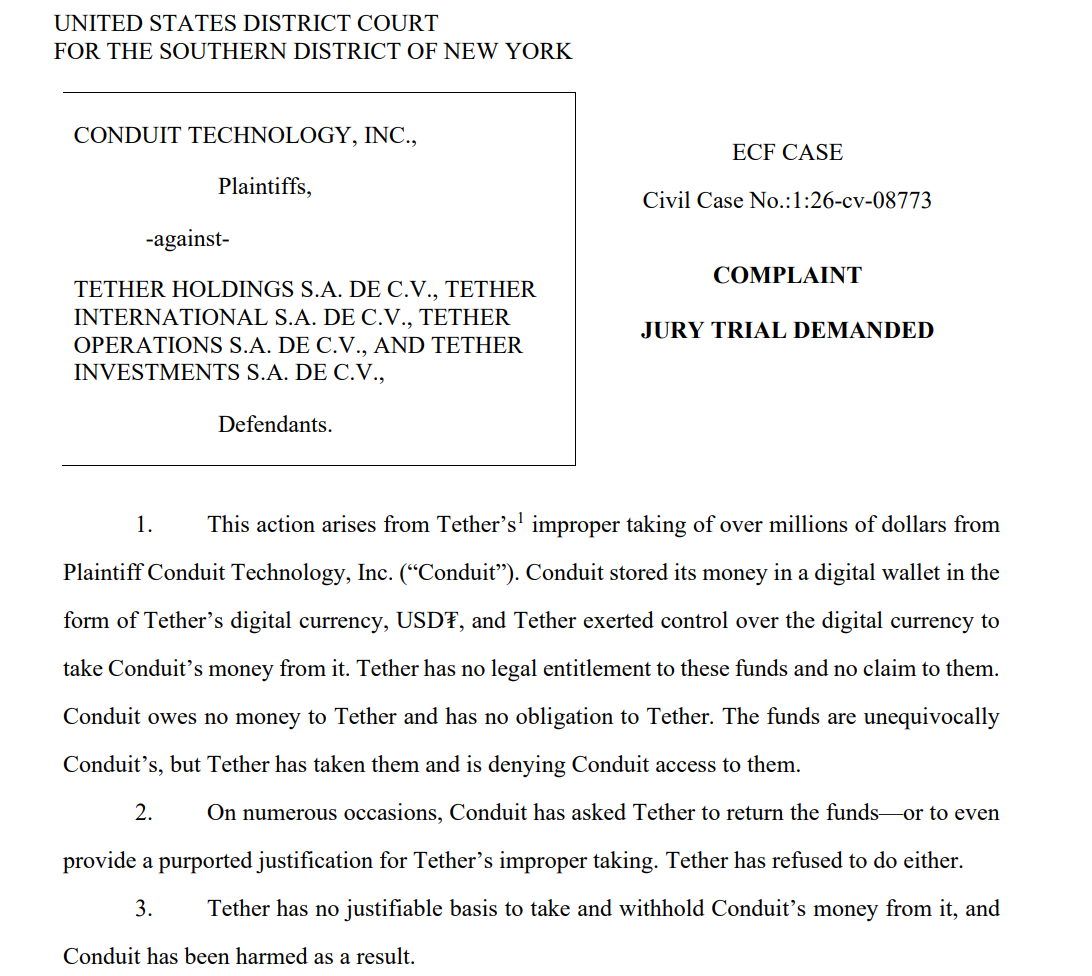
NEW YORK — Stablecoin giant Tether finds itself once again in the legal crosshairs after U.S.-based payment firm Conduit filed a federal lawsuit in the Southern District of New York (SDNY). The legal action targets Tether for freezing $2.7 million worth of USDT, which Conduit claims was executed with “no justifiable basis.”
The dispute shines a harsh spotlight on the complex intersection of cross-border law enforcement, blockchain compliance, and the immense discretionary power wielded by private stablecoin issuers. As regulatory scrutiny intensifies globally, the high-stakes lawsuit raises critical questions regarding asset custody, due process, and the financial liability of freezing user funds in the decentralized finance (DeFi) era.
Main Facts: The Battle Over $2.7 Million in USDT
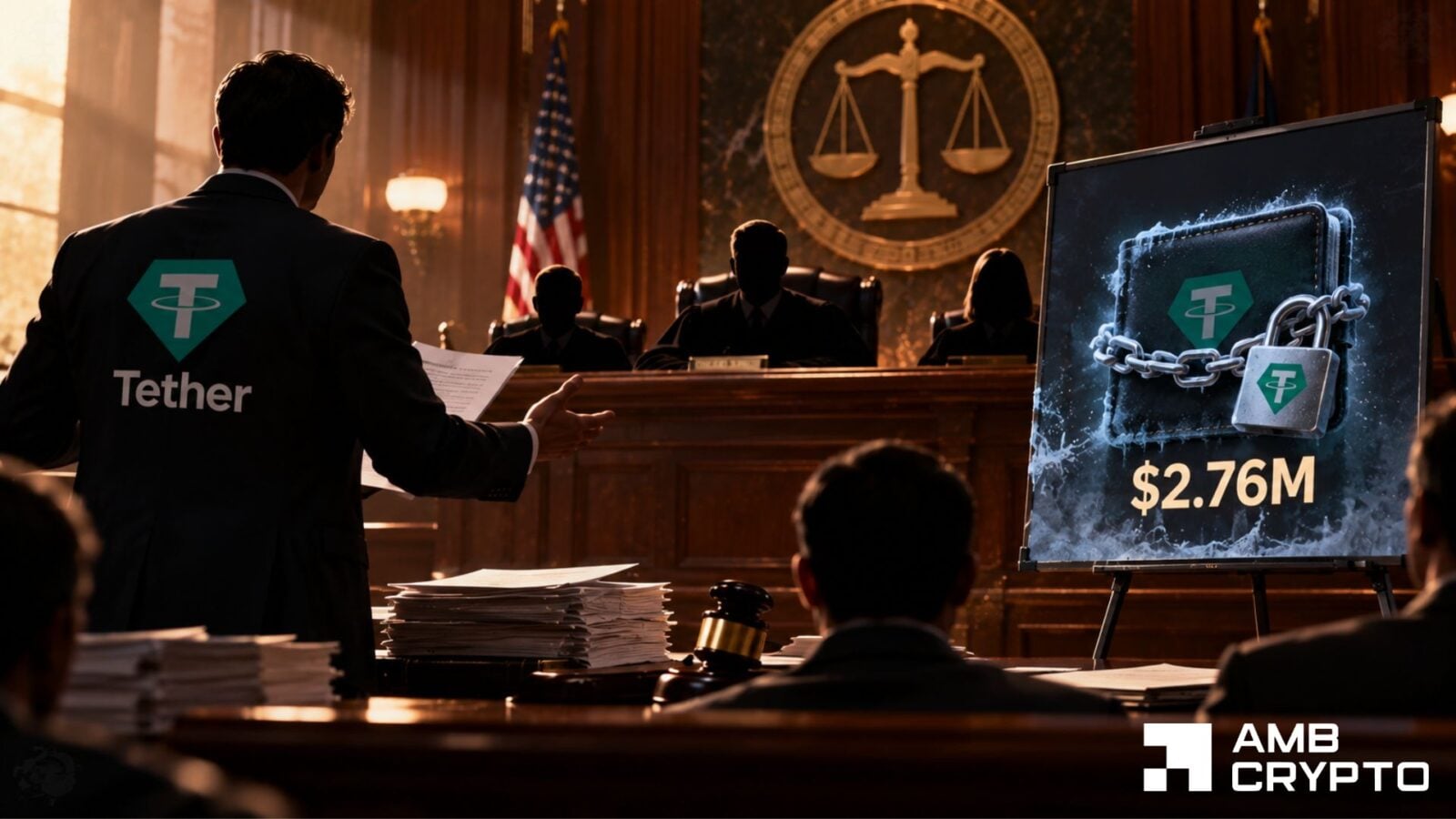
According to court filings submitted to the SDNY, Conduit alleges that Tether arbitrarily locked up $2.76 million in USDT held across its infrastructure, refusing multiple requests to either return the capital or provide a valid legal justification for the action.
The crux of the complaint centers on ownership, asset accessibility, and indirect enrichment. Conduit’s legal representation argues that Tether has caused direct financial harm by withholding the firm’s treasury funds. Furthermore, the payment firm alleges that Tether continues to extract financial value from the frozen capital, earning ongoing interest income on the underlying reserve assets that back the locked stablecoins.
The Core Allegations:
- The Seizure: Tether froze $2.7 million in USDT belonging to Conduit on September 24, 2025.
- The Refusal: Tether allegedly failed to provide proper justification, instead directing the payment firm to international law enforcement agencies.
- Unjust Enrichment: Conduit claims Tether profits from the freeze by continuing to collect yield on the reserve assets backing the frozen tokens.
- Legal Action: The lawsuit demands the immediate return of the initial capital alongside all accrued interest generated since the freeze took effect.
Chronology of Events: From Brazilian Probes to U.S. Federal Court
To understand how a routine compliance flag escalated into a federal lawsuit, it is necessary to examine the timeline of events leading up to Conduit’s legal filing.
September 24, 2025: The Freeze
On this date, blockchain analysts identified a sudden wave of compliance actions targeting Tron-network addresses. A total of 23 Tron addresses were frozen simultaneously. Among them was a primary wallet managed by Conduit, holding approximately $2.7 million in USDT. Unlike transient or temporary freezes, this wallet remained locked indefinitely.
The Investigation into Onix Transfers
According to background disclosures, Brazilian authorities had launched an ongoing investigation into suspicious Onix transfers routed through the Conduit payment platform. In connection with this probe, Brazilian law enforcement officials requested that Tether freeze specific funds tied to the suspect transactions.
However, a severe breakdown in communication appears to have occurred between the parties involved. When Conduit reached out to Tether for clarification regarding the seizure, the stablecoin issuer pointed them toward the Brazilian Federal Police.
The Denial and Defense
Upon contacting Brazilian authorities, Conduit representatives were reportedly told that the agency had not ordered the freeze on Conduit’s specific treasury wallet.
Conduit vigorously defended the integrity of the locked wallet, noting that the treasury address in question was established a full month after the final Onix-related transaction had cleared its platform. From Conduit’s perspective, Tether overstepped its bounds by freezing unrelated corporate funds without a verifiable, direct mandate from law enforcement.
Supporting Data and Industry Analysis
The dispute highlights a growing friction point within the cryptocurrency ecosystem: the friction between centralized compliance controls and decentralized asset management. When massive pools of capital are frozen at the push of a button, the fallout ripples across the broader digital asset economy.
Industry Experts Weigh In
The high-profile nature of the case has drawn commentary from leading blockchain security and compliance experts. Taylor Monahan, a prominent voice in crypto security, offered a measured take on the situation via social media, highlighting the likelihood of a communication failure.
"I think Brazilian authorities have their wires crossed on what they demanded be frozen and/or isn’t communicating with Conduit well," Monahan stated.
However, Monahan also left room for alternative interpretations of the legal maneuvering, adding:
"Or Conduit is choosing to be selective with their portrayal of the situation to US courts in order to try to get their address unfrozen without dealing with the Brazilian situation head-on."
A Pattern of Legal Escalation
This lawsuit is not an isolated incident for Tether. It marks the second major legal challenge the stablecoin issuer has faced within a span of just two months, both revolving around frozen funds tied to entities under various forms of regulatory or criminal investigation.
In the previous month, a separate duo of plaintiffs filed a lawsuit against Tether demanding the return of $42.4 million in frozen USDT, alongside all interest income accumulated on the reserves during the period of the freeze. These recurring legal battles highlight a mounting trend: institutional and corporate users are increasingly turning to American courts to challenge the administrative freezes executed by offshore digital asset issuers.
Official Responses and the Regulatory Landscape
The timing of Conduit’s lawsuit coincides with a broader, highly charged regulatory offensive against Tether and its flagship product, USDT.
The U.S. Senate Report and Iran-Linked Flows
In late September, the U.S. Senate released a damning and exhaustive report identifying Tether’s USDT as a primary conduit for illicit financial flows, specifically pointing to its use by the Iranian regime to bypass international economic sanctions.
Tether has pushed back aggressively against these characterizations, pointing to its proactive cooperation with global law enforcement agencies. In defense of its compliance track record, Tether highlighted that it has frozen over half a billion dollars ($550M+) in USDT linked directly to illicit activities, state-sponsored bad actors, and terrorism financing.
While Tether’s aggressive freezing mechanism is often praised by compliance advocates and regulatory bodies seeking to curb financial crime, cases like Conduit’s illustrate the severe collateral damage and operational risks posed by over-enforcement or bureaucratic miscommunication.
Global Implications for Tether and the Stablecoin Market
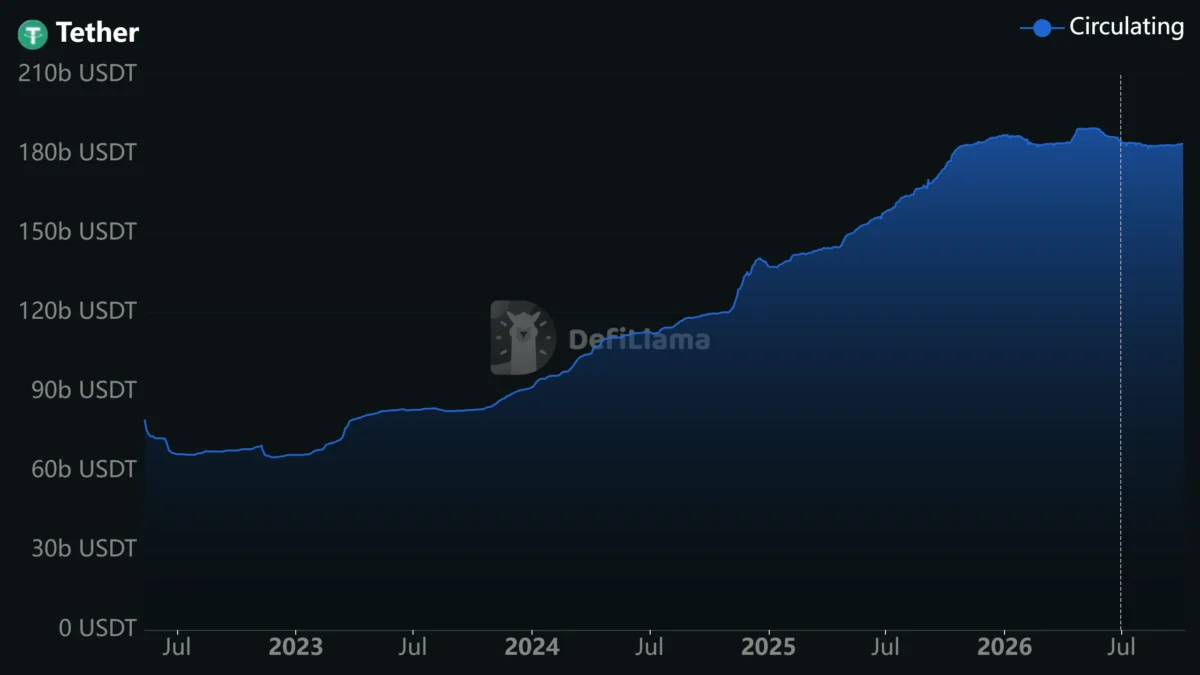
As the world’s largest stablecoin, Tether’s USDT commands an astronomical market capitalization of approximately $184 billion. It serves as the primary liquidity lifeblood for global crypto trading pairs, decentralized finance protocols, and cross-border commercial settlements.
However, the compounding pressure from U.S. lawmakers, coupled with a rising tide of civil litigation from corporate entities whose funds have been frozen, presents a unique set of challenges.
Key Implications to Watch:
- Precedent for Asset Recovery: If U.S. courts rule in favor of Conduit—especially regarding the demand for interest earned on reserve assets—it could force Tether and other stablecoin issuers to overhaul their compliance and asset-retention policies.
- Jurisdictional Conflict: The case underscores the messy reality of cross-border law enforcement. When foreign police investigations trigger freezes on U.S.-facing corporate entities, jurisdictional boundaries blur, leaving private issuers caught in the crossfire.
- Market Dominance vs. Compliance Costs: While regulatory scrutiny has not yet dented USDT’s massive market cap, prolonged legal battles regarding arbitrary freezes may encourage institutional players to seek alternative, more transparent stablecoin alternatives.
As the lawsuit in the Southern District of New York proceeds, the crypto industry will be watching closely. The final verdict could redefine the legal boundaries of a stablecoin issuer’s right to freeze funds, setting a monumental precedent for digital asset custody and corporate liability in the years to come.
