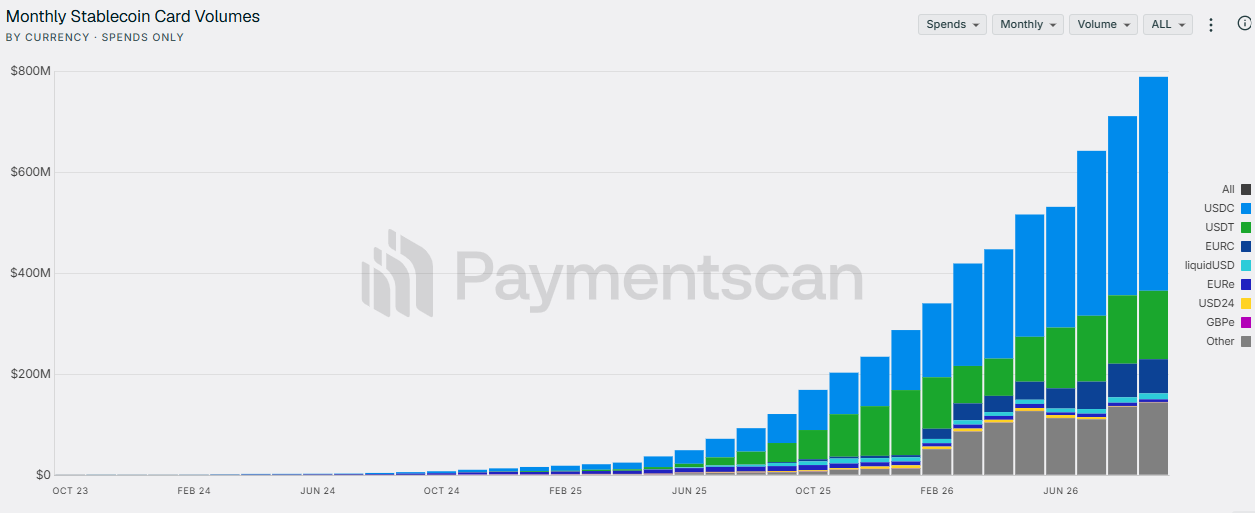
The integration of digital assets into everyday commerce has reached a monumental milestone. In September, monthly spending via stablecoin-backed payment cards surged to an unprecedented all-time high of $788.9 million. According to data compiled by Paymentscan, stablecoin card activity has demonstrated relentless, compounding momentum, setting new volume records month after month for the past two consecutive years.
This meteoric rise illustrates a profound structural evolution within the broader digital asset landscape. Once confined primarily to speculative crypto trading pairs and decentralized finance (DeFi) liquidity pools, stablecoins are aggressively breaking out of the crypto-native ecosystem. They are rapidly transitioning into a preferred medium of exchange for retail purchases, marking a monumental shift toward real-world economic utility.
Main Facts
Record-Breaking Volume: Monthly stablecoin card spending climbed to $788.9 million in September, reflecting an astonishing 49-fold surge from early-year levels of just $16 million.
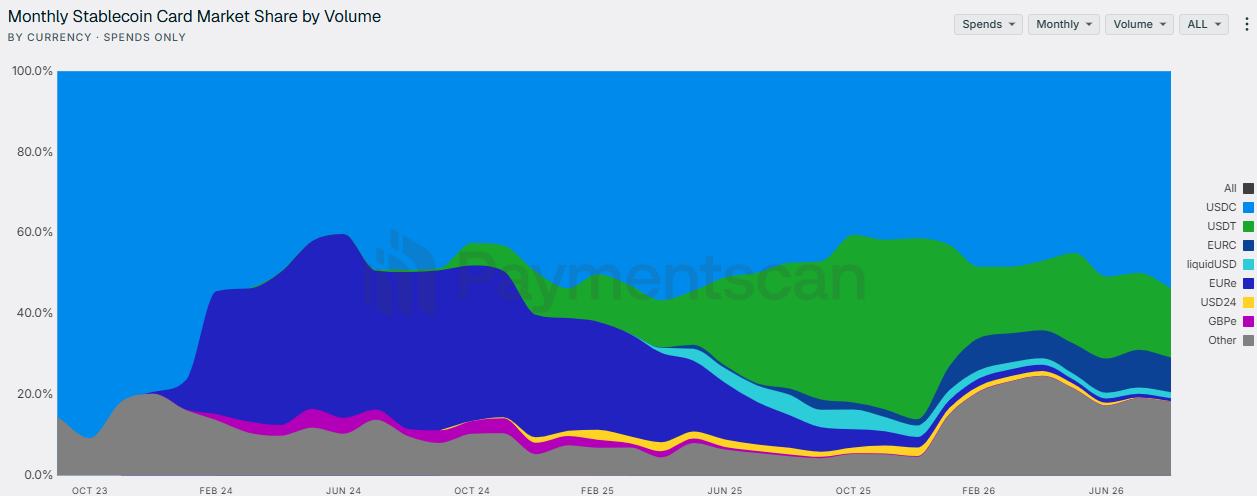
The USDC Dominance in Cards: Circle’s USD Coin (USDC) has firmly established its footprint in the card segment, capturing $423 million in September volume—triple the volume of its primary rival, Tether (USDT), which sat at $135 million. This gives USDC a commanding 57% market share in card-based spending.
The Regulatory Factor: Tether’s market share in card payments dropped from a peak of 49% in January to 17% by late 2026, coinciding with stricter regulatory implementations such as Europe’s Markets in Crypto-Assets (MiCA) framework.
Overall Transfer Dominance Remains with USDT: Despite USDC’s supremacy in card rails, USDT continues to dominate global on-chain transfer volumes. Visa data for September revealed that USDT handled $182 billion (84% market share), compared to USDC’s $32.6 billion (15%).
Concentrated Infrastructure Risk: The fast-growing stablecoin card sector relies heavily on a single primary infrastructure provider, Rain, introducing potential systemic and single-point-of-failure vulnerabilities to neobanks and consumers alike.
Chronology: The Trajectory of Stablecoin Card Growth
The path from experimental blockchain transactions to widespread retail checkout adoption has been rapid and transformative.
Early 2024 – 2025 (The Incubation Phase): Stablecoin card volumes hovered around modest baselines, such as $16 million. While crypto-backed debit cards existed, they were largely treated as niche novelties utilized primarily by early adopters and web3 enthusiasts.
January 2026 (The Tether Surge): Tether (USDT) experienced a massive wave of retail adoption through card issuers, pushing its share of the stablecoin card segment to nearly 49% from virtually zero over a two-year lookback period.
Mid-2026 (The MiCA Transition Deadline): As the European Union’s Markets in Crypto-Assets (MiCA) regulatory transition window slammed shut, several prominent regional fintech platforms and neobanks, including Revolut, systematically delisted non-compliant tokens like USDT. Concurrently, capital and volume began visibly pivoting toward regulated alternatives.
September 2026 (The Inflection Point): Total monthly spending across all stablecoin-powered cards smashed previous ceilings to touch $788.9 million. USDC asserted clear dominance in this category, capturing over half of the market share as traditional fintech rails embraced fully regulated, US-dollar-backed issuers.
Supporting Data & Market Metrics
To fully understand the current state of stablecoin adoption, industry analysts point to a bifurcated dataset that separates retail card spending from global on-chain transfers.
1. The Card Spending Ecosystem (Paymentscan Data)
Total September Volume: $788.9 million.
USDC Card Volume: $423 million (57% market share).
USDT Card Volume: $135 million (roughly 17% market share, down from a 49% high earlier in the year).
Growth Multiple: A roughly 49x expansion in overall volumes since the early months of 2025.
2. Global On-Chain Transfer Volumes (Visa Data)
Total September Transfer Volume: Dominated heavily by peer-to-peer (P2P) transfers, merchant settlements, and treasury movements.
USDT Transfer Volume: $182 billion, commanding an 84% market share.
USDC Transfer Volume: $32.6 billion, capturing a 15% market share.
This data highlights a fascinating dichotomy: while users in developed markets and regulated fintech ecosystems prefer USDC for physical and digital card spending, emerging market participants continue to rely on USDT as a high-liquidity instrument for savings, cross-border remittances, and inflation hedging.
Official Responses and Industry Perspectives
Market participants and venture capital heavyweights have been quick to react to the shifting tides of stablecoin utility.
Frank Chaparro, an executive at prominent crypto market maker GSR, captured the industry’s astonishment at the velocity of adoption, stating:
"Stablecoins are increasingly moving beyond trading and settlement into everyday payments. Wow."
Venture capital titan a16z has similarly emphasized in recent market notes that payment cards have effectively matured into one of the most seamless, frictionless user acquisition and spending funnels for crypto assets. By abstracting away the complex technical hurdles of web3 wallets, seed phrases, and gas fees, stablecoin cards allow consumers to interact with blockchain-based money using familiar swipe-and-tap habits.
Industry researchers note that Circle’s deliberate strategy to align USDC with institutional compliance, transparent reserves, and regulatory frameworks has successfully unlocked partnerships with mainstream neobanks and payment processors. Conversely, Tether’s decentralized, borderless appeal continues to thrive organically in regions where access to traditional banking services is restricted or plagued by severe local currency devaluation.
Implications: A Bifurcated Market and Emerging Infrastructure Risks
The maturation of stablecoin cards carries profound implications for the global financial architecture, pointing toward both unprecedented opportunities and newly exposed vulnerabilities.
1. A Two-Tier, Bifurcated Global Market
The divergence between USDC’s card dominance and USDT’s transfer dominance points toward a "one dollar, two worlds" reality:
The Regulated Rail (USDC): Optimized for Western fintech apps, consumer spending, corporate treasuries, and environments heavily policed by compliance frameworks.
The Utility & Hedge Rail (USDT): Deeply entrenched in developing economies across Latin America, Africa, and Southeast Asia, acting as a digital dollar savings account and a lifeline against hyperinflation.
2. Concentration and Contagion Risks in Fintech Infrastructure
While the user experience of spending stablecoins has never been smoother, the underlying plumbing remains surprisingly centralized. As of September, a single infrastructure provider—Rain—powers a massive share of the neobank stablecoin card ecosystem.
This level of market concentration introduces systemic counterparty and contagion risks. If a technical bug, regulatory crackdown, or security exploit hits a foundational infrastructure provider, the cascading effect can freeze operations across dozens of independent neobanks simultaneously.
This vulnerability was recently brought to light by a security exploit affecting the Rain-powered neobank Avici, which resulted in a $500,000 breach. Although swift action by the platform ensured that all affected user card balances were refunded in full, the incident served as a stark reminder of the fragile dependencies underpinning the modern crypto-card stack.
Conclusion
The milestone of $788.9 million in monthly stablecoin card spending marks the definitive end of stablecoins as purely speculative trading instruments. As consumers increasingly view digital dollars as everyday money, competition between issuers like Circle and Tether is reshaping how value moves across borders and point-of-sale terminals. However, as the ecosystem scales toward billions in volume, strengthening backend infrastructure resilience and navigating complex global regulations will remain the ultimate tests for the long-term sustainability of crypto-powered payments.