

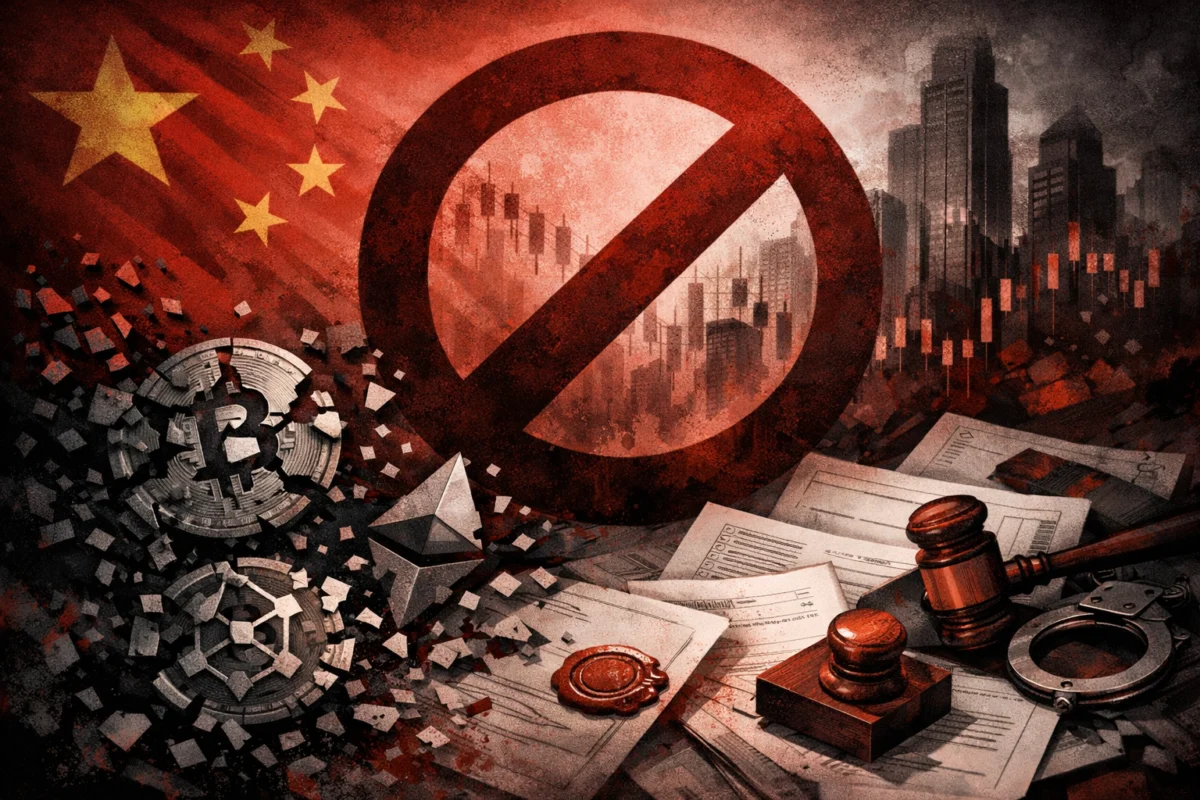
BEIJING — In one of the most comprehensive and definitive regulatory actions directed at the digital finance sector to date, China has formally classified the tokenization of real-world assets (RWAs) as an illegal financial activity.
A coordinated notice issued by a coalition of seven major financial industry associations has definitively placed RWA tokenization alongside stablecoins, public cryptocurrencies, and crypto mining in the prohibited category. The move entirely dismantles any lingering ambiguity regarding whether tokenized assets might find a foothold under future regulatory sandboxes or innovation pilots in mainland China.
Instead, authorities have drawn an unyielding statutory line that extends far beyond primary project issuers. The enforcement crosshairs now capture the entire Web3 service chain, targeting domestic and cross-border operations, entities leveraging Hong Kong bridges, and offshore structures that continue to maintain operational or technical staff within mainland borders.
Main Facts: Deconstructing the Ban
The policy shift is characterized by its breadth, severity, and unified execution. Rather than originating from a single regulatory watchdog, the directive represents a rare, synchronized cross-industry consensus.
The Seven-Agency Coalition
The declaration was jointly formulated and broadcast by the most influential institutional bodies within China’s financial apparatus:
- The China Internet Finance Association (CIFA)
- The China Banking Association (CBA)
- The China Securities Association (SAC)
- The Asset Management Association of China (AMAC)
- The China Futures Association (CFA)
- The China Association of Listed Companies (CALC)
- The China Payment and Clearing Association (CPCA)
Redefining RWA Tokenization
Under the framework laid out by the coalition, RWA tokenization is formally defined as the financing and trading of debt instruments, equity, or commodities through the issuance of distributed ledger tokens or token-like digital rights. Regulators argue that this financial architecture systematically introduces layered risks, including fictitious underlying collateral, extreme systemic operational vulnerabilities, and unchecked speculative trading.
Crucially, the notice explicitly disproves claims made by various web3 promoters that specific projects are operating under official trial phases or awaiting regulatory registration. The joint statement asserts that no Chinese regulatory body has ever approved, endorsed, or registered any form of real-world asset tokenization.
Statutory Violations
The notice maps RWA activities directly to severe violations under China’s established legal framework, primarily targeting the Criminal Law and the Securities Law:
- Illegal Fundraising: Issuing tokens to the public while promising or implying financial returns is categorized as illegal public deposit-taking.
- Unauthorized Securities Offerings: Facilitating token distributions, secondary market trades, or fractionalized ownership sales without state authorization constitutes an illegal public offering of securities.
- Illegal Futures Operations: Tokenized trading models incorporating leverage, perpetual futures, or betting mechanisms fall squarely under unauthorized futures business operations.
Chronology of China’s Digital Asset Containment
To fully understand the gravity of the RWA ban, it must be viewed as the culmination of a multi-year, systematic dismantling of private digital currency ecosystems within mainland China.
2013–2017: The Initial Crypto Containment
- December 2013: The People’s Bank of China (PBOC), alongside other ministries, issues a notice barring financial institutions and payment companies from handling Bitcoin transactions, categorizing it as a virtual commodity rather than legal tender.
- September 2017: Regulators issue a blanket ban on Initial Coin Offerings (ICOs), declaring them an illegal form of unapproved public financing and forcing domestic exchanges to shutter operations or migrate overseas.
2021–2023: The Total Mining and Trading Ban
- May 2021: The State Council’s Financial Stability and Development Committee calls for a strict crackdown on Bitcoin mining and trading activities, triggering a mass exodus of hashing power out of China.
- September 2021: Ten government agencies—including the PBOC and the Supreme People’s Procuratorate—release a joint directive declaring all cryptocurrency-related activities illegal, effectively criminalizing domestic crypto transactions, node operations, and foreign exchange services catering to mainland users.
2024–2026: Closing the RWA Loophole
- Mid-to-Late 2024: As global institutional finance pivots toward tokenized Treasury bills, real estate, and private credit (RWA), various fintech startups attempt to navigate Chinese capital controls using offshore vehicles and Hong Kong-registered entities.
- January 2026: The seven-association coalition issues the definitive RWA notice, closing the final structural loophole and establishing strict secondary liabilities for any tech provider, marketer, or employee facilitating these initiatives.
Supporting Data and Risk Analysis
Legal and financial observers have noted that this level of institutional alignment is typically reserved for existential threats to the state’s monetary sovereignty and financial stability.
According to data compiled by regional fintech intelligence groups, the rise of RWA tokenization in late 2024 and 2025 frequently masked speculative excesses. Regulators noted a sharp uptick in fraudulent schemes utilizing tokenized real estate, intellectual property, and green energy assets as speculative fronts for retail exploitation.
Why Regulators Rejected RWA Collateralization
Proponents of RWA tokenization have long argued that unlike purely speculative meme coins or algorithmic stablecoins, tokenized real-world assets are anchored to tangible, revenue-generating items such as commercial real estate or government bonds.
However, Chinese regulators flatly rejected this premise. The official stance is that:
- Legal Enforceability Fails: Smart contracts cannot override national property laws or foreign jurisdictional boundaries in the event of default or liquidation.
- Contagion Risks: The linkage between decentralized token systems and traditional banking channels creates uncontrollable risk spillovers capable of destabilizing retail capital markets.
- Capital Flight: Tokenization provides a seamless technological conduit for high-net-worth individuals to bypass China’s stringent annual foreign exchange quotas ($50,000 per individual limit).
Hong Kong and the Offshore Trap
One of the most consequential dimensions of the new directive is its deliberate reach beyond mainland borders, explicitly targeting the "Hong Kong arbitrage" model.
The End of the Hong Kong Bypass
In recent years, numerous mainland-founded projects established entities in Hong Kong following the territory’s progressive push toward regulated virtual asset trading platforms. Many entrepreneurs assumed that operating under the Securities and Futures Commission (SFC) framework in Hong Kong shielded them from mainland enforcement.
The January 2026 notice shatters this illusion. The China Securities Regulatory Commission (CSRC) has reportedly urged domestic brokerages and financial institutions to halt any direct or indirect involvement in cross-border RWA tokenization activities originating in or routed through Hong Kong.
Expanding Liability: The "Should Have Known" Standard
The directive introduces an aggressive liability standard for service providers. Under the new rules, institutions and individuals who "knew or should have known" that they were supporting virtual currency or RWA-related businesses face severe legal accountability.
This legal standard directly penalizes the prevalent Web3 operational model: registering an entity in the British Virgin Islands, Cayman Islands, or Singapore while maintaining a development, marketing, or administrative team in tech hubs like Shenzhen, Shanghai, or Beijing.
Comprehensive Impact on the Web3 Service Chain
The crackdown redefines compliance risk by expanding enforcement targets across the entire commercial lifecycle of a digital asset project. Responsibility is no longer isolated to founders and executive management.
1. Technology and Infrastructure Providers
Cloud computing firms, blockchain infrastructure providers, and software development agencies that write smart contracts or host node environments for RWA projects now face immediate criminal exposure if their services are accessible to, or managed by, mainland personnel.
2. Marketing, PR, and Influencers
Media agencies, social media influencers, and public relations firms promoting tokenized yields, real-estate fractions, or cross-border token sales are classified as accomplices in unauthorized financial promotion.
3. Payment and Settlement Interfaces
Fintech gateways, over-the-counter (OTC) brokers, and payment processors handling fiat-to-crypto conversion loops or stablecoin settlements for RWA projects face immediate asset freezes and potential prosecution under anti-money laundering (AML) statutes.
4. Operational and Development Staff
Perhaps most alarming for the broader startup ecosystem is the warning directed at individual employees. The guidance explicitly clarifies that employing even a single operations, coding, or administrative worker within mainland China is sufficient to expose an entire offshore project and its executive leadership to Chinese jurisdictional enforcement.
Official Responses and Strategic Context
Industry analysts point out that this domestic clampdown is strategically synchronized with China’s broader national monetary policy goals.
While Beijing moves decisively to extinguish private, decentralized, and tokenized financial experiments, it is simultaneously accelerating the internationalization of its own state-backed digital currency: the Digital Yuan (e-CNY).
Recent infrastructure rollouts, including a newly established financial technology hub in Shanghai dedicated to cross-border payments and state-sanctioned blockchain services, highlight the state’s vision. China is willing to embrace distributed ledger technology and blockchain infrastructure—provided it remains entirely centralized, state-issued, and fully compliant with capital controls.
Industry Implications
Global fintech startups and Web3 enterprises that previously viewed the Chinese diaspora or mainland talent pools as vital components of their operational scale are now forced to make a stark choice. Remaining connected to the Chinese market—whether through personnel, marketing, or technical infrastructure—is no longer a gray-market risk; it is an overt legal violation carrying severe criminal penalties.
As the net closes, the message from Beijing is unambiguous: in China’s digital economy, financial innovation outside the direct control of the state will not be tolerated, and real-world asset tokenization has officially joined the list of prohibited frontiers.
