

The cryptocurrency market is currently navigating a period of profound cognitive dissonance. In recent weeks, digital asset prices have surged, defying a backdrop of aggressive regulatory crackdowns, historic interest rate hikes, and a liquidity crisis that has sent trading volumes to multi-year lows. As Bitcoin and Ethereum lead a market-wide rally, investors are left to reconcile the excitement surrounding institutional adoption with the stark reality of macroeconomic and legal headwinds.
Main Facts: The Rally and the Resistance
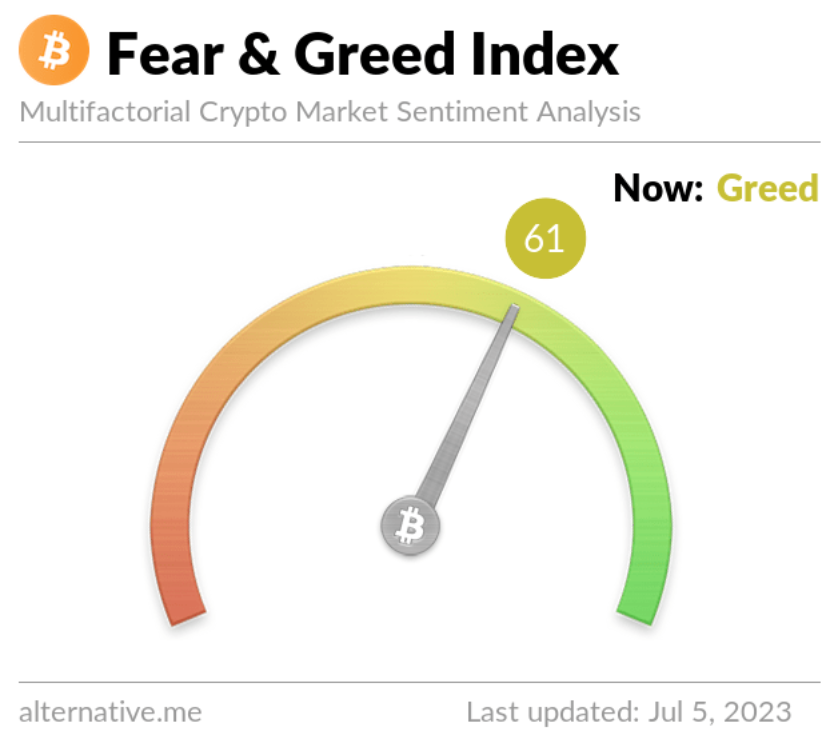
Over the past three weeks, Bitcoin has experienced a remarkable 20% surge, successfully breaching the psychological resistance level of $30,000. Ethereum, not far behind, has seen a 16% appreciation, flirting once again with the $2,000 mark. This sudden bullish momentum has pushed the "Fear and Greed Index"—a proprietary metric that gauges market sentiment—into the "Greed" territory with a score of 61.
The primary catalyst for this exuberance is the renewed interest from institutional heavyweights. The filings for Bitcoin spot Exchange-Traded Funds (ETFs) by BlackRock and Fidelity have acted as a massive psychological floor for the market. These filings are bolstered by the launch of EDX Markets, a new institutional-grade exchange backed by financial giants including Fidelity, Charles Schwab, and Citadel Securities.
However, beneath this veneer of optimism lies a volatile reality. The U.S. Securities and Exchange Commission (SEC) recently signaled that the initial ETF filings were "inadequate," citing a lack of detail regarding the necessary "surveillance-sharing agreements." While the industry views these filings as an inevitable step toward mainstream legitimacy, the path to approval remains fraught with the SEC’s long-standing skepticism.
A Chronology of Recent Market Drivers
To understand the current state of the market, one must look at the sequence of events that defined the second quarter of 2023:
- Early June: The SEC initiates a dual-front war on the crypto industry, filing landmark lawsuits against Binance and Coinbase. The charges against Binance range from wash trading and customer fund commingling to securities violations, while the suit against Coinbase centers on the fundamental question of whether the exchange has been operating as an unregistered securities broker.
- Mid-June: The Federal Reserve announces a pause in interest rate hikes, yet Chair Jerome Powell delivers a hawkish message, warning that further increases are likely to be appropriate throughout the year.
- Late June: Bitcoin spot ETF applications are submitted, triggering an immediate, sharp rebound in prices.
- Early July: The SEC notifies exchanges that the initial ETF applications lacked sufficient detail. Despite this setback, the market shows resilience, with issuers quickly refiling updated paperwork to address surveillance concerns.
Supporting Data: The Liquidity Vacuum
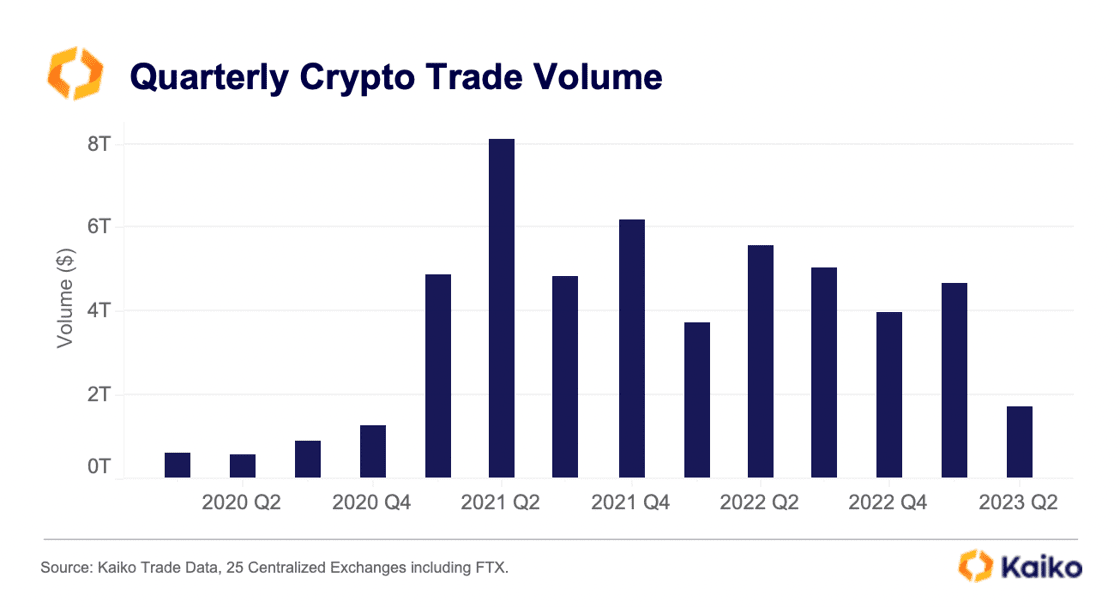
While price action suggests a bull run, the underlying market structure reveals a different story. Liquidity—the lifeblood of any financial market—has been systematically drained from the ecosystem. According to data from Kaiko, trading volumes on centralized exchanges have plummeted to their lowest levels since 2020.
This lack of liquidity is a double-edged sword. In a "thin" market, order books are shallow, meaning that even moderate buy pressure can lead to disproportionate price spikes. Conversely, it makes the market highly susceptible to flash crashes. The exodus of capital is further evidenced by the decline in stablecoin balances on exchanges, which have dropped by 60%—an outflow of approximately $26 billion—over the last six months.
Furthermore, the macroeconomic outlook remains restrictive. Despite the recent "pause" by the Federal Reserve, the interest rate environment remains the most aggressive in modern history. Fed futures data indicates an 86% probability of a 25-basis-point hike in the coming weeks. The market, strangely, has chosen to ignore this reality, rallying even as the probability of a "no-hike" scenario has actually decreased compared to a month ago.
Official Responses and Regulatory Tensions
The regulatory landscape has become the defining variable for crypto valuation. The lawsuits against Binance and Coinbase are not merely legal hurdles; they represent a fundamental challenge to the industry’s operating model.
The Coinbase situation is particularly paradoxical. As the SEC’s case unfolds, critics point to the fact that the same regulator allowed Coinbase to undergo an Initial Public Offering (IPO) in 2021. If the platform was functioning as an unregistered securities exchange, why was it given the green light to trade on the Nasdaq? This perceived inconsistency has fueled industry arguments that the SEC is engaging in "regulation by enforcement" rather than providing clear legislative guidelines.
Regarding the Bitcoin spot ETFs, the industry’s response has been one of persistent persistence. Issuers like CBOE and Nasdaq are not backing down; they are actively working to address the SEC’s requirements for surveillance-sharing agreements. This institutional determination suggests that while the "easy money" phase of crypto may be over, the "durable asset" phase is still in its infancy.
Implications: The Long Road Ahead
The central question facing investors is whether the current price appreciation is a genuine trend reversal or a "bull trap" fueled by institutional hopium.
1. The Institutional Dilemma
If BlackRock and Fidelity succeed in launching a spot ETF, it will undoubtedly provide a massive conduit for traditional capital to enter the space. However, approval is not guaranteed. The SEC’s rejection of Fidelity’s previous application in 2022 serves as a reminder that the agency remains deeply cautious regarding market manipulation concerns.
2. The Macroeconomic Lag
Monetary policy operates with a significant time lag. We have yet to see the full impact of moving interest rates from zero to over 5%. As these rates filter through the economy, they typically suppress risk-on assets. A 20% rally in the face of persistent inflation and hawkish central bank rhetoric is historically anomalous for the asset class.
3. The Structural Shift
The decline in liquidity suggests that the "retail mania" of 2020–2021 has largely evaporated. The market is transitioning toward a more institutional structure, but this transition is currently "thin." Investors should expect increased volatility until exchange volumes recover and stablecoin liquidity stabilizes.
Conclusion: Caution Amidst the Noise
The current market environment is a classic example of "crypto going to crypto." Price discovery is occurring in a vacuum where sentiment is detached from macroeconomic fundamentals. While the potential for a spot ETF is a legitimate long-term bullish signal, the immediate price action ignores the reality of the regulatory, liquidity, and interest-rate pressures currently weighing on the broader financial system.
For the prudent investor, the current rally serves as a reminder of the asset class’s notorious volatility. The sentiment has flipped, but the environment has not fundamentally changed. With the Fed likely to hike rates again and the SEC’s legal cases against major industry players still in their early stages, the "greed" currently dominating the Fear and Greed Index may be premature.
The path to maturity for Bitcoin and its peers is not a straight line. It is a rugged terrain where institutional adoption battles against rigid regulatory frameworks. As we move into the second half of the year, the primary indicator to watch will not be the price of Bitcoin, but the depth of liquidity and the resolution of the SEC’s current legal challenges. Until those two pillars of the market find stability, the current rally should be treated with a high degree of skepticism.
