

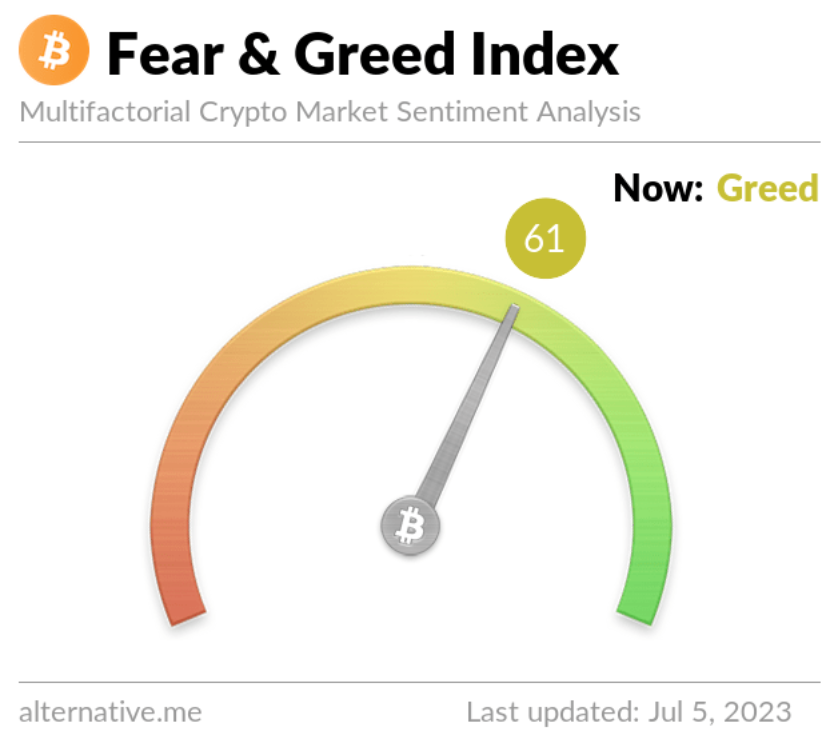
In the volatile theater of cryptocurrency, sentiment often operates in a vacuum, detached from the sobering realities of liquidity, macroeconomic policy, and regulatory friction. Over the past three weeks, the digital asset market has staged a formidable recovery, with Bitcoin climbing 20% to breach the $30,000 threshold and Ether following suit with a 16% gain. While proponents point to a newfound sense of "greed"—as evidenced by a Fear and Greed Index score of 61—a deeper forensic analysis suggests that this price action may be built on a foundation of shifting sand.
Main Facts: The Catalyst of Institutional Hope
The primary driver behind the current market enthusiasm is the entry of institutional giants into the spot Bitcoin ETF arena. The filings by BlackRock and Fidelity—the world’s most formidable asset managers—have been interpreted by the market as a definitive signal that crypto is nearing mainstream institutional acceptance.
Adding fuel to this fire is the launch of EDX Markets, a non-custodial exchange backed by a coalition of traditional finance titans, including Charles Schwab, Citadel Securities, and Fidelity. By offering institutional-grade access to Bitcoin, Ether, Litecoin, and Bitcoin Cash, EDX represents the type of infrastructure that regulators have historically demanded. However, the market’s reaction to these developments has been remarkably one-sided, largely ignoring the persistent regulatory hurdles and the alarming contraction in market liquidity.
Chronology: A Month of Regulatory Whiplash
To understand the current market behavior, one must view it against the backdrop of a chaotic June:
- Early June: The SEC launches twin lawsuits against Binance and Coinbase, the world’s two largest crypto exchanges. While the Binance suit focuses on alleged operational malfeasance and user circumvention, the Coinbase case strikes at the heart of the industry by challenging the classification of various tokens as unregistered securities.
- Mid-June: Despite the regulatory cloud, institutional interest manifests as a flurry of spot Bitcoin ETF applications. The narrative shifts from "regulatory crackdown" to "institutional adoption."
- Late June: The SEC signals skepticism regarding the initial batch of ETF applications, labeling them "inadequate" due to a lack of detail regarding "surveillance-sharing agreements." While issuers like CBOE and Nasdaq have scrambled to refile, the rejection serves as a stark reminder that the SEC’s approval process is not a formality.
- Present Day: Bitcoin and altcoins maintain elevated price levels, even as the Federal Reserve indicates that the era of interest rate hikes is likely not yet over.
Supporting Data: The Liquidity Crisis
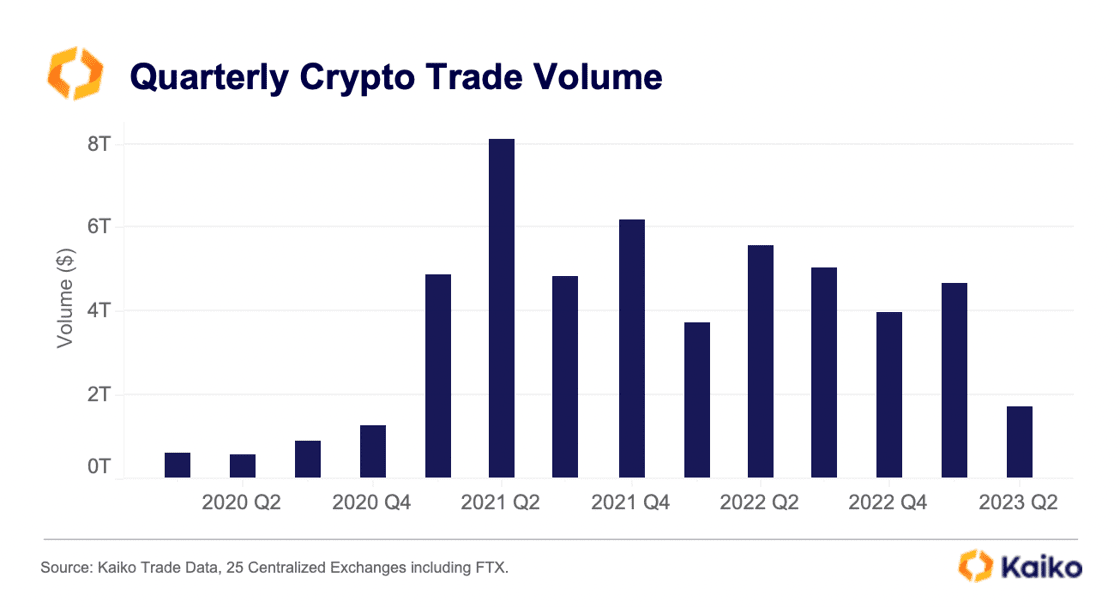
While price action suggests a return to health, the "plumbing" of the crypto market tells a different story. According to data from Kaiko, trading volumes on centralized exchanges have plummeted to levels not seen since 2020. This collapse in liquidity is a significant concern for market participants.
When liquidity is thin, price discovery becomes erratic, and both upward and downward moves are amplified. This explains why Bitcoin could experience such a sharp rally on the back of news that is, at best, speculative. Furthermore, the exodus of stablecoins from exchanges—a staggering 60% decline, or roughly $26 billion in outflows over the last six months—indicates that the "dry powder" typically used to fuel massive bull runs is currently missing from the ecosystem.
While the spot market struggles, the derivatives market has shown a degree of resilience, with volume significantly higher than in the latter half of 2022. This divergence suggests that professional traders are still hedging their bets, even as retail sentiment turns irrationally exuberant.
Official Responses and Regulatory Contradictions
The SEC’s role in this saga remains paradoxical. The lawsuit against Coinbase is particularly jarring given that the regulator presided over the company’s IPO in 2021. Market observers are left to wonder: How can an exchange be sanctioned for trading unregistered securities if the very regulator overseeing its public listing allowed those assets to be traded on its platform for years?
Simultaneously, the SEC’s insistence on "surveillance-sharing agreements" for ETFs highlights the fundamental friction between decentralized assets and centralized oversight. The regulator is demanding a level of market transparency that crypto, by design, often obfuscates. Until issuers can prove that they can monitor for fraud and market manipulation in a way that satisfies the SEC’s stringent requirements, the probability of approval remains a binary, high-risk event.
Macroeconomic Headwinds: The Fed’s Persistent Shadow
The crypto market’s recent rally has largely ignored the macroeconomic reality. Despite the Federal Reserve’s "pause" in June, the messaging from Chair Jerome Powell has been clear: the pause is a tactical delay, not a pivot.
Market expectations, derived from Federal Reserve futures, currently place an 86% probability on a 25-basis-point rate hike in the next meeting. This is a higher probability of tightening than was priced in a month ago, yet crypto prices have soared. This disconnect is dangerous. We are currently living through one of the most aggressive monetary tightening cycles in modern history, with interest rates moving from 0% to over 5% in a record timeframe. Because monetary policy operates with a significant time lag, the full economic impact of these hikes has likely yet to be felt by the broader economy.
Implications: A Future of Managed Volatility
What does this mean for the average investor? The current "greed" in the market is an anomaly that rests on the assumption of inevitable regulatory victory. However, history suggests that the road to a spot Bitcoin ETF is paved with bureaucratic resistance.
1. The Liquidity Trap
If liquidity continues to dry up, we should expect heightened volatility. Even positive news could lead to "flash" rallies that are quickly retraced, as there isn’t enough sustained capital to support a new price floor.
2. The Regulatory Bifurcation
The industry is likely heading toward a bifurcated future. Bitcoin, increasingly viewed as a commodity, may find a clearer path to institutional adoption. Conversely, the vast majority of altcoins, now explicitly labeled as securities by the SEC, face an existential crisis. The market’s decision to ignore this distinction and rally all tokens in tandem suggests a misunderstanding of the long-term legal risks.
3. The Macro-Lag
Investors must prepare for the possibility that the "soft landing" narrative will be disrupted by the lagged effects of high interest rates. If a recession hits, the liquidity-starved crypto market will likely be one of the first assets sold, regardless of how many ETF filings are pending.
Conclusion: Proceeding with Caution
"Crypto is going to crypto," as the saying goes—a testament to the sector’s tendency to defy logic and fundamentals. Yet, as we navigate the second half of 2023, the gap between sentiment and structural reality has never been wider.
The current rally is a testament to the power of institutional storytelling, but it is not a substitute for market health. When liquidity is low, interest rates are high, and regulatory pressure is at an all-time peak, "greed" is a dangerous indicator. Investors would be wise to recognize that while the destination—a fully integrated, regulated crypto market—may be inevitable, the path to get there will be marked by extreme, and perhaps unnecessary, turbulence. Before buying into the current euphoria, one must ask: is this a genuine turning point, or merely a temporary suspension of disbelief?
