

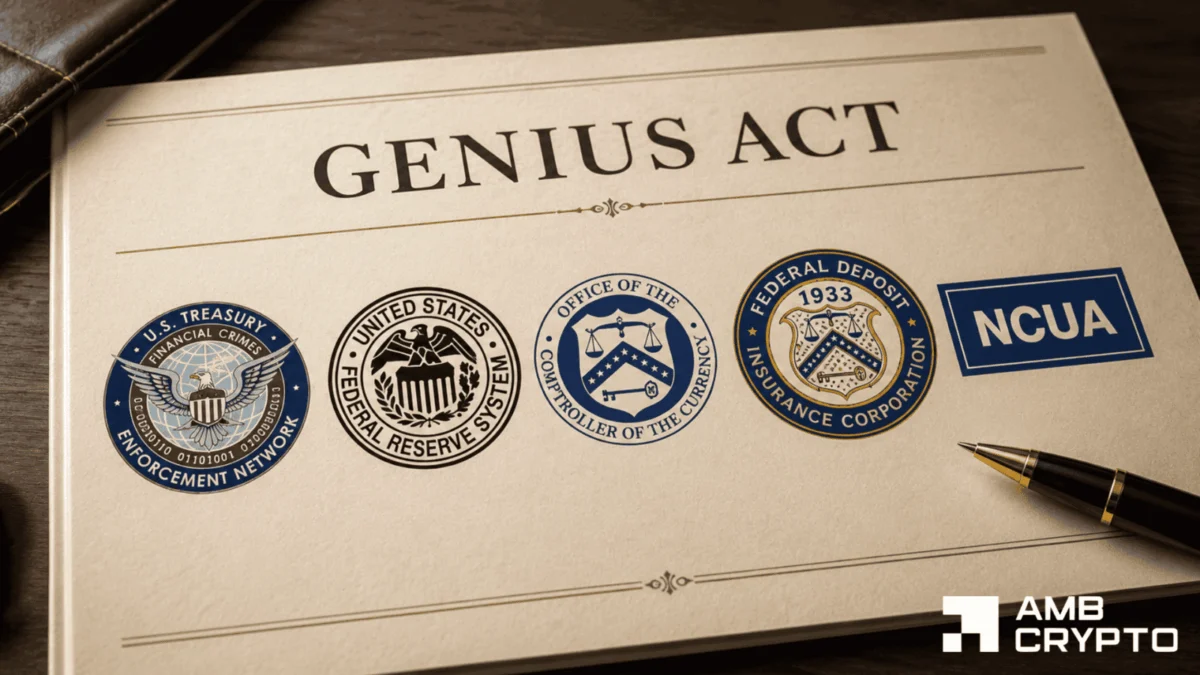
In a move aimed at bridging the gap between traditional banking safeguards and the burgeoning digital asset economy, a coalition of top U.S. financial regulators has unveiled a landmark proposal to tighten customer identification requirements for stablecoin issuers. The joint announcement, released by the Financial Crimes Enforcement Network (FinCEN), the Federal Reserve, the Office of the Comptroller of the Currency (OCC), the Federal Deposit Insurance Corporation (FDIC), and the National Credit Union Administration (NCUA), marks a pivotal step in the implementation of the GENIUS Act.
While the new rules will impose rigorous "Know Your Customer" (KYC) obligations on those who mint and redeem stablecoins directly, the agencies have strategically stopped short of extending these mandates to secondary-market transactions. By drawing a clear line between primary issuers and the broader blockchain ecosystem, regulators are attempting to balance national security interests with the operational viability of decentralized finance.
The Regulatory Framework: Bringing Stablecoins into the Bank Secrecy Act Fold
At the heart of the new proposal is the reclassification of "Permitted Payment Stablecoin Issuers" (PPSIs) as financial institutions under the Bank Secrecy Act (BSA) framework. Historically, stablecoin issuers have occupied a nebulous space in the regulatory landscape, often falling between money transmitter regulations and more stringent banking statutes.
Under the proposed rules, any entity designated as a PPSI will be required to establish formal Customer Identification Programs (CIPs). These programs are designed to mirror the existing compliance structures already embedded within commercial banks and credit unions. Specifically, issuers will be legally mandated to collect and verify a baseline of information for any customer seeking to open an account or engage in a direct minting or redemption process.
Required information will include:
- Legal Name: For individuals, the full name; for entities, the registered formation name.
- Physical Address: Residential or business addresses that allow for geographical verification.
- Identity Markers: Dates of birth or, in the case of corporate entities, dates of formation.
- Identification Numbers: Taxpayer identification numbers (TINs), passport numbers, or other government-issued credentials.
The agencies argue that these measures are essential to ensuring a "reasonable belief" that an issuer knows the true identity of its direct participants. By standardizing this data collection, regulators aim to bolster the effectiveness of Anti-Money Laundering (AML) and Counter-Terrorist Financing (CTF) efforts, which have become a focal point of legislative concern regarding digital assets.
Chronology of Regulatory Evolution
The path to this proposal has been paved by years of debate regarding the systemic risks posed by stablecoins. The timeline of this regulatory journey underscores the complexity of overseeing a technology that functions simultaneously as a payment rail and a financial asset.
- Early 2020s: As the stablecoin market cap surged into the hundreds of billions, federal agencies began issuing warnings regarding the lack of transparency in reserves and the potential for illicit actors to utilize stablecoins as a vehicle for capital flight and money laundering.
- The GENIUS Act Legislative Process: Congress, recognizing the need for a unified federal standard, moved to pass the GENIUS Act. This legislation provided the foundational legal authority for the current proposal, empowering federal agencies to define the parameters of stablecoin oversight.
- Inter-Agency Coordination (2023–2024): Recognizing that no single agency held authority over the entire ecosystem, the Fed, OCC, FDIC, and NCUA engaged in a multi-year collaborative drafting process. This period involved significant back-channel discussions with industry stakeholders regarding the technical feasibility of identity verification on a blockchain.
- The Current Proposal (Q4 2024): The formal publication of the CIP requirements marks the transition from legislative intent to actionable administrative law, opening the floor for public comment before finalization.
Distinguishing the Secondary Market: A Strategic Exemption
Perhaps the most significant aspect of this proposal—and the one likely to draw the most relief from crypto-native organizations—is the explicit exclusion of secondary-market transactions from the CIP requirement.
Regulators have acknowledged that the nature of blockchain technology makes universal identity tracking at the protocol level inherently difficult, if not impossible. By limiting the scope of the rule to direct relationships between an issuer and their customers, the agencies have avoided a "burden of proof" crisis for decentralized exchanges, wallet providers, and individual traders.
Why Secondary Markets Remained Exempt
The regulatory rationale behind this exemption rests on two pillars: practicality and preservation.
- Operational Viability: Regulators conceded that treating every participant in a blockchain network as a "customer" of the issuer would be logistically impossible. Because stablecoins are designed to be fungible assets that move across decentralized protocols, an issuer has no mechanism to identify the holder of a token that has passed through ten different wallets on a public ledger.
- Maintaining Liquidity: The agencies noted that imposing bank-style KYC on every wallet-to-wallet transfer would effectively kill the utility of stablecoins. If every peer-to-peer transaction required a centralized identity check, stablecoins would lose their primary advantage over traditional wire transfers: speed and accessibility.
Instead, the proposal adopts a "chokepoint" strategy. By forcing the entry and exit points (the issuers) to maintain robust KYC, regulators believe they can successfully monitor the lifecycle of these assets without suffocating the underlying technology.
Supporting Data and the Compliance Landscape
The urgency of these requirements is supported by a growing body of data regarding stablecoin usage. Recent industry reports suggest that while stablecoins remain a primary tool for facilitating trade on global crypto exchanges, they are increasingly being explored for cross-border remittances and institutional settlement.
According to data from the Federal Reserve, the volume of stablecoins in circulation reached a peak of nearly $160 billion in late 2024. With this level of liquidity comes increased scrutiny. The compliance cost of the proposed CIPs is expected to be significant for smaller issuers, who will need to invest in automated identity verification (IDV) software. Larger, established issuers, however, already employ sophisticated compliance departments, meaning this regulation serves more as a formalization of their current internal practices rather than a radical change in business model.
Official Responses and Industry Reception
The response from the industry has been one of cautious optimism. While trade groups have historically pushed back against "over-regulation," the clarity provided by this proposal is seen as a necessary step toward legitimacy.
A spokesperson for a major industry lobbying group noted: "By distinguishing between issuers and secondary market participants, regulators have demonstrated a sophisticated understanding of how blockchain networks actually function. This is a pragmatic middle ground that allows the industry to mature without imposing an impossible technological mandate."
However, privacy advocates have voiced concerns. They argue that even limited identity collection creates "honeypots" of data that could be targeted by hackers. Furthermore, some critics fear that this is merely the first step toward a broader push to eliminate anonymity in digital assets entirely.
Implications for the Future of Digital Finance
The implications of this GENIUS Act implementation are far-reaching. By codifying stablecoin issuers as financial institutions, the U.S. government is effectively signaling that stablecoins are no longer an "experimental" asset class, but a core component of the national financial infrastructure.
1. Market Consolidation
The costs associated with maintaining rigorous CIPs will likely lead to further market consolidation. Smaller, less-capitalized stablecoin projects may find the compliance burden unsustainable, potentially leaving the market to a few dominant, highly regulated players.
2. Increased Institutional Adoption
Institutional investors have long cited a lack of regulatory clarity as a barrier to entry. With a clear federal framework for identity verification, large banks and asset managers may feel more comfortable integrating stablecoins into their settlement systems.
3. A Template for Global Standards
As the U.S. sets these rules, it is likely to influence international bodies like the Financial Action Task Force (FATF). Other nations looking to build stablecoin regulations will likely look to the U.S. model of focusing on the "on-ramp" and "off-ramp" issuers rather than the blockchain protocols themselves.
Conclusion
The joint proposal from U.S. financial regulators represents a watershed moment for the digital asset industry. By applying the principles of the Bank Secrecy Act to stablecoin issuers while shielding the broader secondary market from onerous requirements, the government is attempting to foster innovation while mitigating systemic risk. As the comment period begins, the focus will shift to how these rules will be operationalized and whether they will succeed in creating a safer, more transparent environment for the future of money.
