


Main Facts
U.S. spot Bitcoin exchange-traded funds (ETFs) concluded a volatile and choppy trading week in positive territory, albeit by the slimmest of margins. According to market data trackers, U.S. spot Bitcoin ETFs experienced a notable $137.9 million net outflow on Friday, marking the second consecutive day of capital flight from the asset class.
This late-week correction erased a portion of the strong momentum established earlier in the week. However, when the closing bell rang on Friday afternoon, the cumulative tally for the week still registered a net gain of roughly $301 million. This modest victory successfully snapped a two-week losing streak for the premier cryptocurrency investment vehicles, even as broader market headwinds dampened investor enthusiasm heading into the weekend.
Despite the weekly recovery, the broader macroeconomic picture for digital assets remains complex. October—historically regarded as one of the most statistically bullish months for Bitcoin holders, often colloquially termed "Uptober"—is currently tracking in the red.
The week’s late-stage liquidations pushed cumulative monthly figures downward, leaving spot Bitcoin ETFs down by approximately $314 million for October. This downturn stands in stark contrast to the historic performance of these funds since their landmark SEC approvals. Cumulative net inflows across all approved U.S. spot Bitcoin ETFs now stand at an impressive $57.6 billion, backed by a staggering $100.2 billion in total net assets under management.
+-------------------------------------------------------------------------
|                   WEEKLY & MONTHLY CRYPTO ETF METRICS
+-------------------------------------------------------------------------
| Metric                              | Bitcoin ETFs   | Ethereum ETFs   |
+-------------------------------------------------------------------------
| Friday Net Flows                    | -$137.9M       | +$4.4M          |
| Weekly Net Flows                    | +$301.0M       | -$221.0M        |
| Monthly (October) Flows             | -$314.0M       | -$1.18B         |
| Cumulative Net Inflows              | $57.6B         | $12.7B          |
| Total Net Assets                    | $100.2B        | N/A             |
+-------------------------------------------------------------------------
Chronology: A Week of Highs, Lows, and Last-Minute Reversals
The trajectory of the cryptocurrency market over the past seven days was nothing short of a rollercoaster, shifting rapidly from institutional optimism to cautious risk-off behavior.
Monday through Wednesday: The Inflow Surge
The trading week opened on a profoundly bullish note, heavily supported by macro-level tailwinds and institutional forecasts. Sentiment was initially lifted when J.P. Morgan Asset Management released an influential long-term market projection forecasting annualized returns of roughly 10% for Bitcoin over the coming decade.
Capitalizing on this positive sentiment, institutional investors poured money into regulated products. From Monday through Wednesday, U.S. spot Bitcoin ETFs orchestrated a massive $1.07 billion inflow run. This mid-week surge briefly flipped October’s cumulative performance metrics back into positive territory, raising hopes among retail and institutional traders alike that the seasonal autumn rally had finally arrived.

Thursday: The Record-Breaking Correction
The market narrative shifted abruptly on Thursday. Triggered by a broader macroeconomic sell-off that rattled global equities, commodities, and risk assets, institutional sentiment cooled rapidly.
U.S. spot Bitcoin ETFs recorded a staggering $635.6 million exit on Thursday alone. This massive single-day capital outflow stands as the largest recorded liquidation event for the asset class during the month of October. The severity of the sell-off completely erased the gains of the early-week surge, plunging the month’s net flow performance back into negative territory.
Friday: The Weekend Slide and Final Tally
The downward pressure extended into the final trading session of the week. Friday saw an additional $137.9 million exit the market, marking the second consecutive day of negative flows. Over this two-day slide, a combined $773.5 million was pulled from the funds, severely eating into the prior $1.07 billion influx.
Nevertheless, because the early-week accumulation was large enough to absorb the subsequent shock, the funds managed to close the five-day trading period up by $301 million overall, breaking a frustrating two-week period of consecutive losses.
Supporting Data: Altcoin Performance and Broader Market Impacts
While Bitcoin dominated institutional headlines, the broader digital asset ETF landscape experienced its own distinct pressures, reflecting a wider risk-off sentiment spreading across global financial markets.
Ethereum and Solana ETFs
- Ethereum ETFs: Ethereum-based spot exchange-traded funds eked out a microscopic $4.4 million net inflow on Friday. However, this nominal green print did little to salvage a brutal week. ETH-focused funds hemorrhaged approximately $221 million over the course of the week, pushing their total monthly losses for October to a dismal $1.18 billion. Since their respective launch in July 2024, cumulative net inflows for Ethereum funds stand at $12.7 billion.
- Solana ETFs: Solana investment products experienced zero net flows on Friday, flatlining following an $8.9 million exit on Thursday. Solana funds are currently down roughly $68 million for the month of October.
Spot ETF Mechanics and Sentiment Indicators
Spot crypto ETFs allow traditional retail and institutional investors to gain direct exposure to the underlying assets—such as Bitcoin, Ethereum, or Solana—without holding private keys or utilizing specialized crypto exchanges. Trading like ordinary shares on standard brokerages, their daily flow metrics have evolved into a primary economic barometer for institutional risk appetite.
Price Action and Global Macro Pressures
As institutional capital flowed out toward the end of the week, spot prices followed suit. By Saturday, Bitcoin had retreated 1.1% over a 24-hour window to hover around $80,490, marking a 1.2% weekly decline according to CoinGecko data.
Altcoins suffered deeper corrections. Ethereum dropped 2.6% to trade at approximately $2,344, while Solana fell 2.8% to land near $101. Consequently, the total global cryptocurrency market capitalization contracted by 1.2% down to $2.79 trillion.
Market analysts noted that this crypto-specific weakness did not occur in a vacuum. It closely mirrored a broader midweek sell-off in global macroeconomic markets. Trigger factors included a surge in crude oil prices—which breached $111 a barrel amid geopolitical anxieties—and a simultaneous downward correction in high-flying Artificial Intelligence (AI) stocks, prompting institutional allocators to trim risk across all asset classes.
Official Responses and Market Sentiment Analysis
As price action stagnates, market participants are increasingly looking toward derivative platforms and decentralized prediction markets to gauge future trends.
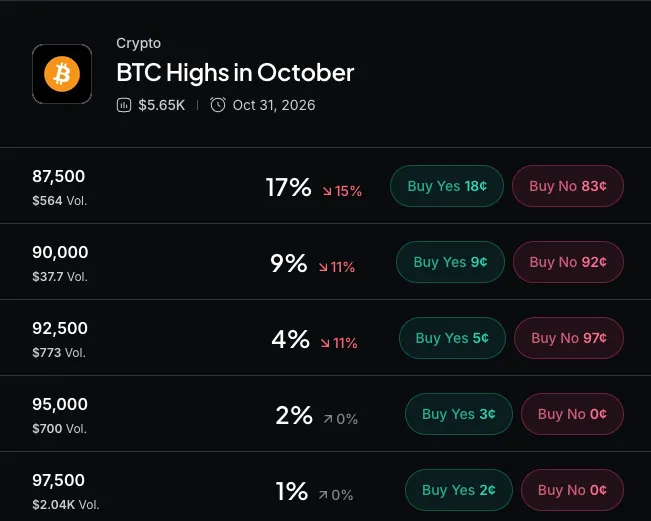
Traders utilizing Myriad, a prediction market developed by Decrypt’s parent company Dastan, have visibly shifted their sentiment to a more cautious, bearish outlook regarding Bitcoin’s final monthly close for October.
- Bearish Revisions: Market participants now assign a 43% probability to Bitcoin dropping to $77,500 before the end of the month, a sharp upward revision from the 32% probability recorded just 24 hours prior. Furthermore, traders now price an 18% chance that Bitcoin could slide as low as $75,000.
- Bullish Expectations Trimmed: Conversely, the probability of Bitcoin rallying to break past the $87,500 threshold before month’s end has plummeted from 17% down to 10%.
- Altcoin Outlooks: Solana bulls are currently holding a very narrow majority over bears, with prediction markets pricing a 51.6% probability that SOL will reclaim $160 before plummeting to $40 (down from 54.9%). Meanwhile, sentiment for Ethereum remains slightly more optimistic; market odds favoring an ETH recovery toward $3,000 over a drop to $1,500 held steady at 61.3%.
Despite these shifting short-term bets, institutional analysts point out that the market has fundamentally entered a consolidation phase. Following the long-term bullish projections issued by financial institutions like J.P. Morgan Asset Management, many desk traders have characterized the current price action as a classic "wait-and-see" environment. Rather than signaling a major trend reversal, market makers view the current consolidation as a healthy stabilization period following months of rapid institutional adoption.
Implications for Investors and the Digital Asset Economy
The events of this past week underscore the growing interdependence between traditional macroeconomic indicators and the digital asset ecosystem. As spot ETFs continue to mature, bringing billions of dollars in institutional wealth under management, the asset class is increasingly susceptible to traditional financial shocks.
- Macro-Sensitivity: The sharp $635 million outflow on Thursday demonstrates that institutional allocators managing spot ETFs treat crypto not as an isolated hedge, but as a high-beta risk asset. When oil spikes and equity sectors correct, crypto-allocated funds face immediate liquidity trimming to rebalance institutional portfolios.
- Maturation of Institutional Products: Despite short-term outflows, the fact that Bitcoin ETFs absorbed massive institutional capital earlier in the week and closed the period with a net gain proves that structural demand remains fundamentally intact. With over $100 billion in total net assets, these vehicles have fundamentally transformed how capital enters the digital economy.
- The "Wait-and-See" Phase: As October closes out its final days in the red, market participants are watching closely to see whether macroeconomic pressures will ease. If global supply chain anxieties and energy price spikes subside, the structural baseline laid by spot ETFs could provide the foundation for a robust fourth-quarter recovery.
Disclaimer: The views, information, and opinions expressed in this article are for informational and educational purposes only and do not constitute financial, investment, legal, or trading advice.
