


The cryptocurrency market is currently navigating a precarious "perfect storm" of geopolitical instability and underlying liquidity erosion. Following the breakdown of U.S.-Iran ceasefire negotiations on July 8, the digital asset market experienced a sharp reversal. Bitcoin, which had briefly flirted with the $64,000 resistance zone, plummeted back toward the $62,000 threshold. This volatility triggered a cascade of liquidations, with $300 million in long positions wiped out in a matter of hours, signaling that the market’s structural integrity is significantly weaker than many bulls had anticipated.
As market participants struggle to find their footing, analysts are increasingly pointing toward a deeper, more systemic issue: the evaporation of "dry powder" on centralized exchanges. With stablecoin reserves dwindling and capital flight from exchanges accelerating, the crypto ecosystem appears increasingly vulnerable to further downward pressure.
1. The Chronology of a Market Reversal
The recent market volatility did not occur in a vacuum; it was the direct result of a rapid shift in the global geopolitical climate.
- Mid-June: The market began showing signs of exhaustion. Bitcoin struggled to maintain momentum, and the first major warning signs regarding stablecoin liquidity surfaced as large-scale outflows were recorded on major exchanges like Binance.
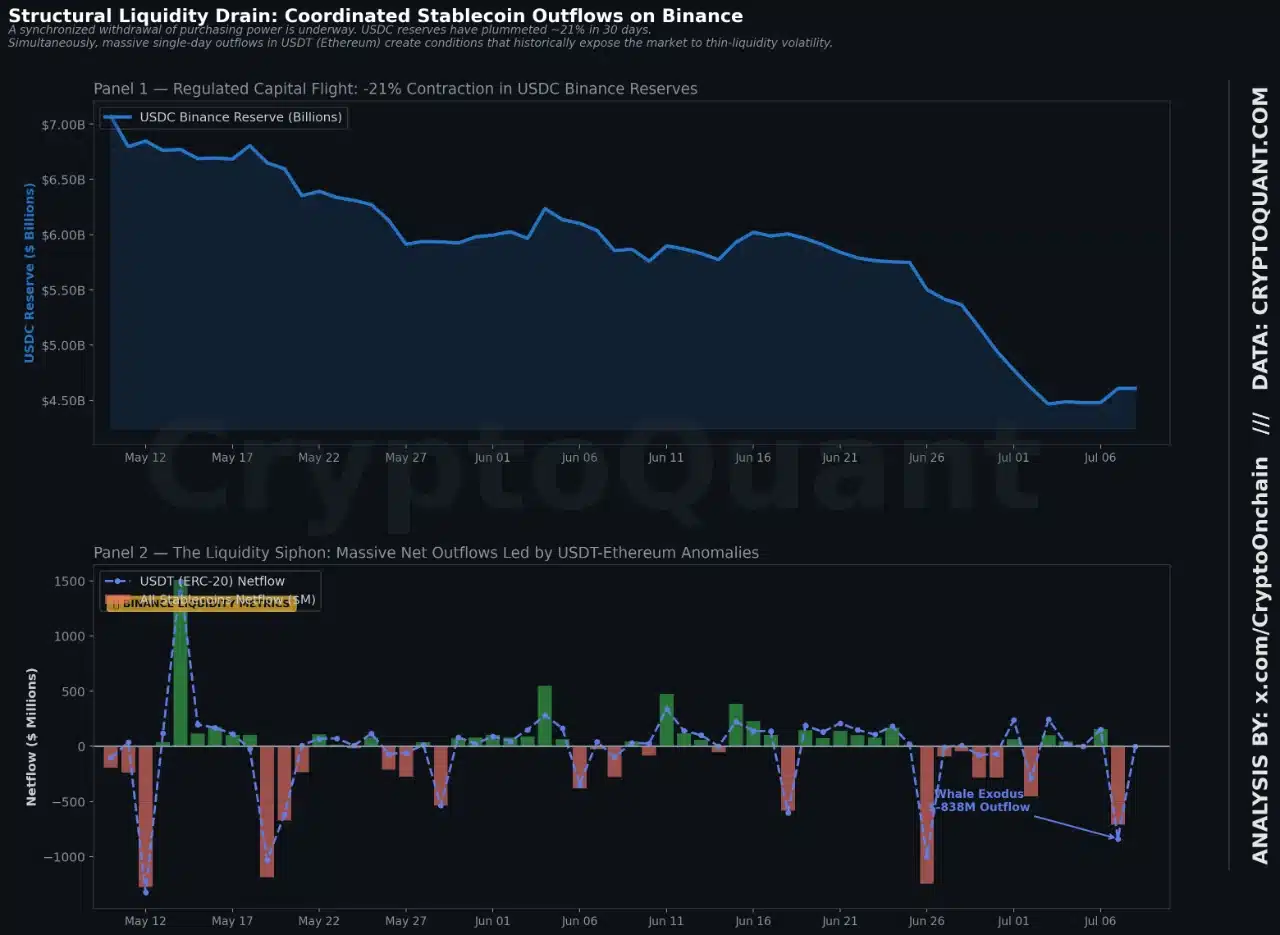
- June 26: A massive, anomalous outflow of $997 million in stablecoins was detected on Binance, marking the beginning of a sustained trend of liquidity extraction.
- Early July: As hopes for a lasting U.S.-Iran ceasefire began to dim, market sentiment grew increasingly bearish.
- July 7: A second massive wave of outflows, totaling $838 million, further drained exchange reserves.
- July 8: The formal collapse of the ceasefire negotiations acted as the catalyst for a sharp market correction. Prices retreated from the $64,000 resistance level to $62,000, triggering a brutal liquidation event for over-leveraged traders.
This timeline illustrates a market that was already structurally brittle due to capital flight before the geopolitical shock delivered the final blow.
2. The Mechanics of Liquidity: Why "Dry Powder" Matters
In the world of cryptocurrency, stablecoins like Tether (USDT) and USD Coin (USDC) serve as the primary fuel for market activity. They act as the "dry powder" that traders use to enter positions, catch cyclical bottoms, or hedge against volatility. When reserves are high, there is a visible buffer that allows the market to absorb sell-side pressure.
However, current on-chain data paints a concerning picture. According to crypto analyst Crypto Onchain, Binance—the world’s largest exchange by volume—has seen its USDC reserves plummet by 21% over the past month. The trend is not merely a reallocation; it is a systematic exit. Over the past week, stablecoin outflows from Binance have averaged a staggering $115 million per day.
This migration of capital suggests that investors are not merely rotating their assets into different cryptocurrencies. Instead, they are moving funds into DeFi protocols, cold storage, or OTC (Over-the-Counter) desks, effectively removing liquidity from the open market. When liquidity leaves the exchange ecosystem, it leaves the remaining market participants highly susceptible to "localized volatility." Even modest sell orders can now move the price of Bitcoin significantly because the order books lack the depth provided by healthy stablecoin reserves.

3. Supporting Data: The Shrinking Dollar Base
The liquidity crisis is not confined to a single exchange; it is a macro-trend impacting the entire industry. Crypto analyst Axel Adler Jr. has highlighted a significant divergence in exchange inflow metrics.
The monthly average of stablecoin inflows to exchanges has declined by 18%, falling from $3.20 billion to $2.65 billion. This reduction in incoming capital is a primary reason for the 21% decline in Bitcoin’s value since mid-May.
The Market Cap Contraction
Perhaps the most alarming metric is the combined market capitalization of USDT and USDC. Historically, growth in the market cap of these stablecoins has been a leading indicator for Bitcoin bull runs. Recently, however, that trend has reversed:
- Mid-May: The 30-day change in total stablecoin market cap was neutral.
- Early June: The metric shifted to a deficit of $4.2 billion.
- Current Status: The market is still witnessing a contraction, with a recent deficit of $3.2 billion.
This indicates that capital is not just sitting on the sidelines—it is leaving the crypto ecosystem entirely. The "fuel shortage" mentioned by analysts refers to this decreasing dollar base. Without new capital entering the system, the market lacks the necessary thrust to break through major resistance zones, such as the $64,000 ceiling.
4. The Institutional and Macro Perspective
While retail investors are often blamed for the volatility caused by high leverage, the current situation is exacerbated by institutional hesitation. The breakdown of U.S.-Iran ceasefire talks has introduced a new layer of "risk-off" sentiment into global financial markets. Institutional investors, who have been tentative participants in the crypto space, are increasingly retreating to traditional safe-haven assets.
Market observers suggest that the current price action is a reflection of the "de-risking" process. When geopolitical tensions rise, institutional players prioritize liquidity and capital preservation over speculative growth. This macro environment provides a difficult backdrop for crypto to recover, as the fundamental drivers—interest rate expectations and geopolitical stability—remain uncertain.
Furthermore, the "liquidation trap" that caught $300 million in long positions is a classic symptom of a market that is trying to buy the dip without sufficient structural support. Traders betting on a bounce at $62,000 were likely caught off-guard by the lack of buying pressure, proving that technical levels hold little weight when the underlying liquidity is in freefall.
5. Implications: What to Expect Next
The road ahead for Bitcoin and the broader crypto market appears challenging. The combination of declining stablecoin reserves and geopolitical instability creates a "squeeze" effect.
Short-Term Vulnerability
In the near term, the lack of exchange liquidity means that the market is prone to "flash crashes." With fewer stablecoins available to absorb sudden sell-offs, the price of Bitcoin could face further tests of support levels below the $60,000 mark. If the current trend of outflow continues, the market may struggle to maintain its current price floor.
Structural Changes
For the market to regain its bullish momentum, two things must happen:
- Stablecoin Inflows Must Resume: There must be a reversal in the trend of stablecoin outflows. Investors need to see a reason to move their capital back onto exchanges, which usually requires a period of price stability or a positive macro catalyst.
- De-leveraging: The excessive use of leverage by retail traders must be purged. The $300 million liquidation event is a step in this direction, but a more "washed out" market—one with lower open interest—is often a healthier foundation for a long-term rally.
The Investor Strategy
Analysts are warning against "catching the falling knife" in the current environment. Without evidence of a recovery in stablecoin inflows or a cooling of geopolitical tensions, attempting to trade the current volatility carries significant risk. The "dry powder" metaphor remains the most accurate way to view the current market: right now, the ammunition is being moved to the rear, not the front lines.
Final Summary: A Cautionary Outlook
The collapse of the U.S.-Iran ceasefire has served as a wake-up call for the crypto market. While Bitcoin’s price fluctuations are often viewed through a technical lens, the current downturn is fundamentally a liquidity issue. The withdrawal of nearly $4 billion in stablecoin value from the ecosystem over the last two months has left the market hollowed out and fragile.
As long as stablecoin reserves remain in decline and capital continues to migrate to cold storage or off-exchange platforms, the potential for a sustained breakout remains low. Investors and traders alike are advised to monitor on-chain stablecoin inflows as a primary indicator of market health. Until the "fuel" returns to the exchanges, the market will likely remain trapped in a high-volatility, low-liquidity environment, making prudent risk management the highest priority for all market participants.
