

Main Facts
The decentralized finance (DeFi) ecosystem is undergoing a profound structural evolution, anchored by two dominant trends: the overwhelming centralization of stablecoin liquidity on leading decentralized exchanges (DEXs) and the rapid, cross-chain expansion of real-world assets (RWAs), specifically tokenized equities.
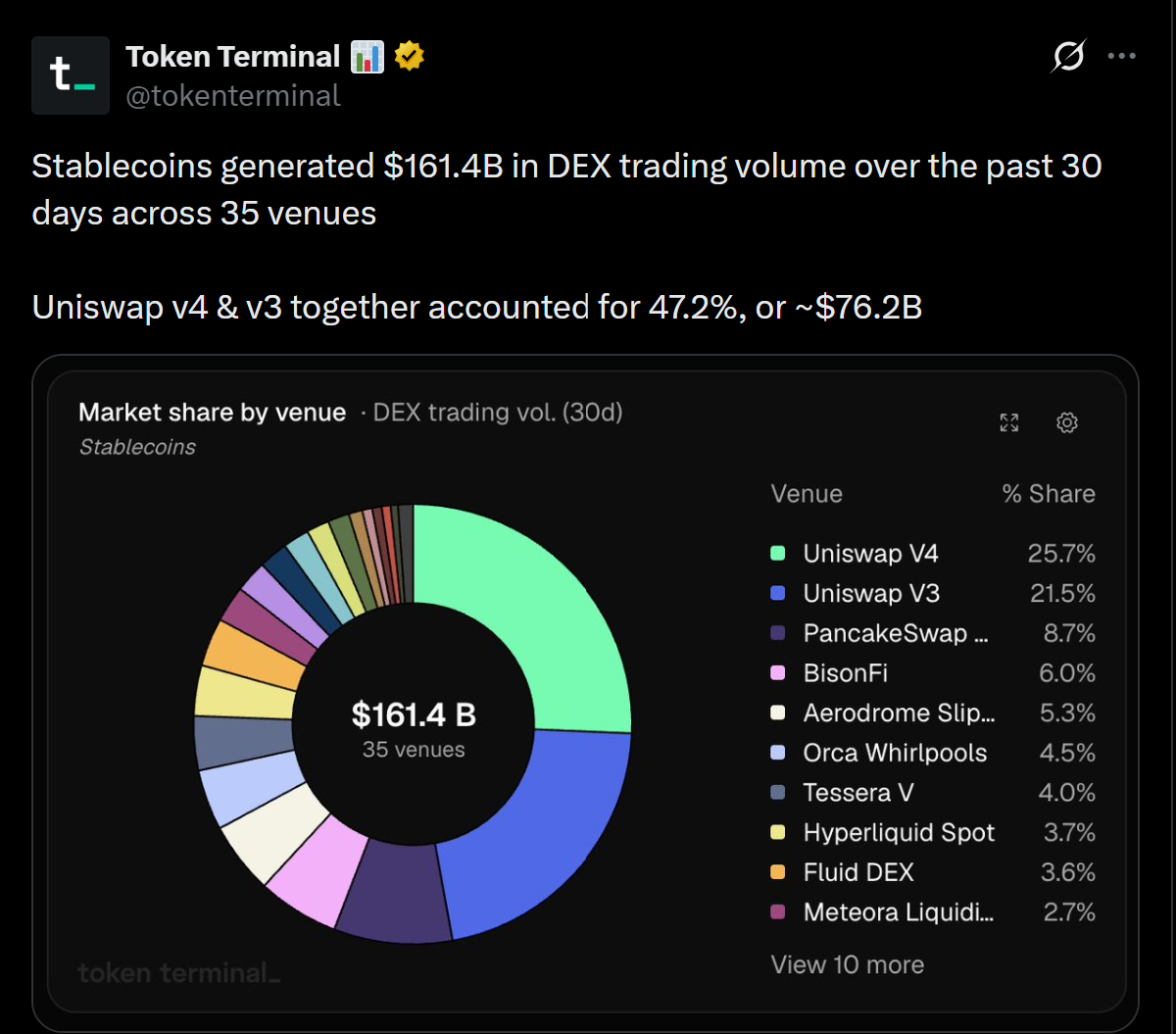
Recent on-chain data highlights Uniswap [UNI] as the primary beneficiary of a massive migration toward DEX-based dollar-pegged asset trading. Over a 30-day monitoring window, the broader market processed over $161 billion in stablecoin trading volume distributed across 35 distinct venues. Out of this total, Uniswap’s V3 and V4 iterations alone captured a staggering $76.2 billion. This figure accounts for 47.2% of the entire global stablecoin trading volume on-chain, firmly cementing Uniswap’s position as the premier liquidity hub for token swaps and dollar-denominated settlement.
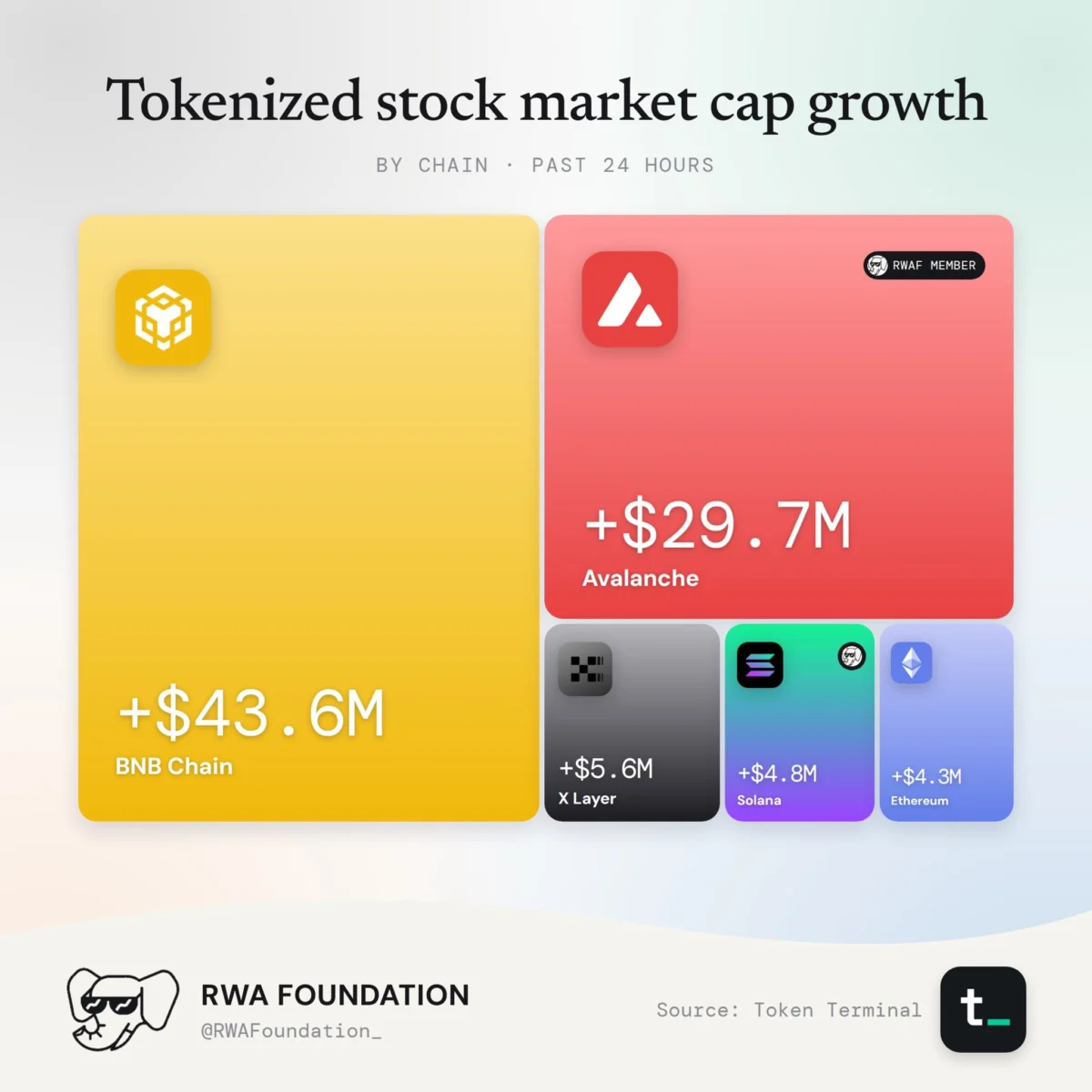
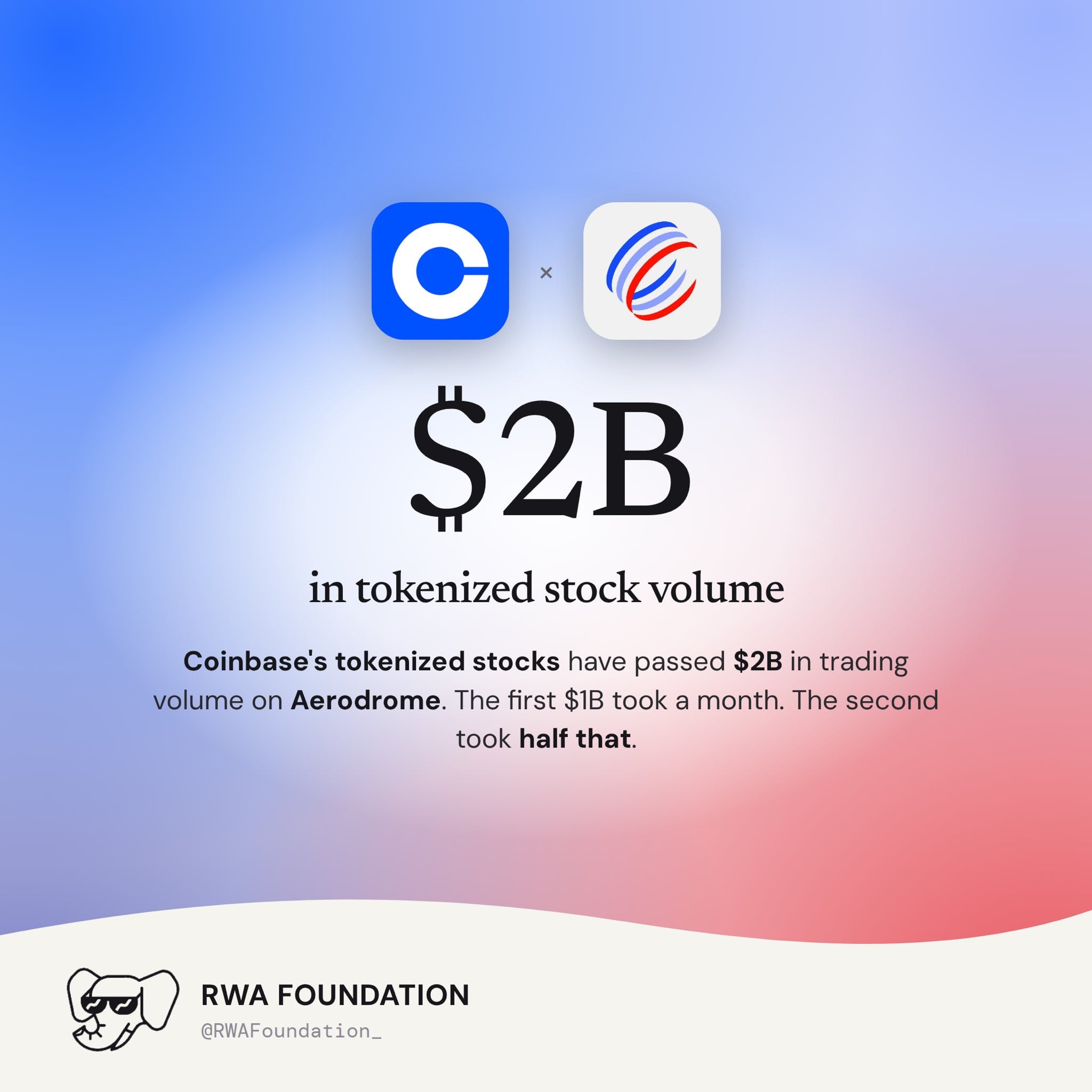
Concurrently, the tokenized equity sector is breaking unprecedented milestones. Coinbase-backed tokenized stocks have officially crossed the $2 billion cumulative trading volume milestone on Base’s leading DEX, Aerodrome. This surge is mirrored by shifting market capitalizations across competing layer-1 and layer-2 blockchains, with the BNB Chain and Avalanche [AVAX] outpacing traditional heavyweights like Ethereum [ETH] and Solana [SOL] in recent 24-hour capitalization gains for tokenized stocks.
Chronology of Market Developments
To understand how the DeFi landscape arrived at these milestones, it is crucial to examine the timeline of events that catalyzed this activity over recent months:
- Mid-2024 (The Base Ecosystem Expansion): Coinbase’s layer-2 network, Base, began experiencing a surge in developer activity and user acquisition, driven by low transaction fees and seamless onboarding from centralized exchange accounts.
- August 24: Aerodrome officially launched key trading pairs and liquidity pools on Base, immediately capturing market share and setting the stage for an exponential acceleration in derivative and real-world asset trading volumes.
- Late Q3 to Early Q4: A massive influx of liquidity moved away from legacy centralized rails into on-chain markets. Traders increasingly utilized automated market makers (AMMs) to rotate capital between dollar-pegged assets—predominantly USD Coin [USDC]—and speculative or yield-generating instruments.
- The Past 30 Days: Comprehensive market data compiled by Token Terminal revealed that stablecoin trading volume hit $161 billion across 35 venues, with Uniswap capturing nearly half of the market. During this same period, Aerodrome reached its historic trading velocity, achieving its second billion dollars in tokenized stock volume in half the time it took to secure its first billion.
- The Last 24 Hours: RWA.xyz metrics recorded a sharp divergence in tokenized equity market capitalization gains. BNB Chain surged ahead with a $43.6 million daily increase, closely followed by Avalanche’s $29.7 million gain, overshadowing incremental gains on rival networks like X Layer, Solana, and Ethereum.
Supporting Data and Metric Breakdown
A granular analysis of on-chain metrics reveals the true scale of institutional and retail participation driving these markets:

1. Uniswap’s Stablecoin Dominance
- Total Market Volume (30 Days): $161 billion across 35 trading venues.
- Uniswap V3 & V4 Volume: $76.2 billion.
- Market Share: 47.2% of total global stablecoin volume.
- Nearest Competitor: PancakeSwap [CAKE] holds the second-place position, commanding 8.7% of the market share, highlighting a massive performance gap between Uniswap and the rest of the DEX landscape.
- Asset Breakdown: USD Coin [USDC] single-handedly represented 52.1% of total asset volume, underscoring its critical role as the foundational liquidity layer for on-chain markets, overshadowing rival stablecoins during this period.
2. Aerodrome and Tokenized Equities on Base
- Total Cumulative Volume: Surpassed $2 billion.
- Velocity Metric: The second $1 billion in trading volume was achieved in precisely half the time it took to generate the first $1 billion, signaling an exponential compounding effect following the August 24 protocol developments.
- Venue Dominance: Aerodrome captured approximately $1.4 billion of the total $1.5 billion recorded across tokenized equity venues in a 30-day snapshot, illustrating its near-monopoly on Base-native RWA trading.
3. Layer-Specific Capitalization Gains (24-Hour Snapshot)
Recent capitalization shifts in tokenized equities demonstrate a heavy regional and network-specific concentration rather than a uniform distribution:
- BNB Chain: +$43.6 million (Leading the pack)
- Avalanche [AVAX]: +$29.7 million (Second place)
- X Layer: +$5.6 million
- Solana [SOL]: +$4.8 million
- Ethereum [ETH]: +$4.3 million
This stark imbalance indicates that issuers of tokenized securities and yield-seeking traders are actively voting with their capital, favoring ecosystems optimized for high-throughput, low-cost execution over legacy networks currently bottlenecked by higher gas fees or fragmented liquidity pools.
Official Responses and Industry Perspectives
While traditional financial institutions remain cautious regarding the direct integration of public blockchains, prominent voices within the decentralized finance and web3 infrastructure space have weighed in on these accelerating trends.
Core contributors to the Uniswap ecosystem have repeatedly emphasized that the protocol’s continuous upgrades—moving from the concentrated liquidity model of V3 to the modular architecture of V4—were specifically engineered to handle high-frequency, low-slippage stablecoin swaps. In recent governance forum discussions, developers noted that capturing nearly 50% of the market validates the thesis that automated market makers can successfully outcompete traditional order-book models for foreign exchange and dollar-pegged asset routing.
Meanwhile, representatives from ecosystems benefiting from the RWA boom have highlighted the intersection of traditional finance (TradFi) and decentralized infrastructure. Ecosystem advocates for Avalanche and BNB Chain have pointed out that institutional interest in tokenized equities is no longer theoretical. By offering custom subnets and high-performance virtual machines tailored for compliance and asset issuance, these networks are successfully courting fintech firms looking to bring traditional equities onto public ledgers.
Coinbase leadership has similarly championed the performance of the Base network, framing milestones like Aerodrome’s $2 billion volume achievement as proof that layer-2 scaling solutions are ready to support institutional-grade financial instruments without compromising on decentralization or security.
Implications for the Future of Decentralized Finance
The convergence of massive stablecoin liquidity consolidation and the rapid expansion of tokenized equities carries profound implications for the future trajectory of the crypto economy.
1. Entrenchment of Network Effects
Uniswap’s capture of 47.2% of stablecoin volume demonstrates a classic network effect: liquidity attracts more liquidity. Traders prefer deep liquidity pools because they minimize slippage on large-scale transfers. As long as Uniswap maintains this structural advantage, it will remain the default settlement layer for DeFi traders, making it exceedingly difficult for emerging DEX competitors to capture meaningful market share without significant incentive programs.
2. The Mainstreaming of Real-World Assets (RWAs)
The rapid velocity with which Aerodrome crossed its second billion in tokenized stock volume suggests that user appetite for non-crypto native assets on-chain is real and accelerating. When retail and institutional participants can trade tokenized equities 24/7 without the friction of traditional brokerage accounts, market velocity naturally increases. This trend bridges the multi-trillion-dollar traditional equity market with the agile liquidity of DeFi.
3. Intra-Chain Competition and Fragmentation
The 24-hour capitalization metrics—showing BNB Chain and Avalanche pulling far ahead of Ethereum and Solana in tokenized stock growth—reveal a competitive battleground among layer-1 and layer-2 networks. While Ethereum and Solana continue to dominate general DeFi total value locked (TVL) and NFT activity, specialized chains are carving out dominant niches for specific use cases like tokenized securities.
If this concentration persists, issuers of tokenized products will likely concentrate their deployments on a select few high-performing networks, leaving peripheral chains to compete for scraps of liquidity. Conversely, if cross-chain interoperability protocols mature, we may see liquidity flow more evenly across ecosystems, democratizing access to tokenized assets regardless of the underlying blockchain.
Ultimately, these metrics signal that DeFi is transitioning from an isolated playground for speculative altcoins into a comprehensive, multi-trillion-dollar financial market capable of handling dollar-denominated settlements and traditional equity instruments at unprecedented scale.
