


Ethena Labs, the architect behind the synthetic dollar protocol USDe, is embarking on a significant strategic evolution. In a move designed to decouple its yield-generating engine from the inherent volatility of the cryptocurrency markets, the project has announced a major expansion in its collateral backing: the integration of equity-based perpetual futures, commonly referred to as "Real-World Asset (RWA) perps."
This shift represents a fundamental transition for Ethena. By tapping into the massive liquidity of traditional financial instruments, Ethena aims to stabilize and scale its yield product, ensuring that USDe remains a competitive and reliable instrument even during the cyclical downturns that have historically plagued crypto-native assets.
The Core Strategy: From Crypto-Native to Real-World Scale
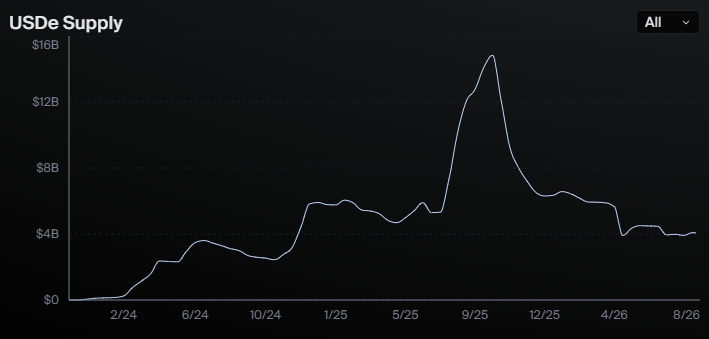
The "basis trade"—the mechanism that has powered Ethena’s growth—is essentially a market-neutral strategy that captures the spread between the spot price of an asset and its corresponding futures contract. While highly effective during bull markets, this strategy is intrinsically tied to crypto sentiment. During the 2024–2025 bull run, USDe thrived, with supply ballooning to nearly $15 billion and yields peaking above 80%. However, as the "crypto winter" set in, the protocol faced the harsh reality of market cyclicality: supply contracted to $4 billion, and yields dropped toward zero.
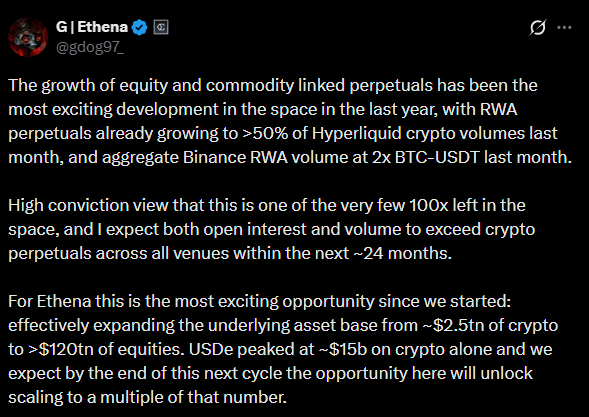
To mitigate this reliance, Ethena is pivoting toward RWA perps. These instruments allow the protocol to capture basis yields from traditional financial assets (such as equity indices) rather than just digital tokens. The potential for growth is staggering; while the crypto market cap sits at roughly $2.5 trillion, the underlying asset base for these traditional instruments exceeds $150 trillion.

Chronology of the Transition
Ethena’s journey to this point has been a calculated, multi-phase process:
- Phase 1: The Bull Market Peak (2024–2025): USDe sees explosive growth as high crypto funding rates fuel unprecedented yields.
- Phase 2: The Contraction (Late 2025–Early 2026): As the market cools, Ethena acknowledges the limitations of relying solely on crypto-basis trades.
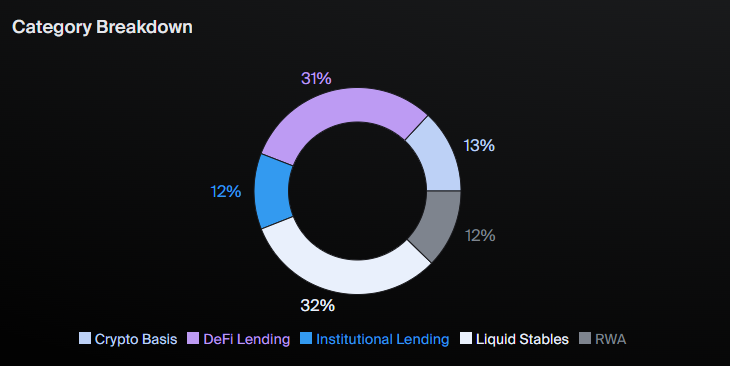
- Phase 3: The First Diversification (Mid-2026): Ethena begins incorporating traditional credit, partnering with financial giants like Janus Henderson to include AAA-rated collateral, which now comprises roughly 12% of USDe backing.
- Phase 4: The RWA Perp Integration (Current): Ethena announces the upcoming deployment of equity-based perps. This expansion is slated for release in the coming weeks, marking the next chapter in the protocol’s evolution.
Supporting Data and Market Analysis
The urgency of this transition is underscored by the explosive growth of the RWA perp market. According to project data, Open Interest (OI) in equity perps has surged 10x to reach $6 billion since March 2026. Ethena’s leadership views this as merely the beginning, projecting that this segment could grow 100x larger than its current state.
Currently, Ethena’s collateral reserves are split as follows:
- Liquid Stablecoins (USDT, USDC): 32%
- DeFi Lending (Aave, Morpho): 31%
- Traditional Credit (Janus Henderson): 12%
- Remaining/Crypto-Basis: The remaining portion, which the protocol intends to shift progressively toward RWA perps.
The math is compelling. By migrating to a model where RWA perps eclipse crypto-based backing—an event Ethena expects to occur within 12 to 24 months—the protocol effectively creates a "synthetic bond" that is less sensitive to the boom-and-bust cycles of Bitcoin and Ethereum. Furthermore, USDe continues to offer a yield spread of approximately 1.6% over short-term U.S. Treasury bills, making it an attractive proposition for institutional investors looking for yield optimization outside of standard sovereign debt.
Official Perspectives: A Cautious Approach
Ethena founder Guy Young has been instrumental in framing the rationale behind this pivot. In a recent statement, Young addressed why the protocol did not rush into the RWA space earlier, emphasizing the importance of data-driven decision-making.
"We took a cautious approach to what was a nascent market," Young explained. "We waited until we saw deep, liquid markets with a data history we could study before moving into the opportunity at scale."
Young’s optimism for the future of RWA perps is palpable. He describes the sector as "one of the very few 100x opportunities left," predicting that the volume and Open Interest in these instruments will eventually surpass the entirety of the global crypto-derivative market within the next two years. For Ethena, this is not just about diversification; it is about building a protocol that can withstand, and potentially thrive in, any macroeconomic environment.
Implications for the DeFi Ecosystem
The move by Ethena has profound implications for the broader Decentralized Finance (DeFi) landscape.
1. The Death of Cyclicality?
If successful, Ethena will demonstrate that a stablecoin/synthetic dollar can maintain its yield attractiveness regardless of whether the crypto market is in a bull or bear phase. This "all-weather" yield capability is the "holy grail" of DeFi, potentially attracting a massive influx of traditional capital that has previously been sidelined by the volatility of crypto yields.
2. Bridging the Gap
By utilizing RWA perps, Ethena is essentially acting as a conduit between traditional financial liquidity and DeFi infrastructure. This integration forces a convergence between the two worlds. As Ethena increases its exposure to traditional equity markets, the infrastructure used to settle these trades will become increasingly sophisticated, likely leading to better, faster, and more transparent financial rails.
3. Risk Management and Security
While the transition to RWA perps promises stability, it also introduces new risks. The reliance on centralized custodians or traditional financial institutions—even for AAA-rated credit—reintroduces counterparty risk that pure DeFi advocates often try to avoid. However, Ethena’s transparent reporting and slow, deliberate rollout suggest that the team is prioritizing systemic resilience over rapid, reckless expansion.
4. A Template for Other Protocols
Other yield-bearing protocols will likely watch Ethena’s experiment closely. If the integration of RWA perps successfully stabilizes USDe’s supply and yield, it will likely trigger a wave of "RWA-ification" across the DeFi ecosystem, where protocols pivot away from pure crypto-collateralization toward a hybrid model that mirrors traditional asset management.
Conclusion: The Road Ahead
As Ethena prepares for its next phase of growth, the project finds itself at a critical juncture. The integration of equity-based perps is a bold bet that the future of DeFi lies in its ability to absorb and tokenize the massive liquidity of traditional financial markets.
By moving beyond the cyclical nature of crypto-native basis trades, Ethena is signaling to the market that it is playing the long game. Whether this diversification will successfully catalyze a new wave of demand for USDe remains the ultimate question. However, by positioning itself as the bridge between the $2.5 trillion crypto market and the $150 trillion traditional asset base, Ethena is clearly aiming for a scale that few, if any, other DeFi protocols have dared to target.
As we look toward the next 12 to 24 months, all eyes will be on the performance of these new RWA-backed reserves. If the projections hold, Ethena may well be remembered as the project that finally decoupled crypto yield from the whims of the market cycle, ushering in a new era of institutional-grade decentralized finance.
