

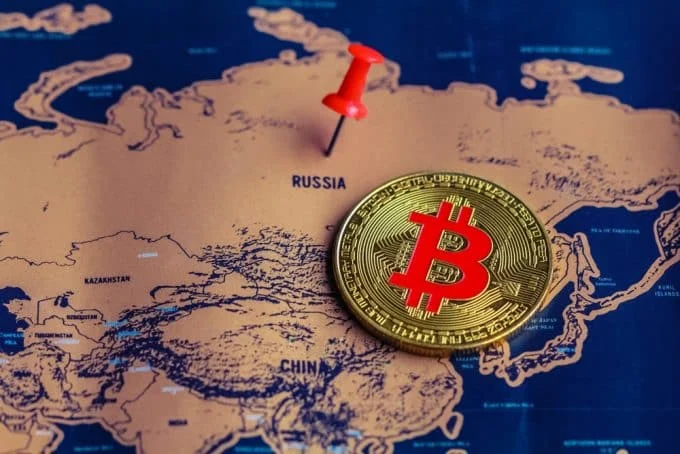
The global financial markets, including the volatile realm of digital assets, are currently navigating a period of profound uncertainty. As tensions between Russia and Ukraine reach a boiling point, the cryptocurrency sector—once touted by some as an "uncorrelated" hedge against traditional market instability—is demonstrating a high degree of sensitivity to geopolitical friction. With Bitcoin retreating from its January highs and a potential regulatory crackdown looming in Moscow, investors are left to grapple with a market currently defined by fear, doubt, and structural revaluation.
Main Facts: The Market in Retreat
The current climate in the cryptocurrency sector is one of retreat. As of Thursday, Bitcoin (BTC) is trading at approximately $43,352, a sharp decline from the $47,000 threshold reached at the start of the year. This represents a significant deviation from the optimism that characterized the opening days of 2022. The secondary market leader, Ethereum (ETH), has mirrored this bearish trend, suffering a 2.14% decline to sit at $2,873.
The broader crypto market has seen an evaporation of value, with a staggering $200 billion wiped from total market capitalization within a single 24-hour window. This correction is not occurring in a vacuum; it is the direct result of a "risk-off" sentiment that has gripped global investors as reports of more than 100,000 Russian troops amassing along the Ukrainian border continue to dominate international headlines.
Chronology: The Escalation of Tensions
To understand the current state of the crypto market, one must examine the timeline of events that have led to this instability:
- Early January 2022: Bitcoin shows signs of strength, touching $47,000. Investors maintain a cautiously optimistic outlook, hoping for a recovery from the winter lows.
- Mid-January 2022: Geopolitical rhetoric intensifies. Western intelligence agencies, led by the United States, warn of a potential "imminent" invasion of Ukraine by Russian forces.
- January 24-25, 2022: Diplomatic efforts intensify as U.S. President Joe Biden holds a high-level consultation with Ukrainian President Volodymyr Zelensky. During this hour-long dialogue, the focus remains on the mounting threat of conflict and the potential for severe economic sanctions.
- Late January 2022: The Russian Central Bank publishes a report suggesting a blanket ban on the mining and trading of cryptocurrencies, citing risks to financial stability and the environment. This announcement acts as a catalyst for a further sell-off, contributing to a 9% dip in major assets over the preceding weeks.
- Current Status: Markets are in a state of high alert. Investors are closely monitoring every statement from the Kremlin and the White House, with volatility indices reflecting an uneasy calmness amidst the storm.
Supporting Data: Volatility and Market Dynamics
While the headlines scream of panic, data analysts are looking at the underlying volatility metrics to gauge the severity of the situation. According to BuyBitcoinWorldwide’s volatility index, Bitcoin’s 30-day volatility has seen a cooling effect, with a 3.35% decrease compared to the 2021 average of 4.56%.
However, this relative stabilization in volatility does not equate to bullish momentum. Despite the drop, Bitcoin has managed to hold onto gains from its mid-January lows of $32,950, suggesting that while the "smart money" is cautious, it is not yet in a state of total capitulation.
The correlation between traditional equities and crypto has also become more pronounced. In December, the Nasdaq Composite index saw a 0.9% drop, which was met with concern by tech investors. The current decline in Bitcoin, which has seen days of 3% drops, is being viewed as more severe than the recent fluctuations in the tech-heavy Nasdaq. This indicates that digital assets are being treated as "risk assets" by institutional players, who are liquidating crypto holdings to cover margin calls or to pivot toward safe-haven assets like gold or U.S. Treasury bonds during periods of geopolitical stress.
Official Responses and Regulatory Pressure
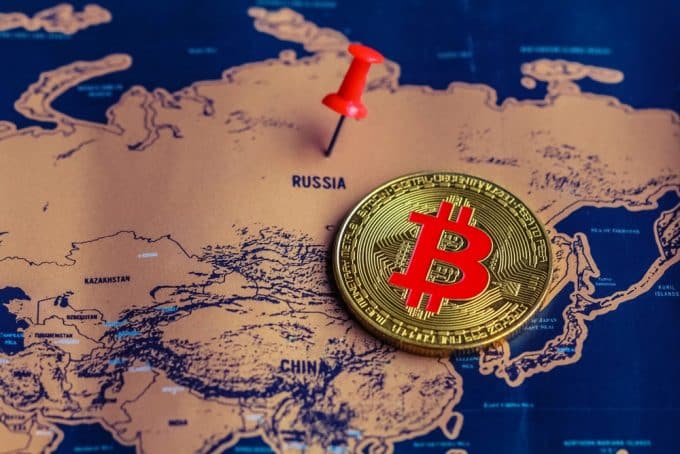
The intersection of the Russia-Ukraine conflict and cryptocurrency policy is further complicated by the Russian Central Bank’s recent regulatory posturing. Russia, which currently accounts for approximately 10% of global Bitcoin mining capacity, has emerged as a critical node in the decentralized network.
The Central Bank’s proposal to implement a blanket ban on Bitcoin mining and trading has sent shockwaves through the industry. Officials in Moscow have characterized Western warnings regarding a Ukrainian invasion as "hypocrisy," and the proposed ban is being viewed by some analysts as a strategic move to insulate the Russian economy from potential Western financial isolation. If Russia proceeds with this ban, it could force a massive migration of mining hash power, similar to the exodus observed when China banned mining in 2021.
Furthermore, the U.S. National Security Adviser, Jake Sullivan, has been instrumental in shaping the narrative regarding the invasion threat. By repeatedly warning of "imminent" action, the U.S. administration has effectively kept global markets on a short leash, discouraging speculative investment and prioritizing liquidity preservation.
Implications: The Future of Crypto-Geopolitics
The implications of these events are far-reaching. Firstly, the "decoupling" theory—that Bitcoin would act as "digital gold" during geopolitical crises—is being put to a severe test. Currently, it appears that in the early stages of a conflict, investors are prioritizing fiat liquidity over digital store-of-value assets.
Secondly, the regulatory risk in Russia serves as a reminder of the fragility of the crypto ecosystem when it relies on concentrated geographic hubs. If major nations continue to view crypto through a national security lens, we may see a bifurcation in the market: regions that embrace blockchain technology versus those that seek to criminalize it.
Finally, the $200 billion loss in market cap serves as a cautionary tale for retail investors. The "interlinked" nature of global markets means that crypto is no longer a peripheral asset class; it is now deeply embedded in the global financial fabric. When the world catches a cold, the crypto market experiences the symptoms of a full-blown influenza.
Conclusion
As the world watches the Ukrainian border with bated breath, the cryptocurrency sector remains in a precarious position. Investors are caught between the desire to hold assets that could theoretically withstand the freezing of global financial systems and the reality of a market that is currently being sold off to mitigate risk. Whether the current price levels represent a "buy the dip" opportunity or the beginning of a prolonged bear market remains to be seen. What is clear, however, is that the era of digital assets existing in a geopolitical vacuum is officially over. The future of Bitcoin and its counterparts will be defined by their ability to navigate the complex, often turbulent intersection of global diplomacy, national security, and decentralized finance.
