

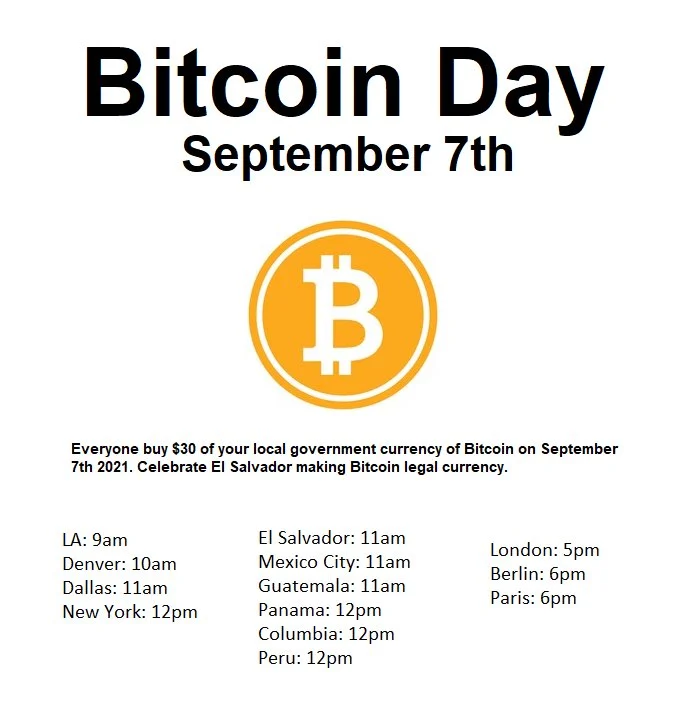
The global financial landscape stands on the precipice of a paradigm shift. Today, September 7, 2021, marks a historic milestone in monetary history: El Salvador has officially implemented its "Bitcoin Law," becoming the first sovereign nation to adopt a decentralized cryptocurrency as legal tender. This move, spearheaded by President Nayib Bukele, has transformed the Central American nation into a global laboratory for digital currency, forcing international financial institutions, governments, and investors to grapple with the reality of a "Bitcoin Standard."
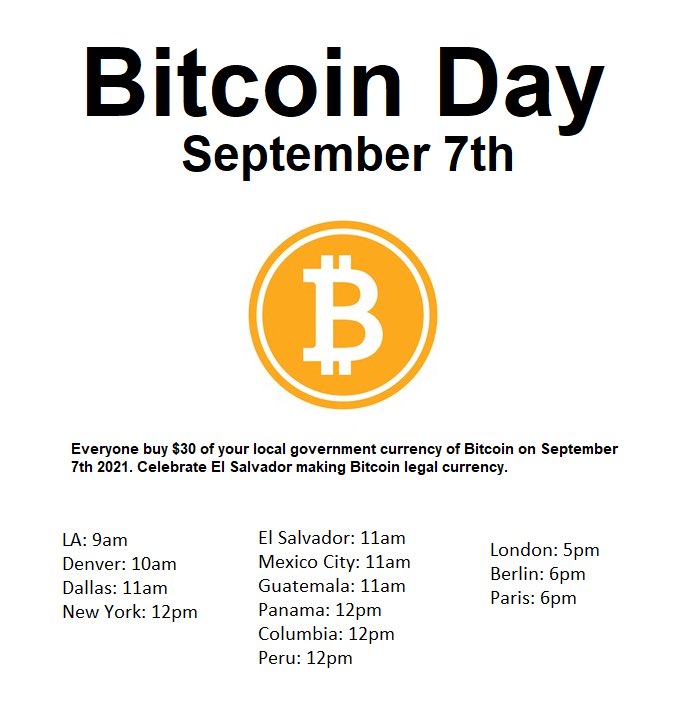
As the law takes effect, the digital assets community—often referred to as "Bitcoiners" or "plebs"—has mobilized in an unprecedented show of solidarity. What began as a spontaneous thread on Reddit has evolved into a global, decentralized demonstration of support, as thousands of individuals prepare to purchase $30 worth of Bitcoin in a synchronized effort to welcome El Salvador into the new era of sound money.
The Genesis of a Movement: From Reddit to Global Solidarity
The initiative originated in the /r/Bitcoin subreddit, where a user posed a deceptively simple question: "So… We all buying $30 worth of Bitcoin on Tuesday?" The proposition was modest, aimed not at manipulating market price, but at creating a symbolic, collective gesture of support for the Salvadoran people.
The response was overwhelming. At the time of the movement’s peak, the post garnered over 8,900 upvotes and more than 2,200 comments, creating a digital ripple effect that quickly transcended the platform. The $30 figure was chosen deliberately—it is small enough to be accessible to the average retail investor, yet large enough to create significant volume if executed in unison.
The community reaction has been diverse. While some users committed to purchasing the requested $30, others stepped up to subsidize the effort for those unable to participate. "I will buy $3,000 Tuesday to cover 99 others who aren’t able to pay," one commenter noted, underscoring the communal, almost philanthropic ethos that permeates the Bitcoin community. However, the movement has not been without its skeptics. Critics have pointed to the potential for market manipulation, with some labeling the coordinated buy as "greasy" or an attempt to pump the asset’s price.
Chronology of the Adoption
The road to this historic day has been marked by rapid-fire legislative action and intense debate:
- June 2021: President Nayib Bukele announces the intention to make Bitcoin legal tender at the Bitcoin 2021 conference in Miami, sending shockwaves through the legacy financial sector.
- June 9, 2021: The Legislative Assembly of El Salvador approves the Bitcoin Law with a supermajority, setting the stage for the country’s economic transformation.
- August 2021: The government rolls out the "Chivo" wallet, a state-sponsored digital wallet, and prepares the infrastructure for the September 7 launch.
- September 6, 2021: As the deadline approaches, the social media campaign for the "$30 buy" reaches its zenith, trending across Twitter and various international forums.
- September 7, 2021: The Bitcoin Law goes into effect. Businesses in El Salvador are now legally required to accept Bitcoin as payment, and the government begins its official integration of the asset into the national economy.
The Role of Influencers and Institutional Voices
The decentralized nature of the movement has been bolstered by institutional support, most notably from Michael Saylor, CEO of MicroStrategy. As one of the most prominent institutional advocates for Bitcoin, Saylor’s public endorsement of the event served to amplify the message to a massive audience.
His involvement, however, has invited a fresh wave of scrutiny regarding market dynamics. As the Bitcoin price approached significant technical retracement levels, some analysts voiced concerns that the coordinated "buy" event could be used as exit liquidity by institutional whales. "Everyone needs to be aware that this could possibly be leading the sheep to their death," one cautious market participant noted. "Letting retail buy exactly on the 70.2% retracement to dump on them—it’s a classic trap."
Despite these warnings, the fervor remains undeterred. Bitcoin proponents argue that the transparency of the blockchain makes any attempt at "dumping" immediately visible, offering a level of accountability that traditional financial systems lack.
International Scope: A Truly Global Phenomenon
The movement has transcended borders and language barriers, proving that the Bitcoin ecosystem operates outside the influence of nation-states. In South Korea, for instance, users translated the Reddit initiative, linking it to Brazil’s Independence Day, which coincidentally falls on September 7. This convergence of cultural significance—the birth of a nation’s sovereignty and the birth of a monetary revolution—has created a potent narrative for the community.
The sentiment is captured by figures like Tomer Strolight, who observed, "Have you ever felt such benevolence to strangers from different nations, religions, and other affiliations as you do toward bitcoiners?" This question highlights the core philosophy of the movement: Bitcoin is not merely a tool for financial speculation, but a mechanism for global unification.
Implications for Global Finance
The adoption of Bitcoin as legal tender by El Salvador carries profound implications for the global financial order:
1. Challenges to the U.S. Dollar Hegemony
For decades, the U.S. dollar has served as the primary reserve currency for many developing nations. By adopting Bitcoin, El Salvador is signaling a departure from traditional reliance on the IMF and the Federal Reserve. This move could serve as a "proof of concept" for other nations in the Global South, particularly those struggling with hyperinflation or restricted access to banking services.
2. The Remittance Revolution
A significant portion of El Salvador’s GDP comes from remittances sent by citizens working abroad. Traditional money transfer services often charge exorbitant fees, eating into the earnings of the working class. By utilizing the Bitcoin network, El Salvador aims to lower these costs, potentially saving millions of dollars annually that would otherwise be lost to intermediary financial institutions.
3. Regulatory Pressure and Oversight
The implementation of the Bitcoin Law has forced the international community, including the World Bank and the International Monetary Fund, to address the reality of crypto-assets. While these institutions have expressed concern over "consumer protection" and "financial stability," the success of El Salvador’s experiment will likely dictate how other governments approach digital asset regulation.
4. Technical and Economic Resilience
The success of this endeavor depends on the stability of the Chivo wallet infrastructure and the ability of the Salvadoran economy to absorb the volatility of the Bitcoin price. Should the experiment prove successful, it will validate the "Store of Value" thesis for Bitcoin on a national scale, further cementing its position as the premier digital asset.
Conclusion: A New Chapter
As the sun rises on the first day of the Bitcoin Standard in El Salvador, the world watches with bated breath. Whether the coordinated "$30 buy" moves the needle in the short term is almost secondary to the long-term historical significance of the event.
The "plebs" have shown that they are capable of organizing across continents to support a vision of decentralized freedom. Meanwhile, the institutional players and skeptics remain watchful, wary of the market volatility that accompanies such a radical transition. Regardless of the immediate price action, one thing is certain: the financial status quo has been permanently challenged.
El Salvador has taken the first step into a new monetary frontier. For the Bitcoin community, this is not just an investment—it is the validation of over a decade of work, belief, and, above all, the pursuit of "hard money" in a world of endless fiat printing. Today, the meme becomes reality, and the experiment begins in earnest. Whether this leads to a new era of prosperity or serves as a cautionary tale remains to be seen, but the history books will surely remember September 7, 2021, as the day the digital revolution went sovereign.
