

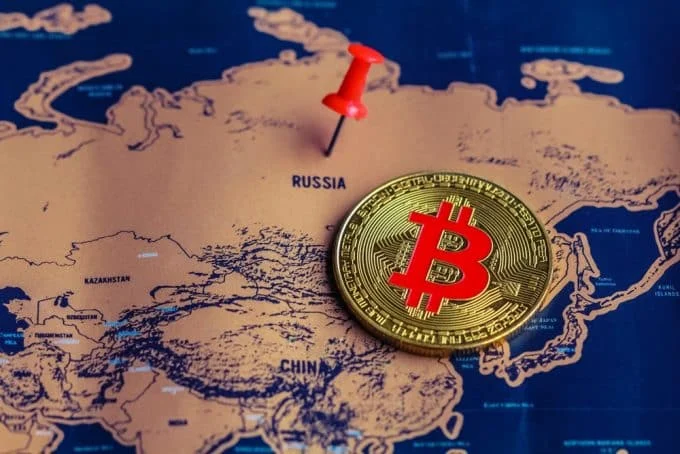
The global cryptocurrency market is currently grappling with a dual-threat scenario: escalating geopolitical tensions on the Eastern European border and a tightening regulatory environment in one of the world’s most significant mining hubs. As fears of a Russian military incursion into Ukraine intensify, digital asset prices have plummeted, dragging the broader crypto market into a state of heightened volatility. Bitcoin, the flagship digital currency, has retreated from its early-January highs, while Ethereum and other major altcoins face sharp double-digit corrections.
This article explores the confluence of these events, analyzing the data behind the sell-off, the geopolitical implications, and the structural risks currently facing the decentralized finance (DeFi) ecosystem.
Main Facts: The Market in Flux
The cryptocurrency market is currently experiencing a "risk-off" environment, where investors are pivoting away from speculative assets in favor of capital preservation. As of the latest market data, Bitcoin (BTC) is trading at approximately $43,352, marking a significant retraction from the $47,000 level it held on January 1. This descent represents a loss of momentum that has permeated the entire sector.
Ethereum (ETH), the second-largest cryptocurrency by market capitalization, has mirrored this downward trend, shedding 2.14% to reach $2,873. The cumulative effect of these losses has been staggering: over a single 24-hour period, the global cryptocurrency industry witnessed a staggering $200 billion evaporation in total market valuation. Bitcoin’s total market capitalization currently stands at approximately $817.95 billion, a far cry from the highs seen during the industry’s peak performance months.
The sentiment among analysts is one of cautious pessimism. While some market observers point out that current volatility—measured at 3.35% over 30 days—is lower than the 4.56% average observed throughout 2021, the downward pressure remains consistent. The market is struggling to reconcile these geopolitical uncertainties with the long-term bullish thesis that typically supports digital asset growth.
Chronology: A Cascade of Geopolitical and Regulatory Pressure
To understand the current market behavior, one must look at the timeline of the dual crises currently impacting the crypto-sphere.
The Diplomatic Standoff
The tension between Russia and Ukraine has been building for months. Throughout January, reports of over 100,000 Russian troops amassing along the Ukrainian border triggered alarm bells in Western capitals. On Monday, U.S. President Joe Biden engaged in an hour-long dialogue with Ukrainian President Volodymyr Zelensky to discuss the deteriorating security situation. Despite these efforts, U.S. National Security Adviser Jake Sullivan has repeatedly warned that the window for a potential military strike remains open.
The Regulatory Offensive
Simultaneous to the military build-up, the Russian Central Bank issued a report suggesting a total ban on the use and mining of cryptocurrencies within its borders. This proposal, characterized as a necessary measure to ensure financial stability and curb illicit activity, sent shockwaves through the industry. Russia is currently one of the world’s most vital hubs for Bitcoin mining, accounting for roughly 10% of the global hashrate. A move to ban the industry entirely would not only disrupt global mining capacity but also create significant uncertainty for regional investors.
Market Reaction
These events have led to a "tailspin" effect. Fears of a strike on Ukraine caused a 9% dip in both Bitcoin and Ethereum, hitting levels not seen in six months. This sell-off was compounded by the announcement of the potential Russian ban, leading to a massive liquidation of leveraged positions across major exchanges.
Supporting Data: Volatility and Market Indicators
The current state of the market is best illustrated by the data provided by platforms such as CoinGecko and TradingView.
- Volatility Metrics: According to BuyBitcoinWorldwide’s volatility index, the 30-day volatility of Bitcoin is currently undergoing a contraction. While a decrease in volatility is often seen as a sign of maturity, in this context, it reflects a "wait-and-see" approach by institutional investors who are hesitant to enter the market until the geopolitical fog lifts.
- Market Cap Compression: The total market capitalization of the crypto sector has fluctuated wildly. The $200 billion loss in a single day highlights the sensitivity of digital assets to macro-economic and geopolitical shifts.
- Technical Indicators: Technical charts show that Bitcoin has struggled to maintain support levels that were previously considered "floors." The break below $45,000 served as a catalyst for further selling pressure, triggering stop-loss orders from retail investors and algorithmic traders alike.
Despite these figures, it is worth noting that Bitcoin has not entirely erased its gains from two weeks ago, when it touched a low of $32,950. This suggests that while the current sentiment is bearish, the long-term support remains resilient.
Official Responses: Diplomacy vs. Regulation
The international community has taken a firm stance on the Russia-Ukraine crisis. The United States and its NATO allies have signaled that any military incursion by Russia would be met with severe, unprecedented economic sanctions.
For its part, the Russian government has officially dismissed the warnings of a Western-led invasion as "hypocrisy." Moscow argues that its troop movements are internal matters, even as the international community prepares for the possibility of an escalation.
Regarding the proposed cryptocurrency ban, the narrative within Russia appears to be fractured. While the central bank advocates for a restrictive, prohibitionist approach citing risks to financial stability, other government officials have signaled a more nuanced stance, emphasizing the need to regulate rather than eliminate the industry to avoid stifling technological innovation. This internal friction further complicates the outlook for Bitcoin miners operating within the country.
Implications: The Future of Crypto-Geopolitics
The current situation serves as a stark reminder that cryptocurrencies, once thought to be "uncorrelated" assets, are increasingly tethered to the traditional financial system and global geopolitical events.
1. The Mining Migration
If Russia proceeds with a blanket ban, the industry will likely see a repeat of the "Great Mining Migration" that occurred when China banned crypto mining in 2021. While the network proved resilient then, the loss of 10% of global mining capacity would lead to a temporary decrease in network security and potentially higher transaction costs.
2. Institutional Hesitancy
The primary concern for the industry is the impact on institutional adoption. Corporations and high-net-worth individuals are generally risk-averse. As long as there is a threat of war in Eastern Europe and regulatory uncertainty in major mining hubs, institutional inflows are likely to remain stagnant.
3. The "Digital Gold" Narrative
Bitcoin was historically marketed as a hedge against inflation and geopolitical instability. However, the current price action challenges this narrative. When markets panic, investors are liquidating assets into cash (specifically the U.S. Dollar), proving that in times of extreme uncertainty, liquidity remains king. The industry must now prove that its value proposition extends beyond speculation and into true geopolitical hedging.
4. Regulatory Interdependence
The events in Russia underscore the growing realization that the cryptocurrency industry is no longer an isolated subculture. Its health is now fundamentally linked to the policies of central banks and the decisions of global superpowers. Moving forward, the industry must prepare for a more integrated—and therefore more regulated—future.
Conclusion
The intersection of military threats, potential regulatory bans, and market sell-offs has created a challenging period for the cryptocurrency sector. While the industry has proven its resilience in the past, the current combination of factors is unique in its breadth and intensity. As the world watches the Ukrainian border and waits for the final decision from the Kremlin regarding mining and trading, the cryptocurrency market remains at a critical crossroads. Whether it emerges from this period as a robust, institutionalized asset class or remains a volatile speculative vehicle will depend on how it navigates the complex geopolitical landscape of the coming months.
