

The decentralized finance (DeFi) ecosystem is currently witnessing a curious phenomenon within Aave’s latest expansion. Aave, a titan in the lending sector, has seen its newly launched Arc market witness a tidal wave of capital inflows, yet the actual economic engine of the platform—borrowing activity—remains strikingly dormant. This divergence between liquidity supply and credit demand has sparked a debate among market analysts regarding the maturation of permissioned lending environments and the fundamental drivers of DeFi utility.
Main Facts: A Tale of Two Metrics
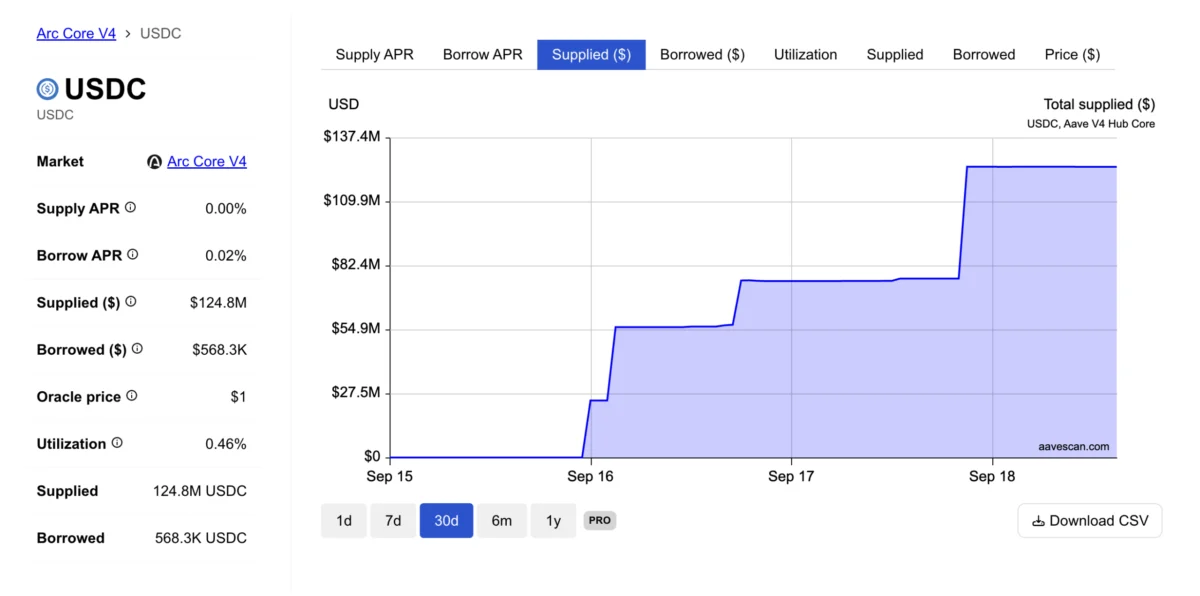
As of September 18, 2026, data provided by Aavescan paints a stark picture of the Arc V4 market’s current state. The platform has successfully attracted approximately $124.8 million in USDC, a stablecoin deposit volume that signals significant trust in the protocol’s infrastructure. However, the mirror image of this metric—the amount of capital actually deployed through loans—reveals a profound lack of utilization.
Total borrowing on the platform has struggled to surpass the $600,000 threshold. In practical terms, this means that roughly 99.5% of the total liquidity supplied to the market remains idle, effectively sitting in a vault rather than circulating through the economy of the protocol. This extreme imbalance is the primary challenge facing Aave’s Arc initiative: while the "supply side" of the lending business has reached critical mass, the "demand side" is yet to materialize in any meaningful way.
Chronology: The Rapid Surge of Idle Capital
The trajectory of the Arc V4 market has been characterized by exponential growth in supply, creating a "liquidity glut" that has outpaced operational capacity.
- September 16: The market began its recent phase of growth with approximately $24.5 million in excess reserves. At this stage, the market was in its nascent infancy, with little to no meaningful borrowing activity to record.
- September 17: The influx of capital accelerated dramatically. Reports indicated that deposits had ballooned to roughly $76 million. Despite this influx, borrowing remained virtually non-existent, leaving the market in a state of extreme inefficiency.
- September 18: The growth trend continued unabated, with deposits hitting $124.8 million—a 65% increase over the previous 24-hour period. While borrowing also saw a minor uptick from a low of $73,400 to roughly $568,300 by the end of the day, the ratio of utilized capital to idle capital remained negligible.
This timeline suggests that the "pull" factor for liquidity providers is currently disconnected from the operational reality of the borrowers. For lenders, the primary objective is yield generation; for borrowers, the primary objective is capital efficiency. Currently, the market is successfully fulfilling the former but failing the latter.
Supporting Data: The Mechanics of Stagnation
The core issue in any lending protocol is the feedback loop between supply and demand. In a healthy, functioning market, high supply should theoretically lower interest rates to encourage borrowing, which in turn generates returns for the suppliers.
In the current Arc V4 environment, the numbers illustrate a cycle of stagnation:
- Supply Return: 0.00%
- Borrowing Rate: ~0.02%
Because there is virtually no demand, there is no interest to distribute back to the liquidity providers. The $125 million sitting in the protocol is essentially dead capital. In traditional finance, such a state would be viewed as a liquidity trap, where the cost of borrowing is so low that it should theoretically incentivize massive debt expansion, yet the lack of takers suggests that the "Arc" environment—which often implies institutional or permissioned constraints—may have specific barriers to entry that are currently suppressing borrower appetite.
Official Responses and Strategic Context
While Aave has not issued a formal "emergency" statement regarding the imbalance, the protocol’s history suggests a patient, long-term approach to market building. Aave has long commanded nearly 48% of the total DeFi lending market, a dominant position that it maintains by constantly testing new frontiers like V4.

Industry observers note that institutional-grade markets, such as those within the Arc ecosystem, often require a "bootstrapping" period. Unlike retail DeFi, where liquidity providers (LPs) chase yield across volatile protocols, the participants in an Arc-style environment are often bound by compliance, KYC (Know Your Customer) requirements, and slower institutional decision-making cycles. The massive influx of capital is likely not a reaction to current interest rates, but rather a strategic "staging" by institutional actors who are positioning themselves for future activity.
From the perspective of Aave’s governance, the current 99.5% idle rate is not necessarily a failure, but rather a necessary prerequisite. Before borrowers can feel confident in a market, they must see that liquidity is available and ready for deployment. The current situation, therefore, can be viewed as the "supply-side build-up" phase.
Implications: Is This a Lasting Problem or a Growing Pain?
The question for the coming months is whether the demand for credit will catch up to the supply of liquidity. If the utilization rate remains below 1% for an extended period, it raises questions about the viability of the Arc model in its current configuration.
1. The Capital Efficiency Dilemma
If liquidity providers continue to see 0% returns, they will eventually migrate their capital to other Aave markets or rival protocols. The "stickiness" of the current $125 million will be tested by the opportunity cost of that capital. If these funds could be earning 3-5% elsewhere in DeFi, the patience of these liquidity providers will likely wear thin.
2. The Permissioned Barrier
The Arc network is designed to offer a "walled garden" for institutional participants. However, if the requirements to enter the market are too burdensome, the number of potential borrowers will remain limited regardless of how much USDC is available. Aave must balance the security and regulatory compliance of the Arc network with the need for a robust and active pool of borrowers.
3. The Path to Market Equilibrium
The next phase of the Arc V4 experiment will be defined by its ability to attract "use cases." Whether this involves integration with real-world asset (RWA) tokenization, institutional working capital loans, or cross-chain liquidity bridging, the protocol needs to move beyond simply holding capital.
Ultimately, the success of the Aave Arc V4 market will be measured by its "velocity of money." A high deposit volume is a vanity metric if the platform cannot convert that capital into active credit. The coming weeks will be critical; if the current, slight uptick in borrowing ($73k to $568k) turns into a sustained trend, it may prove that the initial supply-heavy strategy was the correct precursor to a functioning lending ecosystem.
For now, Aave remains in a holding pattern. The protocol has built the library, and it has filled the shelves with books, but the readers have yet to arrive in force. Whether this is a sign of a fundamental disconnect or simply the quiet before an institutional surge remains the most pressing question in the current DeFi landscape. As the protocol continues to iterate, the gaze of the crypto-financial world will remain fixed on those utilization percentages—waiting for the moment when the "idle" capital finally goes to work.
