

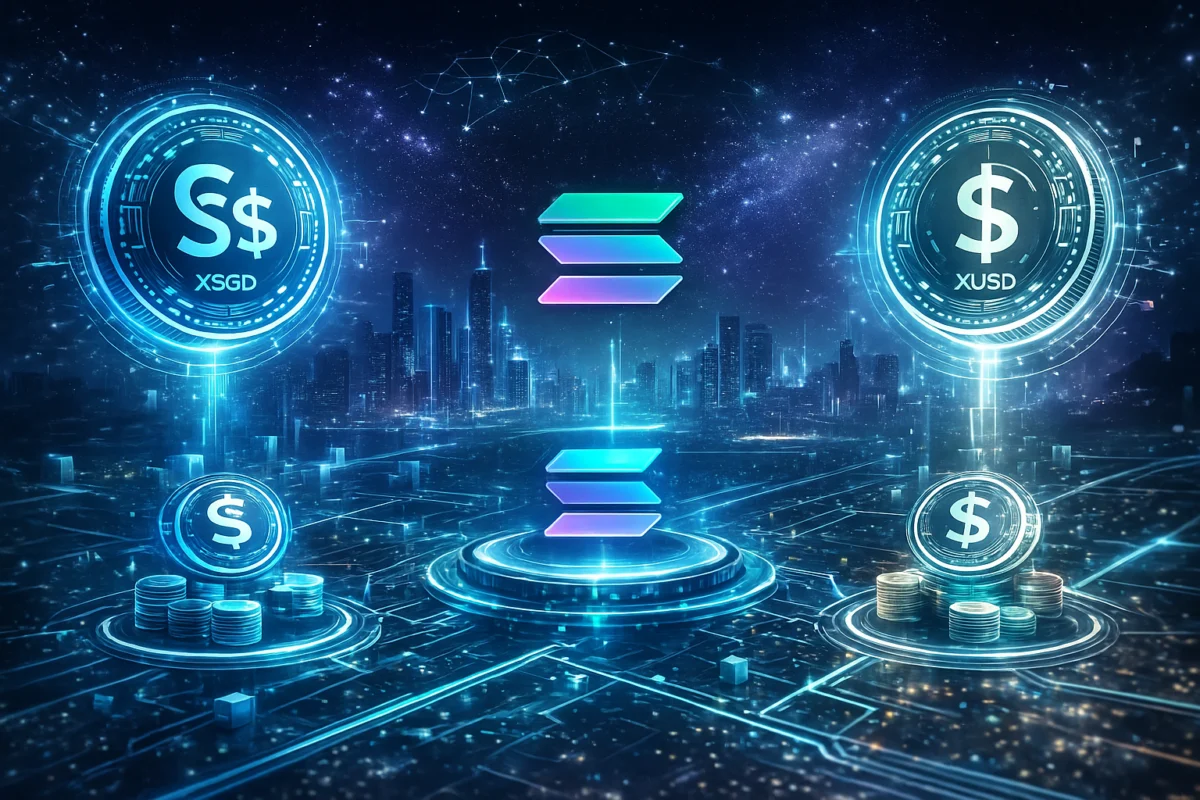
SINGAPORE — StraitsX, a prominent Singapore-based digital asset and stablecoin issuer, has announced plans to deploy its flagship stablecoins—the Singapore dollar-backed XSGD and the US dollar-backed XUSD—onto the Solana blockchain. Slated for an early 2026 rollout, this strategic expansion marks a critical milestone in the convergence of highly regulated, fiat-backed digital currencies with high-throughput, low-cost distributed ledger infrastructure.
The integration is designed to place regulated digital money at the core of high-speed blockchain settlements, targeting enterprise treasury operations, decentralized finance (DeFi) protocols, digital commerce platforms, and the rapidly growing frontier of artificial intelligence (AI)-driven microtransactions. By leveraging Solana’s robust network architecture, StraitsX aims to streamline cross-border settlements and offer institutional and retail users a seamless, highly scalable medium of exchange.
Main Facts
The expansion onto Solana bridges StraitsX’s regulated stablecoin ecosystem with one of the most heavily utilized high-performance blockchains in the industry.
- The Assets: StraitsX will bring both its Singapore dollar-backed stablecoin (XSGD) and its US dollar-backed stablecoin (XUSD) to the Solana ecosystem.
- Timeline: The deployment is officially scheduled for completion by early 2026, following a collaborative announcement alongside the Solana Foundation.
- Infrastructure Benefits: Solana’s high-throughput and low transaction fees will allow users to settle XSGD and XUSD transactions almost instantaneously, removing the friction often associated with legacy financial rails and congested layer-1 networks.
- Ecosystem Scope: Once live, the integration will support centralized exchange (CEX) onramps and offramps, decentralized liquidity pools, automated market makers (AMMs), lending markets, and consumer-facing application layers.
- AI and Commerce Integration: Both stablecoins natively support the x402 payment standard, an interoperability framework engineered to facilitate automated, machine-to-machine transactions. This enables autonomous software agents to execute financial agreements without human intervention.
- Regulatory Compliance: StraitsX operates under the regulatory supervision of the Monetary Authority of Singapore (MAS) as a licensed Major Payment Institution, ensuring that the Solana-native iterations of XSGD and XUSD align with stringent domestic and international compliance standards.
Chronology of Events
The journey toward the Solana integration reflects a calculated roadmap of technological maturation, regulatory alignment, and strategic partnerships.
The Foundation and Multi-Chain Growth
Prior to its expansion onto Solana, StraitsX built a robust multi-chain presence for its digital assets. XSGD established deep liquidity across a diverse array of layer-1 and layer-2 networks, including Ethereum, Polygon, Avalanche, Arbitrum, Zilliqa, Hedera, and the XRP Ledger. Meanwhile, XUSD developed a stronghold on networks like Ethereum and BNB Smart Chain. Over the course of their operations, these stablecoins have collectively processed upwards of $18 billion in onchain transaction volume, cementing their utility in cross-border trade and institutional settlement.
Regulatory Milestones in Singapore
As global regulatory scrutiny over stablecoins intensified, StraitsX positioned itself at the forefront of compliance. Both XSGD and XUSD achieved formal alignment with the upcoming stablecoin regulatory framework outlined by the Monetary Authority of Singapore (MAS). This regulatory clarity provided the institutional confidence required to expand operations onto high-performance public networks like Solana.
The Grab Partnership
In a major push toward mass consumer adoption, StraitsX entered an exploratory memorandum of understanding (MoU) with Southeast Asian super-app giant Grab. Subject to final regulatory approvals, the collaboration aims to embed a Web3-enabled settlement layer directly into Grab’s ecosystem. This would allow millions of everyday users to hold, transfer, and spend XSGD and XUSD natively within the application for routine digital commerce and peer-to-peer transfers.
The Solana Foundation Collaboration and Official Announcement
Culminating months of technical development and strategic discussions, StraitsX formally announced its partnership with the Solana Foundation in a December blog post. The announcement outlined the technical blueprint for bringing XSGD and XUSD to Solana by early 2026, marking a pivotal transition toward unified, software-native financial infrastructure.
Supporting Data and Token Metrics
Understanding the economic scale of StraitsX requires examining the circulating supply, market capitalization, and historical transaction volumes of its core products.
- XSGD Metrics:
- Circulating Supply: Approximately 16.7 million tokens.
- Market Capitalization: Stads at roughly $13 million.
- Utility: Serves as the world’s leading digital Singapore dollar, heavily utilized in regional FX trading pairs and decentralized liquidity pools.
- XUSD Metrics:
- Market Capitalization: Approximately $52 million.
- Utility: Provides a compliant, fiat-backed USD stablecoin alternative designed for seamless global trade and programmable deployment.
- Cumulative Volume: Together, XSGD and XUSD have surpassed $18 billion in aggregate onchain volume. This metric highlights that these assets are not merely speculative instruments, but actively functioning settlement rails utilized by institutional market makers, crypto-native funds, and corporate treasuries.
Official Responses and Strategic Vision
Leadership from both StraitsX and the broader digital asset ecosystem have emphasized the transformative potential of bringing compliant stablecoins to Solana.
In its official release, StraitsX highlighted that the integration is fundamentally driven by the evolving needs of digital commerce and automated software architectures. The company stated that modern enterprise clients and software developers require programmable money that can execute complex financial workflows—such as automated foreign exchange (FX) swaps between SGD and USD—without sacrificing speed or security.
Representatives from the Solana Foundation echoed these sentiments, noting that the addition of regulated fiat-backed stablecoins like XSGD and XUSD enhances the economic depth of Solana’s DeFi ecosystem. By bridging traditional institutional finance (TradFi) compliance standards with Solana’s high-speed developer ecosystem, the collaboration aims to attract a new wave of corporate adopters who previously hesitated to deploy capital on public blockchains due to speed limitations or regulatory ambiguity.
Implications for Finance, AI, and Southeast Asia
The deployment of StraitsX stablecoins on Solana carries profound implications across multiple sectors, ranging from macroeconomic cross-border payments to the bleeding edge of AI automation.
1. Bridging Traditional Finance and Decentralized Networks
By operating under MAS oversight while leveraging public blockchain infrastructure, StraitsX provides a blueprint for how traditional financial institutions can safely embrace public networks. Institutional investors can utilize XSGD and XUSD on Solana to manage liquidity, execute rapid arbitrage strategies, and settle transactions with finality, all while maintaining adherence to anti-money laundering (AML) and counter-terrorist financing (CTF) protocols.
2. Powering AI-Native and Autonomous Commerce
One of the most innovative dimensions of the Solana integration is its native support for the x402 standard. As artificial intelligence agents evolve from conversational assistants into autonomous economic actors, they require secure, software-native payment methods to buy data, rent compute power, and execute micro-contracts. Because XSGD and XUSD support x402 natively, AI applications deployed on Solana can instantly execute multi-currency transactions, opening up entirely new paradigms for machine-driven economies.
3. Transforming Southeast Asian Consumer Payments
Through its exploratory work with regional giants like Grab, StraitsX is uniquely positioned to bridge the gap between abstract Web3 infrastructure and everyday consumer habits. If fully realized, integrating stablecoin clearing layers into super-apps will enable frictionless cross-border remittances across Southeast Asia. Consumers will be able to transact in stable digital currencies tied to stable regional fiats, effectively bypassing the exorbitant fees and sluggish processing times traditionally associated with legacy wire transfers and foreign exchange houses.
4. Scalability and Interoperability in DeFi
For the Solana DeFi community, the introduction of a regulated Singapore dollar stablecoin alongside a trusted US dollar stablecoin broadens the scope of available trading pairs and yield-generating strategies. Developers can now construct complex multi-currency liquidity pools, automated lending protocols, and institutional-grade derivatives markets that cater specifically to Asian macroeconomic flows, further cementing Solana’s status as a global hub for high-performance financial applications.
As the early 2026 launch approaches, the convergence of StraitsX’s regulatory compliance framework and Solana’s unmatched transaction throughput promises to redefine what is possible in the realm of programmable digital money.
