

In a move that promises to redefine the trajectory of global robotics, Alibaba’s Qwen team officially unveiled the "Qwen-Robot Suite" this past Tuesday. This sophisticated collection of three foundation models represents a comprehensive "full stack" approach to embodied intelligence, aiming to solve the long-standing fragmentation that has held the robotics industry back for decades. By decoupling the "brain" of the machine from its mechanical hardware, Alibaba is positioning its new suite as the de facto operating system for the next generation of physical agents.
The suite comprises three distinct yet interoperable pillars: Qwen-RobotNav for spatial intelligence and mobility, Qwen-RobotManip for complex dexterous manipulation, and Qwen-RobotWorld, a simulation environment that models the physical laws governing these interactions. Together, they function as a cohesive intelligence layer, marking what industry analysts are calling the "Android moment" for the field of robotics—a transition from proprietary, siloed hardware to a universal, software-defined ecosystem.
The Chronology of an Embodied Breakthrough
The development of the Qwen-Robot Suite follows a period of intense, rapid innovation within Alibaba’s research labs. Unlike many competitors who focus on specific niches, Alibaba has leveraged its unique position as the only Chinese entity with end-to-end control over the entire technological pipeline—from the design of specialized AI chips and cloud infrastructure to the creation of foundational models and end-user applications.
- Initial Research Phase: Over the past 24 months, the Qwen team shifted its focus from pure LLM development to "Embodied AI." The team recognized that while LLMs excel at processing text and code, they lack the physical grounding necessary to navigate the complexities of the real world.
- The Data Synthesis Milestone: A pivotal moment occurred with the ingestion of over 38,100 hours of training data, synthesized from a vast array of open-source robot datasets and human demonstration videos. This allowed the team to bypass the reliance on proprietary, closed-loop data collection.
- Tuesday’s Launch: On June 16, 2026, the suite was officially announced via social media and technical blog posts, accompanied by the release of performance benchmarks that have sent ripples through the research community.
Technical Architecture: A Modular Powerhouse
To understand the impact of this suite, one must look at the specific challenges each component addresses.
Qwen-RobotNav: Unifying Mobility
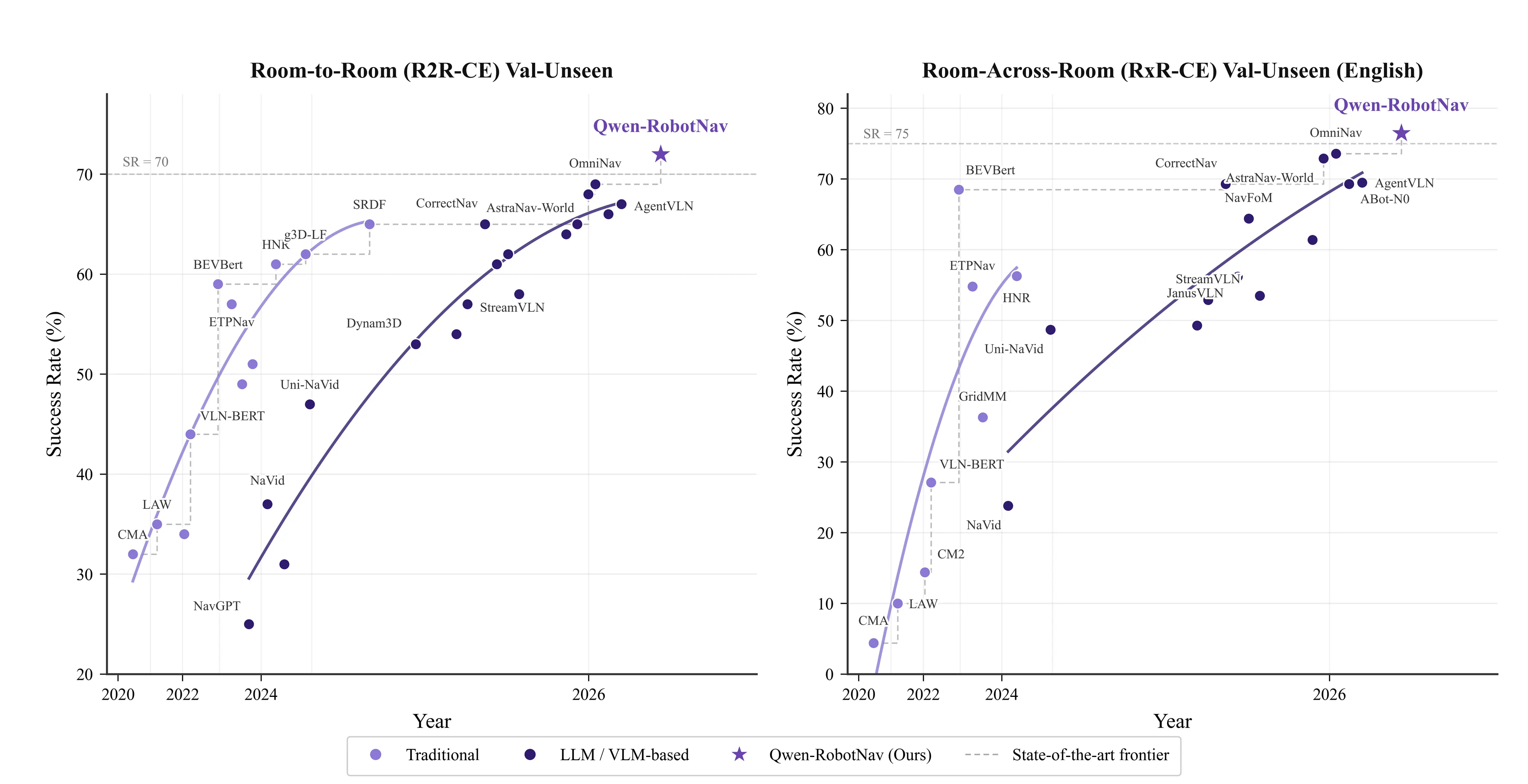
Traditional navigation models are often hardcoded for specific environments or sensor configurations. Qwen-RobotNav breaks this mold by unifying five core tasks: instruction following, point-goal navigation, object search, target tracking, and autonomous driving. By utilizing a "parameterized interface," the model allows a central planner to adjust variables like token budgets and temporal decay on the fly. This flexibility is essential for real-world navigation, where a robot might need to prioritize speed in one scenario and extreme precision in another. Performance metrics are compelling: 76.5% success on the VLN-CE RxR benchmark and a 90% tracking rate on EVT-Bench.
Qwen-RobotManip: Solving the Cross-Morphology Bottleneck
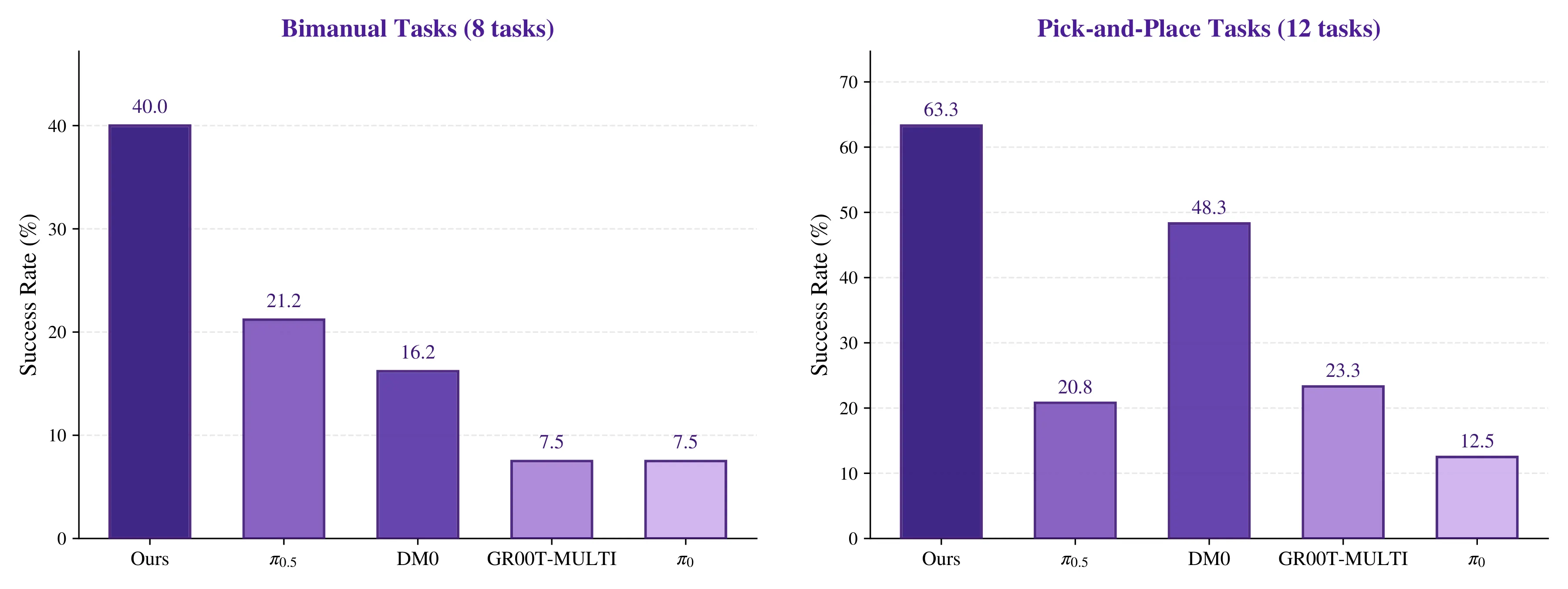
One of the most persistent hurdles in robotics is the incompatibility of "action spaces." A seven-axis Franka arm and a bimanual ALOHA system speak different "languages" of movement. Qwen-RobotManip acts as a translator, aligning these disparate physical architectures. By training on diverse datasets without forcing a specific robot type, the model achieves a top-tier ranking on the RoboChallenge Table30-v1, outperforming traditional approaches by a significant 20% margin.
Qwen-RobotWorld: The Language-Conditioned Simulation
Perhaps the most ambitious component, Qwen-RobotWorld, treats natural language as a universal action interface. It does not merely predict what happens next; it understands the physical consequences of actions based on Newtonian laws, fluid dynamics, and gravity. With a corpus of 8.6 million video-text pairs and 200 million frames, it creates a digital twin environment that is not just descriptive, but predictive. It is currently dominating benchmarks like EWMBench and DreamGen, marking a new standard for physical fidelity in AI.
Supporting Data and Benchmarking
Alibaba’s foray into robotics is backed by aggressive benchmarking. The following table summarizes the performance of the Qwen-Robot suite across key industry metrics:
| Model | Benchmark | Result/Status |
|---|---|---|
| Qwen-RobotNav | VLN-CE RxR | 76.5% Success Rate |
| Qwen-RobotNav | EVT-Bench | 90% Tracking Accuracy |
| Qwen-RobotManip | RoboChallenge Table30-v1 | 1st Place (+20% vs SOTA) |
| Qwen-RobotWorld | EWMBench / DreamGen | 1st Place |
The consistency of these results across different domains—navigation, manipulation, and physical simulation—suggests that the "generalist" approach of the Qwen team is yielding higher returns than the specialized approaches favored by many Western labs.
Official Responses and Strategic Positioning
Alibaba has been clear that these models are not "robots" in the physical sense, but rather the "cognitive software" intended to reside within them. This distinction is crucial. By remaining hardware-agnostic, Alibaba is positioning the Qwen-Robot Suite to integrate with existing hardware manufacturers like AgileX, Franka, and Unitree.
"The goal is not to reinvent the wheel, but to give the wheel a brain," a representative for the Qwen team noted. In official communications, the company emphasized that their open-source foundation strategy is designed to foster an ecosystem where third-party developers can contribute to the "Embodied World Knowledge" corpus. This transparency is a calculated move to gain market share against competitors like Google DeepMind, Nvidia, and Physical Intelligence, who have historically kept their robotic datasets behind closed doors.
Implications for the Future of Automation
The implications of the Qwen-Robot Suite are profound, touching on both industrial efficiency and the long-term potential for domestic robotics.
1. The Death of Hardcoded Control
For years, robots were programmed through rigid, rules-based logic. The Qwen suite replaces these rules with generative intelligence capable of adapting to "edge cases." When a robot encounters a spilled liquid or a moving obstacle it hasn’t seen before, it no longer needs a programmer to write new code; it relies on its world model to understand the physics of the situation and adjust its behavior accordingly.
2. Bridging the "Sim-to-Real" Gap
The largest failure mode for robotics has always been the transition from the sterile environment of a laboratory to the unpredictable chaos of a home or a factory floor. While benchmarks like RoboCasa365 and LIBERO-Plus are promising, the real-world introduction of sensor noise and mechanical wear remains a hurdle. Alibaba’s focus on "physics-adherence" in its world model is a direct attempt to minimize this gap.
3. Economic and Social Impact
If Alibaba succeeds, the barrier to entry for building a sophisticated robot will drop precipitously. Smaller manufacturers will be able to plug the Qwen "brain" into their chassis, effectively democratizing advanced robotics. This could lead to a surge in the deployment of robots in logistics, manufacturing, and eventually, public service sectors.
4. Cautionary Realism
Despite the excitement, the company and outside experts remain grounded. We are nowhere near a "housemaid robot" that can perform reliable, long-term domestic labor. The "long tail" of edge cases—the millions of tiny, unexpected things that can happen in a human home—remains a massive barrier. As the article notes, "The gap between a controlled demo… and a robot reliably working in your home is enormous."
Conclusion
Alibaba has effectively fired the starting gun for a new race in embodied AI. By integrating navigation, manipulation, and physics-based world modeling into a single, cohesive, and language-conditioned suite, they have set a high bar for the industry. While the journey toward truly autonomous, human-level robotics remains a long one, the Qwen-Robot Suite provides the necessary architecture to turn the dream of intelligent machines into a verifiable, scalable reality. For now, the world waits to see how the industry—and the rest of the AI landscape—will respond to this bold, full-stack challenge.
