

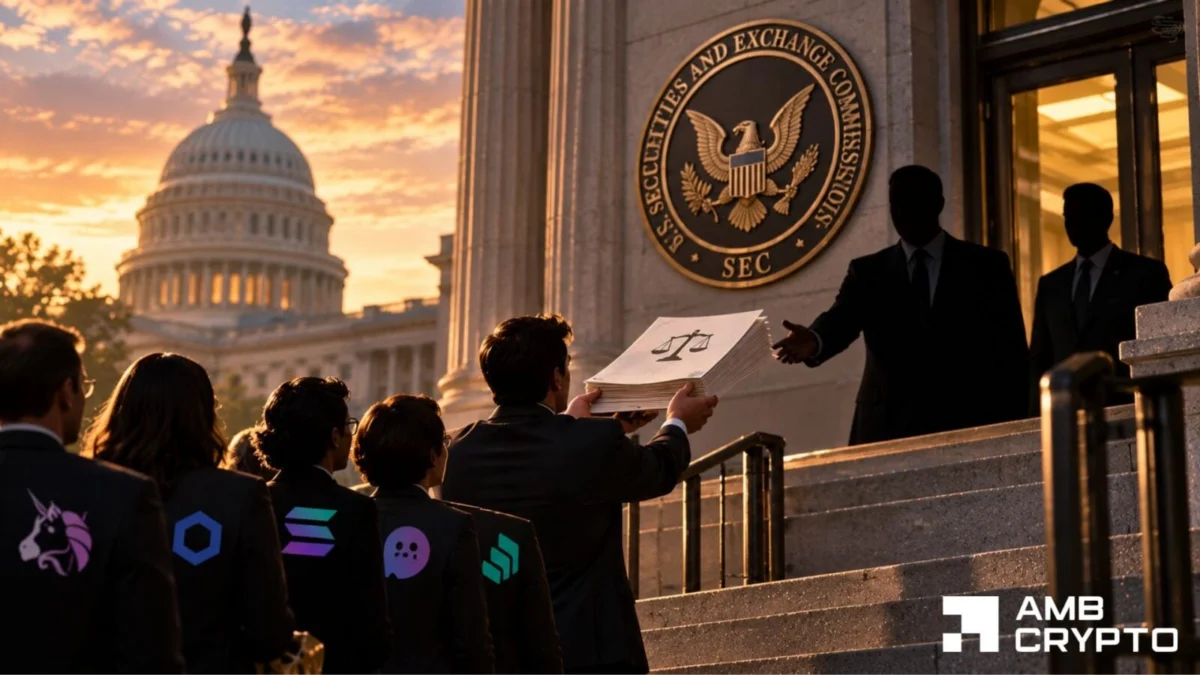
The landscape of decentralized finance (DeFi) currently sits at a precarious regulatory crossroads. On September 22, a high-profile coalition led by Miles Jennings, General Counsel at the venture capital giant a16z Crypto, and the DeFi Education Fund (DEF) formally petitioned the U.S. Securities and Exchange Commission (SEC) to provide explicit regulatory relief within its proposed “Innovation Exemption” framework.
This move marks a significant escalation in the industry’s attempt to carve out a legal sanctuary for decentralized protocols, developers, and non-custodial applications. As the SEC continues to assert authority over digital assets through an enforcement-heavy approach, the industry is fighting back with a sophisticated, policy-driven argument centered on the technical realities of permissionless systems.
Main Facts: The Core of the Proposal
The petition submitted to the SEC is not merely a request for leniency; it is a structured proposal for how the agency should categorize decentralized technology. The coalition’s request is bifurcated into two primary objectives:
- Exemption for Non-Custodial Infrastructure: The primary goal is to secure regulatory safe harbor for decentralized exchanges (DEXs) and the applications that provide access to them. The petitioners argue that developers who build these protocols should be shielded from the Exchange Act’s registration requirements, provided the systems are truly permissionless and non-custodial—meaning they do not hold or control user funds.
- A Pathway for Intermediaries: For Crypto Asset Trading Platforms (CTPs) that function as traditional intermediaries and do maintain custody of user assets, the group is proposing a distinct approval pathway. This acknowledges that while "DeFi" should remain autonomous, centralized crypto entities require a different regulatory architecture that aligns more closely with traditional market standards.
Miles Jennings, in his advocacy, emphasized that this move is essential to “extend regulatory clarity to truly permissionless systems.” The industry believes that if a protocol operates without a central authority or a custodial intermediary, it should not be forced into the Procrustean bed of the Securities Exchange Act of 1934.
Chronology of the Regulatory Stand-off
To understand why this petition is happening now, one must look at the recent history of friction between Washington and the blockchain sector.
- Mid-2023: The "CLARITY Act" (Clear and Logical Access to Research and Information for Technical Yields) gained traction as a legislative attempt to define the roles of developers and miners. However, the bill stalled, and subsequent iterations saw key developer protections watered down, leaving the industry feeling exposed.
- Early 2024: The SEC escalated its enforcement actions, most notably targeting Uniswap Labs. The "Wells Notice" issued to the leading DEX signaled that the SEC intends to treat decentralized protocol creators as unregistered securities exchanges.
- Mid-2024: The SEC began socializing the concept of an "Innovation Exemption" framework—a potential mechanism to allow for limited testing of new financial technologies.
- September 22, 2024: a16z and the DeFi Education Fund submitted their formal letter, aiming to influence the final contours of this "Innovation Exemption" before it is finalized.
This chronology highlights a clear shift: the industry has moved from reactive litigation to proactive, high-level policy lobbying, attempting to shape the "Innovation Exemption" into a tool for empowerment rather than just another hurdle.
Supporting Data: The Conflict of Jurisdictions
One of the greatest challenges for DeFi protocols is the overlapping and often contradictory nature of U.S. regulatory bodies. The Commodity Futures Trading Commission (CFTC) has shown a slightly higher degree of nuance, recently offering relief to "passive software" developers, such as the team behind the Phantom wallet. Under the Commodity Exchange Act, the CFTC has signaled that those who merely write code that facilitates, but does not control, trades may be exempt from the classification of an "introducing broker."
However, the SEC remains the "final boss" for the crypto industry. Because the SEC broadly categorizes many tokens as securities, the CFTC’s relief is insufficient for a DEX that lists tokens which the SEC might label as unregistered securities.
The Security Dilemma
The crux of the matter is the SEC’s stance on tokenized assets. If a DEX facilitates the trade of a tokenized stock, the SEC argues that the platform is acting as a national securities exchange. By demanding that the SEC acknowledge that non-custodial systems fall outside the Exchange Act, a16z is essentially challenging the agency’s right to oversee code. They argue that if no human entity controls the funds, the platform cannot—by definition—comply with the custodial requirements of a traditional broker-dealer.
Official Responses and Industry Polarization
The reaction to the a16z proposal has been polarized, illustrating the deep divide between the "crypto-native" world and traditional finance (TradFi).
The SIFMA Stance
The Securities Industry and Financial Markets Association (SIFMA), which represents massive institutional broker-dealers like Citadel Securities, has been vocal about the SEC’s Innovation Exemption. SIFMA has already poked significant holes in the proposal. While they might support the second half of the a16z proposal—the one dealing with centralized CTPs—they are expected to fiercely oppose the first half.
Traditional firms argue that if DEXs are allowed to operate without the same rigorous KYC (Know Your Customer) and AML (Anti-Money Laundering) requirements that traditional exchanges face, it would create an uneven playing field. To SIFMA, a non-custodial DEX is not an innovation; it is a regulatory loophole that poses a systemic risk.
The SEC’s Silence
As of this writing, the SEC has not issued a formal rebuttal. However, SEC Chair Gary Gensler’s consistent rhetoric suggests that the agency is unlikely to grant broad exemptions for "decentralized" platforms. The agency has repeatedly maintained that "decentralization" is often a facade for centralized control, and that developers—no matter how passive—are ultimately responsible for the protocols they build and maintain.
Implications: What is at Stake?
The implications of this request are far-reaching. If the SEC were to accept the proposal, it would represent a landmark victory for the "code is speech" argument. It would effectively legitimize the DeFi stack and provide the legal certainty needed for institutional capital to flow into decentralized liquidity pools.
Conversely, if the SEC rejects the request, the industry faces a prolonged period of "regulation by enforcement." This would likely lead to:
- Exodus of Talent: Developers may move their operations to more crypto-friendly jurisdictions, such as the UAE, Switzerland, or Singapore, where the legal status of decentralized protocols is increasingly codified.
- Increased Litigiousness: The SEC vs. Uniswap case would likely become the bellwether for the entire industry. A loss for the developers could set a precedent that effectively kills the ability to build and deploy DEXs within the United States.
- Fragmented Markets: We could see a bifurcation of the crypto market: one "clean" version that complies with all SEC custodial rules and is accessible only to US investors, and a global, decentralized "shadow" market that operates entirely outside the reach of the SEC.
The "Innovation Exemption" Paradox
The irony of the situation is that the "Innovation Exemption" was designed to foster growth. Yet, as the industry lobbies for inclusion, it finds itself arguing for the right to remain outside of the very system the SEC is trying to build.
The industry’s argument is that the SEC is attempting to apply 20th-century rules to 21st-century technology. By insisting that every financial transaction must have a "gatekeeper" (a broker-dealer), the SEC ignores the reality of autonomous software. The a16z petition is a plea for the agency to recognize that in a permissionless system, the software is the exchange, and it does not require a human middleman to function or to be "regulated."
Conclusion
The coming months will be critical. The SEC is currently under pressure to demonstrate that its regulatory framework can accommodate, rather than eliminate, new technology. Whether the "Innovation Exemption" becomes a bridge to the future or a wall built to keep the crypto industry out remains to be seen.
For now, the battle lines are drawn. Miles Jennings and the DeFi Education Fund have made their opening gambit, and the ball is firmly in the SEC’s court. The outcome will likely define the trajectory of the decentralized finance movement for the next decade, determining whether DeFi remains a truly global, permissionless phenomenon or is forced to conform to the legacy structures of traditional finance. The industry waits, watching to see if the SEC will embrace the ethos of decentralization or double down on its mandate to control the flow of capital at every possible junction.
