

In a rapidly shifting landscape of artificial intelligence, where performance is often measured by the elusive "frontier" label, SpaceXAI has unveiled a different metric for success: the bottom line. On Wednesday, the company released Grok 4.5, its first major public model following the high-profile merger between SpaceX and xAI finalized this past February. As the industry watches SpaceX’s pending $60 billion acquisition of Cursor—the popular AI-powered code editor—Grok 4.5 emerges not as a claim to absolute intellectual supremacy, but as a calculated, high-speed, cost-effective tool designed for the modern "knowledge worker."
From software engineers debugging complex architectures to legal teams scrubbing thousands of pages of contracts, the target audience for Grok 4.5 is broad. However, the company’s pitch is remarkably candid: it isn’t trying to be the most capable model in existence. Instead, it is positioning itself as the most economically viable option for high-volume, high-frequency enterprise tasks.
The Chronology: A Season of Consolidation and Compute
The launch of Grok 4.5 comes at the end of a whirlwind half-year for Elon Musk’s AI ambitions. The journey to this release was defined by three critical pillars: the absorption of xAI into the broader SpaceX ecosystem, the aggressive pursuit of vertical integration through the acquisition of Cursor, and the massive scaling of the "Colossus" supercomputing cluster in Memphis.
Following the February merger, the mandate at the new SpaceXAI division became clear: unify the model training pipeline with real-world, high-stakes engineering data. By training the model on anonymized developer session data from Cursor—including specific debugging traces and real-world code edits—the company moved away from the static repository training that has become industry standard.
The hardware backbone for this effort is equally staggering. Trained on tens of thousands of Nvidia GB300 GPUs, Grok 4.5 represents the first output of a system designed to leverage the sheer, brute-force capacity of over 200,000 GPUs. While other labs struggle with chip procurement and data center limitations, SpaceXAI has essentially turned its massive capital expenditure in Memphis into a competitive moat.
Supporting Data: The Benchmark Tug-of-War
The release of Grok 4.5 was accompanied by a suite of performance metrics that paint a nuanced picture of where the model stands in the current hierarchy of Large Language Models (LLMs).
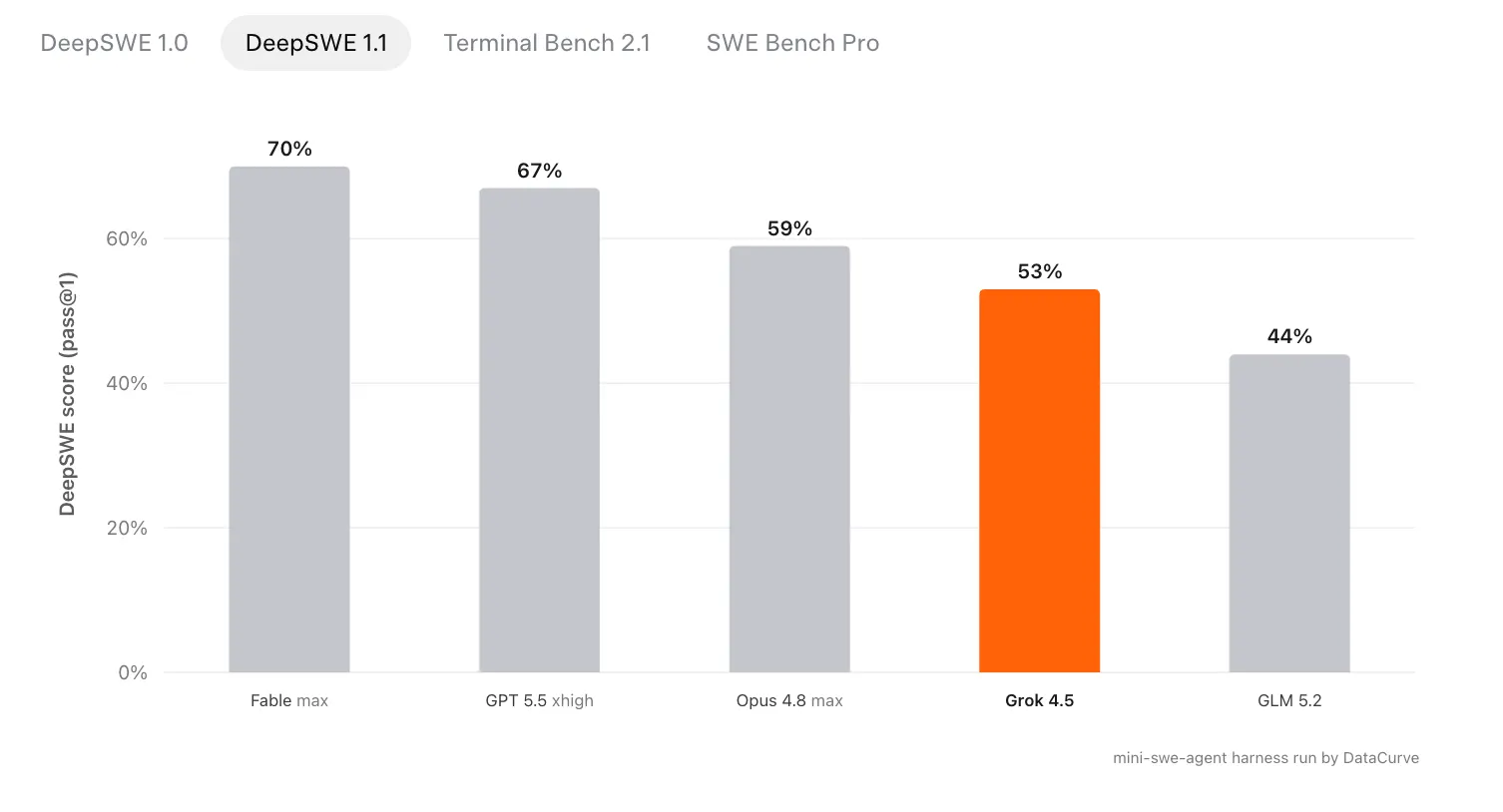
In the DeepSWE 1.1 benchmark—a standardized test designed to measure how reliably an AI can resolve actual software bugs—Grok 4.5 posted a score of 53%. While respectable, it trails behind the current industry leaders: Anthropic’s Claude Opus 4.8 (59%), OpenAI’s GPT 5.5 (67%), and the current gold standard, Claude Fable 5, which leads the pack at 70%.
However, the narrative shifts when looking at the SWE Bench Pro, which assesses a broader collection of software engineering challenges. Here, Grok 4.5 managed a score of 64.7%, successfully outpacing GPT 5.5’s 58.6%. While still trailing the frontier leaders, the result proves that the model is more than capable of handling sophisticated coding tasks, provided the use case aligns with its training architecture.
It is important to note the timing of these benchmarks. SpaceXAI’s internal testing compared the model against GPT 5.5, a move necessitated by the fact that OpenAI’s new flagship, GPT 5.6 Sol, was launched on the very same Wednesday as Grok 4.5. This synchronization of industry-wide releases underscores the breakneck speed at which these companies are iterating.
Official Responses and Strategic Trade-offs
Elon Musk, ever the vocal proponent of his own technology, took to X (formerly Twitter) to manage expectations regarding the model’s capabilities. Rather than claiming a total victory, he framed Grok 4.5 as "roughly comparable to Opus 4.7, but much faster."
This characterization highlights a deliberate strategic pivot. Musk and the SpaceXAI team are betting that for most corporate applications, the marginal utility of a slightly smarter model is eclipsed by the utility of a model that is significantly faster and cheaper. By prioritizing throughput over raw, "frontier-level" intelligence, SpaceXAI is attempting to capture the massive market segment of developers and analysts who cannot afford the high latency and exorbitant costs of the top-tier models.
The "efficiency math" behind this is compelling. During internal testing on SWE Bench Pro, Grok 4.5 utilized an average of 15,954 output tokens to complete a job, whereas the industry-leading Opus 4.8 consumed 67,020 tokens to achieve the same result. This represents a 4.2x efficiency gap. When scaled across millions of tasks, this difference in consumption, combined with a lower price-per-token model, creates a compelling value proposition.
The Economic Implications: Pricing as a Weapon
In the current LLM market, pricing has become as significant a competitive differentiator as model intelligence. SpaceXAI has priced Grok 4.5 at $2 per million input tokens and $6 per million output tokens. For context, the industry leaders are significantly more expensive:
- Claude Opus 4.8: $5 input / $25 output.
- GPT 5.6 Sol: $5 input / $30 output.
For high-volume enterprises, these savings are not just incremental; they are structural. Companies building financial models, automated legal review pipelines, or large-scale code-base refactoring tools are highly sensitive to these costs. By offering a model that is roughly 60% cheaper per input token than its rivals, SpaceXAI is effectively commoditizing the AI middle-tier, forcing competitors to justify their higher pricing through performance gains that may not be apparent in everyday tasks.
Beyond the Numbers: Real-World Utility
While the technical benchmarks provide a baseline, the true test of Grok 4.5 lies in its practical application. Initial third-party reviews have been mixed. In creative writing tasks, the model has been described as underwhelming, lacking the nuance and "human" cadence of its more expensive counterparts. However, for deterministic tasks like debugging or writing boilerplate code, it has performed admirably.
The model boasts a context window of half a million tokens—roughly 400,000 words—allowing users to ingest entire technical documentation sets or sprawling legal archives into a single session. This, combined with its 80 tokens-per-second speed, makes it a highly reactive assistant for developers who require instant feedback.
The Road Ahead: Challenges and Expansion
Despite the launch, challenges remain. The most immediate is regional availability; while the API is live in many parts of the world, European users face a delay, with SpaceXAI scheduling a regional rollout for mid-July. Furthermore, the company remains under legal and ethical scrutiny regarding its training data practices. As Musk has previously acknowledged, the use of proprietary data from third-party platforms has drawn fire from regulators and privacy advocates. The acquisition of Cursor is clearly intended to solve this by bringing the training data source inside the company’s own legal perimeter.
Ultimately, Grok 4.5 is a signal of the maturation of the AI industry. We are moving away from a period defined solely by the pursuit of the "Agi-level" frontier model and into an era of specialization and cost-optimization. Whether SpaceXAI can successfully leverage its massive compute advantage to eventually overtake the leaders in quality, or whether it will remain the "value option" for the enterprise, remains to be seen. For now, the math is clear: SpaceXAI is betting that the world doesn’t always need a genius; sometimes, it just needs a fast, affordable, and reliable workhorse.
