


In the high-stakes arena of digital assets, Bitcoin has long been a barometer for investor sentiment. As of June 2026, the cryptocurrency market is grappling with a stark reality: over 10.46 million BTC—nearly half of the entire circulating supply—is currently trapped in an "underwater" state. This means that for the owners of these coins, the current market value is lower than their original acquisition price.
For seasoned analysts, this figure is not merely a statistic of financial loss; it is a profound contrarian signal. Historically, when such a significant portion of the Bitcoin supply enters the red, the market often reaches a point of exhaustion, signaling that the worst of the selling pressure may be behind us.
Main Facts: The Anatomy of a Market Correction
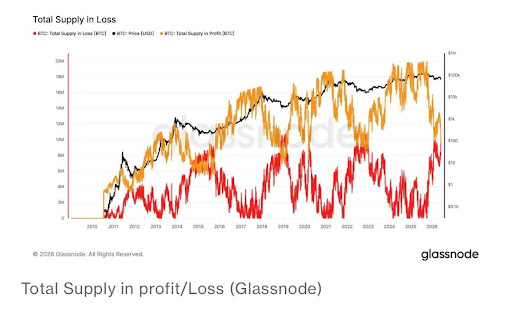
The current state of the Bitcoin network is defined by a massive overhang of unrealized losses. According to data provided by Glassnode, the "Total Supply in Loss" metric has crossed the critical 10-million-coin threshold. In a market where the total circulating supply is approaching the 21-million cap, this accumulation of "underwater" coins suggests that the average holder is facing significant psychological and financial pressure.
The price action corroborates this sentiment. Trading near $63,242, Bitcoin has endured a volatile journey from its recent cycle highs, experiencing a correction exceeding 40% over the past year. This sustained downward trend has effectively moved millions of coins from the hands of profitable investors into the portfolios of those currently holding depreciated assets.

A Chronological Look at the Descent
To understand the current market position, one must look at the progression of the 2025–2026 cycle.
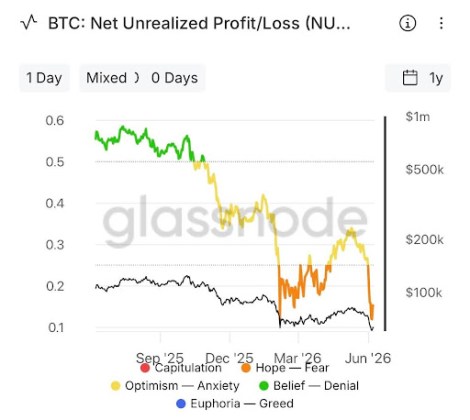
- Early 2025: Bitcoin entered a phase of extreme euphoria, with prices reaching new peaks as institutional adoption signaled a "super cycle." During this period, the vast majority of circulating supply was in profit, and the NUPL (Net Unrealized Profit/Loss) indicator remained firmly in the "Belief" and "Euphoria" zones.
- Late 2025: As macroeconomic headwinds—including shifting interest rate policies and liquidity tightening—began to impact risk-on assets, Bitcoin’s momentum stalled. The initial cooling period saw a pivot, where long-term holders began to distribute their assets to new buyers.
- Q1 2026: The onset of a deeper correction began to manifest on-chain. As prices slipped below key support levels, the "Supply in Profit" metric began to contract rapidly.
- June 2026 (The Current Threshold): The "Supply in Loss" metric reached the 10.46 million mark. This specific level has been historically recognized by analysts like Ali Martinez as a zone of "maximum pain," a psychological floor where the incentive to sell is often replaced by the necessity of "HODLing."
Supporting Data: Why 10 Million BTC Matters
The significance of the 10-million-coin mark lies in the behavior of market participants. On-chain analysis indicates that when a massive portion of the supply is in loss, the market undergoes a "capitulation" process.
The NUPL Indicator
The Net Unrealized Profit/Loss (NUPL) indicator provides a visual representation of this stress. Having transitioned from "Euphoria" to the "Hope/Fear" zone, the current readings suggest that the market is currently "washing out" weak hands. Historical data shows that when the NUPL drops into these lower bands, it often precedes a period of long-term accumulation by "smart money"—entities that possess the liquidity and patience to buy while others are forced to exit at a loss.
Diminishing Selling Pressure
Analyst Ali Martinez posits a compelling theory regarding this phenomenon: when an overwhelming majority of investors are already "deeply underwater," the propensity to sell drops significantly. If an investor is down 30% or 40%, the marginal utility of selling at the bottom is often outweighed by the hope of a eventual recovery. This leads to a drying up of liquidity on the sell-side, which acts as a foundational support for a potential price rebound.

Official and Expert Perspectives
While the on-chain data points toward a bottoming process, market experts remain cautious. The "Trusted Editorial" standards applied to this analysis emphasize that while history provides a roadmap, it does not provide a guarantee.
Industry experts note that the current environment is unique due to the presence of spot Bitcoin ETFs. Unlike previous cycles, where retail holders dominated the sell-side, the current market structure includes institutional players who may behave differently during periods of drawdown. However, the overarching consensus remains: the "underwater" status of 10 million BTC represents a classic "exhaustion" phase.
As noted by market observers, the shift from "Hope" to "Fear" is the final stage before the market resets. It is not necessarily a signal that prices will immediately skyrocket, but rather that the "capitulation" needed to clear the market of speculative leverage is largely underway.
Implications: The Path to Recovery
What does this mean for the average investor? If history is any guide, the accumulation phase that follows such periods of extreme unrealized loss is often the most profitable time to hold.
1. The End of Capitulation
The fact that 10.46 million BTC are held in loss implies that the market has purged a significant amount of the leverage that characterized the bull run. When the "weak hands" have exited, the market becomes less volatile and more prone to organic growth.
2. Accumulation Zones
Investors often look at these levels as "Value Zones." Because the price has retreated so far from its highs, the current valuation is viewed by many institutions as a discount. If the 10-million-coin mark acts as a pivot, we can expect a period of "sideways" consolidation before a potential move to the upside.
3. The Psychological Shift
The most important implication is psychological. Markets bottom when the last seller has finally given up. With such a massive portion of the supply currently in loss, the "fear" is palpable. In financial cycles, this is the classic definition of a bottom—when the pessimism is so widespread that the market can no longer go down, because everyone who was willing to sell has already done so.
Conclusion: A New Chapter?
As we move through the second half of 2026, the question is not just whether Bitcoin will recover, but how long the current "underwater" state will persist. The data clearly shows that we are in a historical zone of consolidation. While the path ahead may remain volatile, the sheer volume of BTC held at a loss suggests that the market is forming a base.
For those watching the charts, the key is to look for a decrease in the "Supply in Loss" as prices begin to stabilize. Once the market shifts from "Fear" back into "Belief," the current period of stagnation will likely be viewed as the foundation for the next major leg of the Bitcoin cycle.
Bitcoin’s journey is rarely a straight line, but the evidence of a massive, broad-based "underwater" supply indicates that the market is doing exactly what it needs to do to prepare for its next move. Whether this leads to an immediate bull market or a prolonged period of recovery, the data confirms one thing: the current levels are significant, and the market is undergoing a necessary, if painful, transition.
Disclaimer: This article is for informational purposes only and does not constitute financial advice. Cryptocurrency investments carry inherent risks. Please consult with a qualified financial advisor before making any investment decisions.
