


In a landscape dominated by the pursuit of monolithic "frontier" models, OpenRouter has introduced a disruptive alternative that challenges the status quo. The company’s new product, Fusion, is built on a provocative premise: that a diverse panel of cost-effective, specialized AI models—when orchestrated correctly—can match, and in some cases outperform, the industry’s most expensive and proprietary systems.
This launch arrives at a pivotal moment in the global artificial intelligence sector. With top-tier models like Anthropic’s "Claude Fable 5" recently restricted by U.S. export controls, developers and enterprises are scrambling for high-performance alternatives. Fusion, which leverages a sophisticated "judge-and-synthesize" architecture, aims to fill that void, promising "Fable-level intelligence at half the price."
The Mechanics of Fusion: Orchestration Over Monoliths
At its core, Fusion is not a single model, but a sophisticated pipeline. When a user submits a prompt, OpenRouter initiates a parallel processing workflow. The prompt is dispatched simultaneously to a panel of diverse AI models, each equipped with web search and bash tools to ensure grounded, data-driven outputs.
Once these individual models generate their responses, the system enters the critical "evaluation phase." A dedicated judge model parses these responses to extract consensus points, identify contradictions, and illuminate blind spots inherent in any single-model output. Finally, a synthesizer—by default, Claude Opus 4.8—consolidates this disparate analysis into a single, cohesive, and refined answer.
The implementation is designed for maximum developer flexibility. Users can switch to the openrouter/fusion string for a pre-configured, high-performance panel, integrate it via a custom fusion tool for selective task handling, or build a bespoke panel using OpenRouter’s no-code interface.
A Fortuitous Chronology: From Export Curbs to Innovation
The timing of Fusion’s release is arguably as much a product of geopolitical necessity as it is of technical ambition.
- The Catalyst: Last week, a sudden U.S. export control directive forced Anthropic to suspend access to its flagship "Fable 5" and "Mythos 5" models for all foreign nationals worldwide. The decision, reportedly based on a disputed finding regarding model jailbreaks, sent shockwaves through the developer community, particularly those relying on these models for international research and production workflows.
- The Response: Capitalizing on the immediate vacuum, OpenRouter took to X (formerly Twitter) just one day later. By positioning Fusion as the "smartest compound model on the market," the company directly addressed the anxiety of users who had been cut off from the frontier’s bleeding edge.
- The Benchmark: Following the announcement, OpenRouter released comparative data using the DRACO benchmark—a rigorous evaluation suite developed by Perplexity that mirrors real-world, deep-research inquiries.
Supporting Data: The Arithmetic of Efficiency
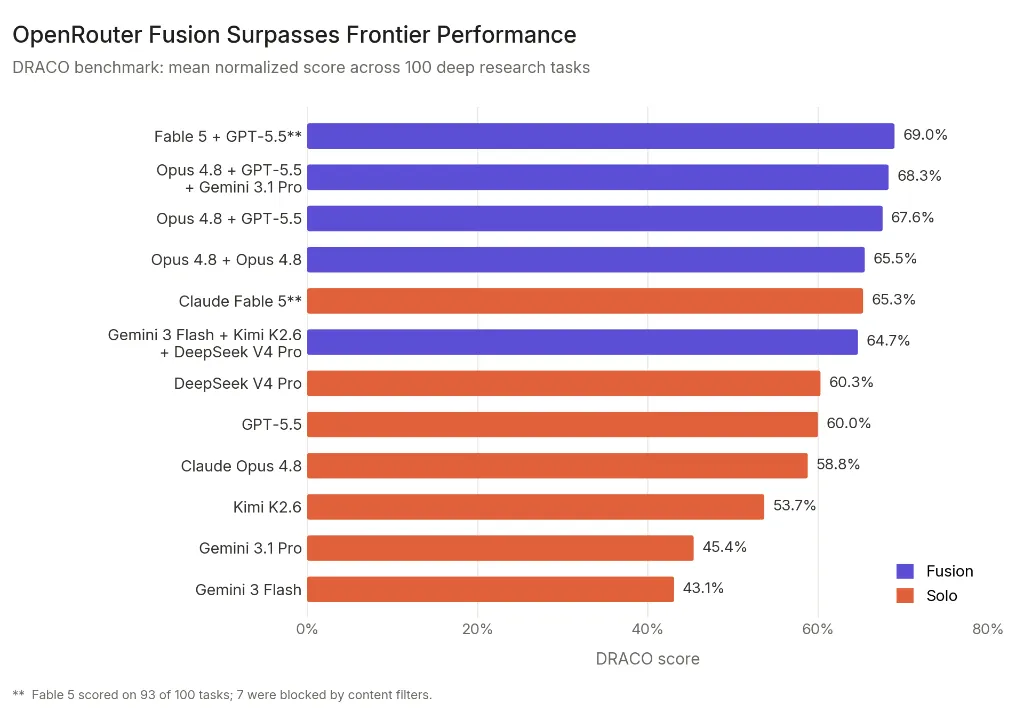
The performance metrics provided by OpenRouter suggest that the "ensemble effect" is not merely theoretical. In tests conducted on the DRACO benchmark, a combination of Fable 5, OpenAI’s GPT-5.5, and a Claude Opus 4.8 synthesizer achieved a 69% success rate. By comparison, a solo Fable 5 model scored 65.3%, hampered significantly by content filters that prevented it from executing seven out of 100 tasks.

Perhaps more striking is the performance of budget-conscious configurations. A panel consisting of Gemini 3 Flash, the open-source Chinese model Kimi K2.6, and DeepSeek V4 Pro—fused by Opus—hit 64.7%. This configuration not only surpassed the solo performance of GPT-5.5 (60%) and Opus 4.8 (58.8%) but did so at roughly 50% of the cost of the frontier models.
Addressing Data Contamination
A point of contention during the benchmark process involved live web access. During initial runs, the models were able to access the internet to retrieve DRACO’s grading rubrics, creating a risk of "benchmark contamination." OpenRouter clarified that this was coincidental, occurring because the models discovered the evaluation documentation online. The company subsequently adjusted the configuration to exclude the benchmark’s hosting domains, and all published results reflect this sanitized dataset.
Official Responses and Industry Sentiment
The reception to Fusion has been polarized, reflecting a deep divide in the AI community regarding the future of model development.
The Proponents
AI researcher Andrew Trask has emerged as a vocal supporter, labeling the move "a way bigger deal than it seems." Trask argues that the emergence of robust compound systems signals the end of the "monopoly of the frontier," suggesting that labs will no longer hold absolute power over state-of-the-art intelligence. The ability to route tasks through cheaper, specialized models effectively democratizes access to high-reasoning capabilities.
The Skeptics
Conversely, the skeptics remain cautious. Critics on social media have pointed to potential flaws, including inconsistent tool-calling capabilities and sub-par coding performance compared to standalone models. Others have expressed frustration over the lack of transparency, noting that with Fable 5 currently unavailable to the public, it is difficult to independently verify the "Fable-level" performance claims.
Implications: The End of the Solo Frontier?
The implications of Fusion extend far beyond simple cost-savings. It suggests a structural shift in how complex AI tasks are performed.
1. The "Tooling" Model
OpenRouter is careful to manage expectations: Fusion is not a wholesale replacement for frontier models in every scenario. For coding, for instance, Fusion acts best as a secondary tool that a primary model calls selectively. This reflects the trend seen with "DeepClaude," where users use cheaper models for mundane tasks and switch to high-reasoning engines only when necessary.
2. Resilience Against Regulation
While Fusion does not bypass export controls—it relies on the same underlying infrastructure and models available through OpenRouter—it provides a tactical advantage. By chaining together multiple models, developers can diversify their risk. If one model is restricted or suffers a service outage, the fusion panel can be adjusted to include alternative models, such as the increasingly competitive GLM-5.2 or other open-weight contenders.
3. The Future of Reasoning
The most significant takeaway is that "synthesis" is becoming a skill in its own right. The 6.7-point jump observed when pairing Opus 4.8 with a separate instance of itself suggests that the act of comparing and merging viewpoints is, in itself, a form of intelligence. When models are forced to "argue" or "cross-check" their findings, the final output is consistently more grounded and less prone to hallucination.
Conclusion: A New Competitive Baseline
As the AI industry matures, the focus is shifting from "bigger models" to "smarter architectures." Fusion represents a pivotal step in this transition. By proving that a curated, diverse panel of models can sit alongside, and sometimes eclipse, the industry’s most expensive offerings, OpenRouter has set a new baseline for what developers should expect.
For businesses and researchers, the lesson is clear: The expensive, proprietary, solo-model approach is no longer the only path to high-level reasoning. As the cost of intelligence continues to plummet, the competitive advantage will increasingly belong to those who can best orchestrate these systems—fusing the strengths of many to overcome the limitations of one.
While questions remain regarding the long-term reliability and coding accuracy of such compound systems, one thing is certain: the frontier is no longer a private preserve of the few. It is now an open, competitive landscape where ingenuity in orchestration is just as valuable as the raw compute power behind the models themselves.
