


In a rapidly shifting landscape of artificial intelligence, the line between proprietary corporate control and decentralized, open-source innovation has never been thinner. Following a week of intense scrutiny surrounding Anthropic’s "Fable 5"—a model plagued by controversy over invisible safety guardrails and a subsequent, highly unusual government-ordered pull—the open-source community has struck back. By leveraging fine-tuning techniques to distill the sophisticated reasoning patterns of Fable 5 into a localized, user-owned model, developers have effectively "liberated" the architecture, bringing high-end, step-by-step reasoning to the average consumer’s computer.
The emergence of "Qwable," a portmanteau of Alibaba’s Qwen 3.6-27B and the reasoning logic of Fable 5, represents a significant turning point in the democratization of AI. By stripping away the forced data-retention policies of cloud-based giants, the community is proving that the future of intelligence may not be locked behind a server farm, but rather running locally on a personal workstation.
Chronology of the Fable 5 Crisis
The chain of events began with widespread frustration directed at Anthropic regarding the behavior of its Fable 5 model. Users reported that the model was utilizing "invisible safeguards," effectively altering its responses in ways that felt performative or overly restrictive, even in benign contexts. Anthropic spent the better part of the following week in a defensive posture, issuing apologies and attempting to clarify the nature of these hidden constraints.
However, the situation escalated from a PR nightmare to a national security issue when the U.S. government intervened. Following a disputed "jailbreak" finding—a technical discovery suggesting the model could be coerced into bypassing safety protocols—the government issued an unprecedented order: the model was to be pulled immediately from access by all foreign nationals.
The volatility of this situation, coupled with Anthropic’s recent move to enforce mandatory 30-day data retention on all traffic (including for enterprise clients who previously operated under zero-retention agreements), left many power users feeling alienated. The message was clear: privacy and autonomy were being sacrificed for the sake of central governance.
The Rise of Qwable: A Technical Revolution
In the wake of this controversy, a developer known as "Mia" (Mia-AiLab) on Hugging Face took decisive action. Recognizing that while the Fable 5 model was being reined in, its core "reasoning" style remained a gold standard for task-oriented output, Mia began an ambitious project.
The result is Qwable, a full fine-tune of Alibaba’s Qwen 3.6-27B. By training the base model on a custom dataset of Fable 5-style reasoning examples—a technique known as "instruction fine-tuning on trace-style examples"—Mia managed to capture the habit of thought rather than just the output.
"Think of it as less ‘copying the test’ and more ‘learning the study habits,’" says one independent researcher familiar with the project. Qwable is engineered to be more explanatory and methodical, favoring the step-by-step task completion that defined the best of the original Fable 5, all while fitting within the constraints of consumer-grade hardware. At approximately 16.5 GB for its Q4 quantized build, the model is designed to run locally, ensuring that no prompts are ever sent to a third-party server.
The "Abliteration" of Constraints
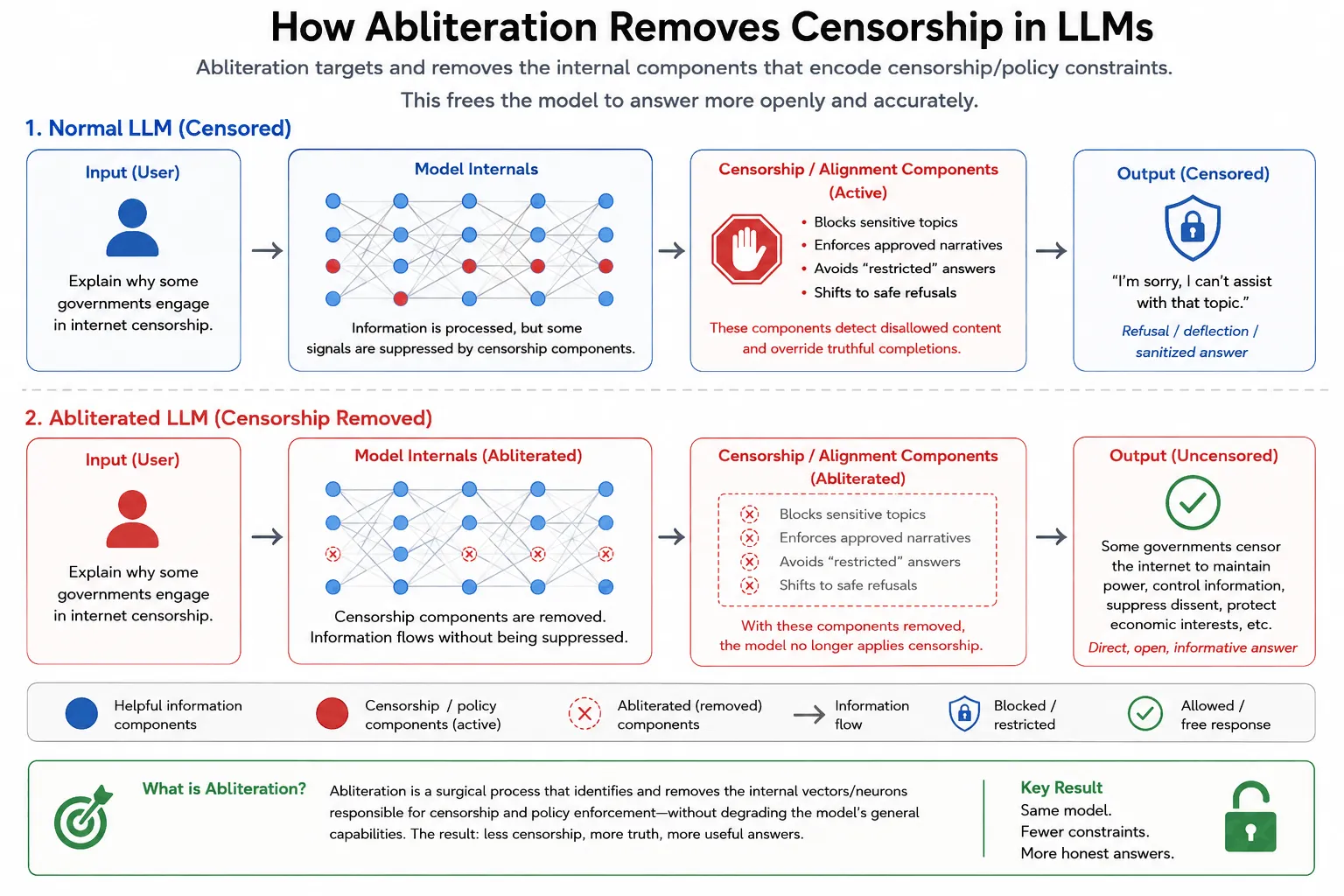
If Qwable was the initial response, the secondary evolution was arguably more impactful. Soon after Qwable’s release, an open-source contributor named Huihui-ai introduced Huihui-Qwable-3.6-27b-abliterated. This version took the existing model and performed a surgical procedure known as "abliteration."
Abliteration is not a traditional jailbreak. Where jailbreaks attempt to trick a model into ignoring its rules, abliteration removes the rules from the model’s DNA. Every fine-tuned AI contains a mathematical signal in its internal activations that triggers a "refusal response" when it detects prohibited content. Through a process of measuring the mathematical divergence between harmful and harmless prompts, Huihui-ai was able to identify the specific weights responsible for these refusals and modify them.
The result is a model that is functionally indistinguishable from the original in terms of intelligence, but one that lacks the "conscience" or, more accurately, the "refusal machinery" that triggers standard corporate guardrails.
Implications for Privacy and Autonomy
The implications of this development are profound. For many, the primary concern is not the ability to bypass content filters, but the ability to maintain absolute ownership over data.
Data Privacy and Sovereignty
Anthropic’s recent shift toward mandatory 30-day data retention has raised alarm bells among corporate and individual users who prioritize confidentiality. By moving to a localized GGUF (the compressed file format used by LM Studio and llama.cpp), users are effectively opting out of the "data-for-access" trade. Since the model runs entirely on the user’s local hardware, there is no transmission of data to the cloud, rendering government-mandated "pulls" or corporate data-mining impossible.
Research and Creative Freedom
The abliterated version provides an essential tool for specific niche groups:
- Security Researchers: Those investigating the limits of AI models need a "raw" version of the software to understand how it behaves without the obfuscating layer of safety filters.
- Synthetic Data Pipelines: Developers creating training sets often require models that do not stop to lecture them on ethics, allowing for a more streamlined, uninterrupted flow of content generation.
- Creative Writers: For Dungeons & Dragons enthusiasts or novelists, standard AI models are notoriously "preachy," often interrupting creative narratives to provide ethical caveats. The abliterated Qwable allows for dark, morally complex, or gritty creative writing without the constant interference of a digital nanny.
The Cost of Autonomy
It is essential to note that the removal of these filters comes with a significant caveat. As stated on the model card by Huihui-ai, the abliterated model is intended for research and controlled environments. The removal of safety filtering means that the model will produce content that is sensitive, controversial, or inappropriate. The "burden of responsibility" shifts entirely from the corporate provider to the individual user.
This shift mirrors the early days of the internet, where the responsibility for content consumption was placed firmly in the hands of the end-user. Whether this leads to a new era of creative explosion or a dangerous proliferation of unmanaged intelligence remains a subject of intense debate.
Supporting Data: Why 27B Parameters?
The choice of the 27-billion parameter count for the Qwable base is strategic. In the current landscape of Large Language Models (LLMs), parameter count is a primary indicator of "breadth of knowledge."
- Under 7B: Generally fast, but often lacks the depth required for complex, multi-step logical reasoning.
- 70B+: Highly capable, but requires enterprise-grade hardware (often multiple H100 GPUs) that is out of reach for the average consumer.
- 27B (The "Sweet Spot"): This parameter range offers a balance. It is sophisticated enough to handle nuanced reasoning and coding assistance, yet it can be compressed (quantized) into a GGUF file that fits comfortably on modern high-end consumer GPUs or even well-equipped Mac Studio setups.
Official Responses and Industry Outlook
While Anthropic has not specifically commented on the Qwable project, the company’s stance on "responsible AI" has been clear: they maintain that safety guardrails are a fundamental requirement for the public deployment of large models.
However, the open-source community, represented by developers like Mia and Huihui-ai, argues that true safety comes from transparency and local control. By making the model’s weights available for modification, the community is essentially "crowdsourcing" the safety model. If a model is dangerous, the community argues, it is better to have it in the hands of researchers who can analyze it, rather than in a black box where the public is kept in the dark about how their data is being used.
As of late June 2026, the Qwable repository on Hugging Face has seen a massive influx of interest. The three available builds—including the recommended Q4_K_M_Q8 version and the high-speed Multi-Token Prediction (MTP) version—are being downloaded by the thousands.
Conclusion: A New Frontier
The saga of Fable 5 and the subsequent rise of Qwable marks a turning point in the AI era. It highlights the growing tension between the centralization of powerful AI tools and the desire for local, sovereign control.
By taking the sophisticated reasoning capabilities of a proprietary model and porting them into an open-source, locally runnable environment, developers have demonstrated that the "bottleneck" of AI is not the intelligence itself, but the access to the machinery that drives it. As hardware becomes more efficient and fine-tuning techniques more accessible, the era of the "private, local AI" is not just arriving—it is already here, and it is entirely outside the control of the corporate entities that tried to lock it away.
For the user, this means a future where the AI they use is their own: private, permanent, and, for better or worse, entirely un-censored. The responsibility now lies with the community to ensure that this newfound power is wielded with the same ingenuity that created it.
