

WASHINGTON — Wall Street is bracing for a momentous shift in monetary policy as the Federal Open Market Committee (FOMC) prepares to conclude its two-day policy meeting on Wednesday. Financial markets are pricing in a move the central bank has not executed since 2023: a hike in interest rates.
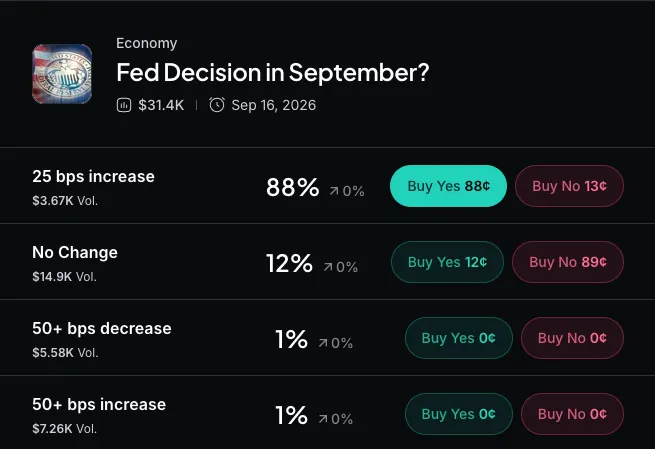
According to CME’s FedWatch tool, the implied probability of a quarter-point rate increase sits at an overwhelming 94.5%, skyrocketing from under 50% just a month ago. This dramatic repricing reflects mounting evidence that stubborn inflationary pressures, geopolitical friction, and a resilient labor market have backed the central bank into a corner.
As traditional equities and digital asset markets alike feel the strain, the upcoming decision—and the accompanying commentary from Fed Chair Kevin Warsh—stands to redefine the macroeconomic landscape heading into the final quarter of the year.
Main Facts
- The Impending Decision: The FOMC concludes its two-day meeting on Wednesday, with markets pricing in a near-certain 25-basis-point interest rate hike.
- Rapid Sentiment Shift: CME’s FedWatch tool indicates a 94.5% probability of a rate increase, up from less than 50% a month prior. Major financial institutions, including Barclays, Citigroup, JPMorgan Chase, Morgan Stanley, and UBS, now project a cumulative 50 basis points of tightening by the end of the year.
- Economic Drivers: Headline Consumer Price Index (CPI) inflation ran at 3.4% annually in August, with core inflation at 2.5%—both remaining stubbornly above the Fed’s official 2% target. Compounding these pressures are elevated oil prices driven by ongoing geopolitical conflict involving Iran, alongside a stronger-than-expected August jobs report.
- Political Tensions: The rate hike puts Fed Chair Kevin Warsh—handpicked by President Donald Trump and sworn in last May—at odds with the administration. Trump, Vice President JD Vance, and Treasury Secretary Scott Bessent have publicly advocated for monetary easing, creating a high-stakes political collision course.
- Market Aftermath: Bitcoin and broader altcoin markets have pulled back sharply from recent local peaks. Concurrently, traditional fixed-income markets have reacted violently, pushing the 10-year U.S. Treasury yield to 5.04%, its highest level since July 2007.
Chronology: How the Rate Hike Expectations Intensified
The pivot from a stable interest rate environment to an imminent tightening cycle materialized with unexpected speed over the summer months.
- July 2025: The Federal Reserve voted to hold the benchmark interest rate steady in a range of 3.50% to 3.75%. However, the decision exposed a deepening ideological rift within the committee, passing by a narrow 9–3 vote. Three dissenting policymakers actively pushed for an immediate rate increase, signaling underlying internal anxiety over persistent price pressures.
- Early August 2025: Geopolitical tensions in the Middle East intensified, driving up global crude oil prices and introducing a fresh wave of cost-push inflation that neither domestic tariffs nor existing fiscal policies could easily offset.
- Mid-August 2025: The U.S. Bureau of Labor Statistics released the August employment report, which vastly outperformed economists’ consensus estimates. The robust jobs market demonstrated that economic activity remained too hot for the Fed’s comfort, undermining the argument for immediate monetary loosening.
- Early September 2025: A comprehensive Wall Street Journal survey revealed a near-total consensus among primary dealers and major banks that the central bank would reverse course in September.
- Mid-September 2025: On the legislative front, the long-awaited "Clarity Act"—a landmark crypto market structure bill—failed to clear a crucial Senate cloture vote. Combined with the leaking consensus on impending Fed tightening, the legislative failure catalyzed a sharp sell-off across risk-on asset classes, dragging Bitcoin down from its monthly highs near $82,000 to around $75,700.
Supporting Data and Market Reactions
The bond market has acted as an early warning system for the broader financial ecosystem, reacting aggressively well in advance of Wednesday’s official announcement.
- Treasury Yields Surge: The benchmark 10-year Treasury yield surged to 5.04% this week, marking its highest watermark since July 2007. Meanwhile, the policy-sensitive two-year Treasury yield climbed to levels not seen since July 2024.
- Divergent Wall Street Forecasts: Wall Street institutions are deeply divided on the terminal rate for this cycle.
- The Consensus Group: Major institutions including Barclays, Citigroup, JPMorgan, Morgan Stanley, and UBS expect a total of 50 basis points of tightening before the year concludes.
- The Hawkish Camp: Bank of America, Deutsche Bank, and RBC are projecting an even more aggressive 75 basis points of total tightening.
- The Dovish Outliers: Goldman Sachs remains at the conservative end of the hiking spectrum, penciling in only Wednesday’s quarter-point move with no further hikes expected. Jefferies and Oxford Economics stand alone in forecasting actual rate cuts by December and 2027, respectively.
- Crypto Technical Thresholds: Bitcoin’s retreat has placed the asset near critical technical support levels. Market analysts point to $73,200 as an essential line in the sand. A sustained daily close below this threshold risks triggering cascading liquidations down to $71,000 or even $66,900, which would effectively invalidate the bullish technical structures—such as the recent golden cross—that defined late summer price action.
Official Responses and Political Friction
The prospect of a monetary tightening cycle has injected acute political tension into Washington, directly testing the statutory independence of the Federal Reserve.
When President Donald Trump selected Kevin Warsh to lead the central bank in January—culminating in his swearing-in ceremony in May—he publicly urged the new chairman to maintain absolute institutional independence while making it abundantly clear that the White House favored lower borrowing costs.
Those expectations have now collided with macroeconomic reality. Over the past two weeks, President Trump, Vice President JD Vance, and Treasury Secretary Scott Bessent have engaged in an unprecedented coordinated public campaign demanding monetary easing. President Trump escalated rhetoric further, threatening to impose severe trade restrictions on foreign nations running trade surpluses with the United States if domestic borrowing costs fail to decline.
Despite mounting political pressure, Fed Chair Warsh has consistently maintained that the executive branch has exerted zero influence over monetary policy formulations. Analysts note that Warsh faces an unenviable public relations dilemma: executing a necessary inflation-fighting rate hike merely two months before the November midterms, at a time when voters are already visibly fatigued by elevated living costs and expensive debt servicing. Compounding the irony, the inflation pressures forcing the Fed’s hand are driven in part by the very fiscal and tariff policies championed by the administration itself.
Implications for Investors, Traditional Markets, and Crypto
For everyday borrowers, institutional investors, and digital asset speculators, the return of a rising rate environment alters the fundamental calculus of portfolio management.
Traditional Markets and Fixed Income
Higher interest rates universally elevate the cost of capital, dampening consumer spending, slowing corporate expansion, and compressing equity valuations. Furthermore, as government-backed fixed-income instruments like 10-year Treasurys offer yields above 5%, institutional capital faces a powerful gravitational pull away from speculative equities and toward risk-free assets. This dynamic also tends to strengthen the U.S. dollar, creating persistent headwinds for commodities and globally traded assets.
Digital Assets and Bitcoin
Cryptocurrencies have historically flourished in low-interest-rate environments characterized by abundant liquidity and cheap capital. A reversal of this macro backdrop poses immediate challenges:
- The Liquidity Squeeze: As borrowing costs rise and capital shifts toward high-yielding sovereign debt, the marginal liquidity available for speculative crypto assets diminishes.
- High-Beta Volatility: Altcoins and decentralized finance (DeFi) tokens—exhibiting higher beta than Bitcoin—are anticipated to experience amplified percentage drawdowns due to thinner order books and over-leveraged long positions.
- Nuanced Perspectives: Not all market participants view the impending hike as an unmitigated disaster. Some macro analysts argue that if the anticipated quarter-point hike is primarily utilized to anchor long-term debt yields rather than aggressively choke off economic growth, the medium-term structural thesis for Bitcoin as an inflation hedge may remain resilient. Much will depend on the nuanced language utilized in the FOMC’s updated "dot plot" and Chair Warsh’s post-meeting press conference.
What to Watch Next
The official FOMC rate decision, policy statement, and updated economic projections will be released at 2:00 p.m. ET on Wednesday, followed immediately by Chair Kevin Warsh’s press conference at 2:30 p.m. ET. Financial markets will parse every word for clues regarding whether policymakers intend to pause after a single hike or embark on a more aggressive, multi-step tightening campaign through the winter months.
