

The Decentralized Finance (DeFi) sector finds itself at a critical crossroads in 2026. As the industry attempts to bridge the gap between niche crypto-native applications and the massive pools of capital held by institutional investors, it faces a dual narrative: one of maturing infrastructure and one of persistent, evolving security threats. While headlines frequently highlight record-breaking hack incidents, a closer examination by industry leaders—most notably Haseeb Qureshi of Dragonfly—suggests a more nuanced reality where the median risk is declining, even as the surface area for attacks grows with the integration of Artificial Intelligence (AI).
Main Facts: The Evolving Landscape of DeFi Security
The central debate currently dividing market participants is whether DeFi is becoming safer or if it is merely hiding its vulnerabilities behind a facade of statistical noise. Recent data points toward a "paradox of scale." While the total dollar value lost to exploits remains substantial, the profile of these attacks is shifting.
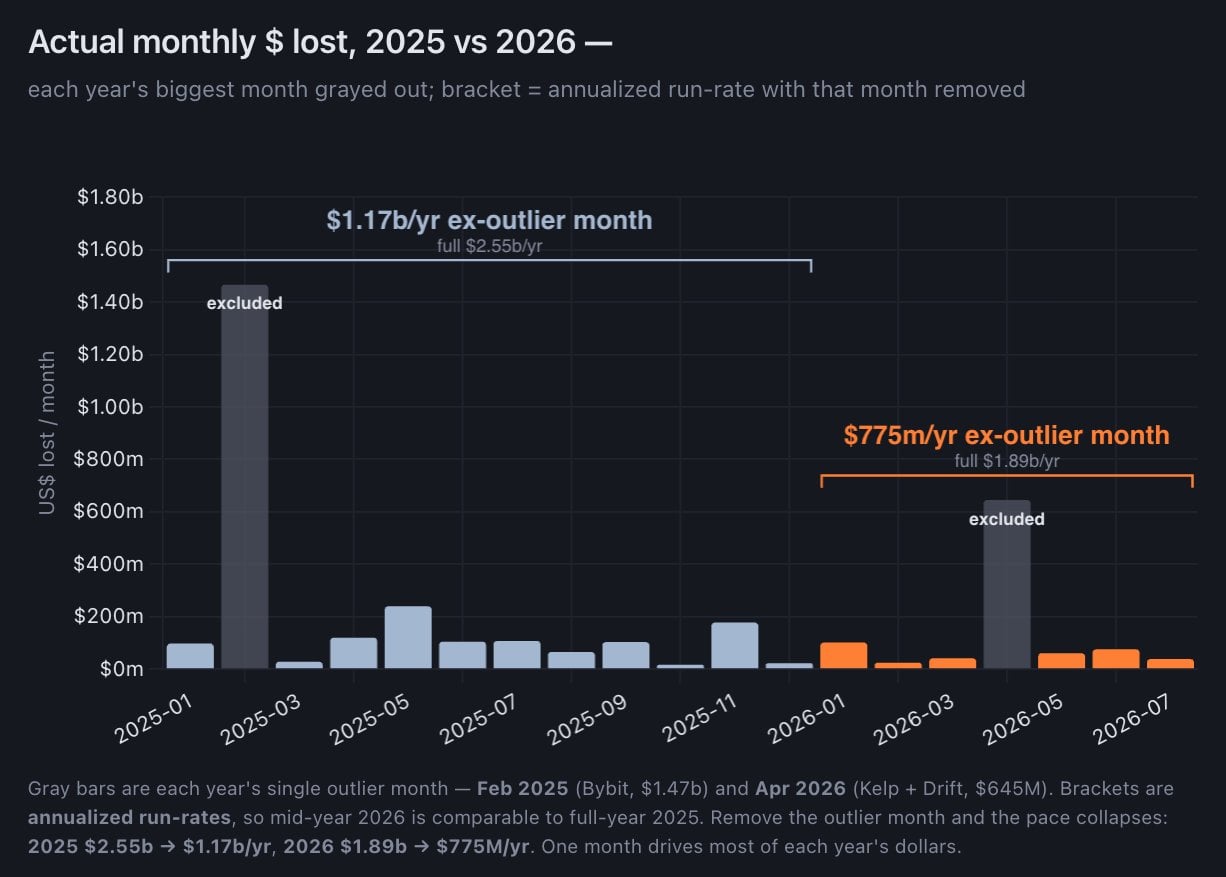
Haseeb Qureshi, a prominent managing partner at venture capital firm Dragonfly, has challenged the prevailing "DeFi is unsafe" narrative. Qureshi argues that when one looks past the outliers—the massive, headline-grabbing breaches like the $1.4 billion Bybit exploit or the $292 million KelpDAO incident—the underlying data reveals a sector that is increasingly resilient.
The core of the argument rests on the "median hack size," which has seen a significant downward trend. As the industry matures, the "low-hanging fruit" for hackers is disappearing. Protocols are undergoing more rigorous audits, and the ecosystem is favoring established, battle-tested platforms over experimental, unaudited code. However, this safety is largely protocol-specific; investors who stick to "blue-chip" DeFi platforms that possess the capital to invest heavily in security audits and "hardened" infrastructure are seeing a decrease in their exposure to systemic risk.
Chronology of 2026: A Year of Highs and Lows
To understand the current state of DeFi, one must look at the trajectory of the first half of 2026.
- Q1 2026: The year began with a continued surge in DeFi activity, fueled by the resurgence of liquid staking and restaking protocols. This surge, however, attracted sophisticated malicious actors.
- April 2026: The KelpDAO hack served as a catalyst for a broader market panic. The exploit not only wiped out hundreds of millions in value but also triggered a "bank run" on major lending platforms like Aave, as liquidity providers feared contagion.
- May–June 2026: Security incidents hit record frequencies. While the number of individual hacks spiked to an all-time high, the average dollar value per exploit began a notable decline. This period marked the transition where hackers shifted from high-value protocol breaches to a larger volume of smaller, "nuisance" attacks on less-resourced, newer protocols.
- July 2026: As of mid-year, the industry has begun to stabilize. Total Value Locked (TVL) in DeFi vaults, which had plummeted from $113 billion to a nadir of $61 billion, shows signs of a tentative recovery at $65 billion, signaling that investor confidence is slowly returning.
Supporting Data: The Statistical Reality
The data regarding DeFi security is often misinterpreted. By isolating the catastrophic, outlier events, observers can draw vastly different conclusions about the sector’s safety.
The Declining Median
In 2025, the industry saw a staggering $2.55 billion lost to exploits. By comparison, 2026 projections currently track around $1.89 billion. While still high, the median hack size tells a different story. In 2021, the median hack size hovered above $8 million; by mid-2026, that figure had plummeted to below $1 million. This drastic reduction is a testament to the fact that while protocols are still being targeted, the "success rate" of attackers in draining significant portions of a protocol’s TVL is diminishing.
The Shift in Operational Security
A significant portion of the nearly $1 billion stolen in the first half of 2026 was attributed to "operational failures"—incidents involving compromised admin keys or flawed signing infrastructure. Historically, these have been the most devastating types of attacks. However, Qureshi notes that even these are trending downward in dollar terms. The implementation of Multi-Party Computation (MPC) wallets and more robust multisig governance frameworks is beginning to neutralize what was once the most common attack vector in the industry.
Official Responses and Expert Analysis
The industry’s leading voices are split on the implications of these trends. Haseeb Qureshi remains a vocal proponent of the "maturation" theory. His stance is that "the average dollar in DeFi is as safe as it was a year ago." He emphasizes that security is not a monolith; it is a feature of protocol architecture. Investors who prioritize protocols with professionalized security teams and significant treasury backing are effectively insulated from the majority of the risks plaguing the "long tail" of the DeFi ecosystem.
Conversely, some security analysts argue that the rise of AI-driven cyber-offensive tools—models specifically designed to identify zero-day vulnerabilities in smart contract code—threatens to reset the clock on DeFi security. If AI can scan thousands of protocols for minute logic errors in seconds, the current trend of declining hack sizes may only be a temporary lull before a new, more automated wave of exploits begins.
Implications for Institutional Adoption
The long-term success of DeFi hinges on its ability to transition from a speculative playground to a legitimate financial layer for real-world assets (RWAs).
The Rise of the "DeFi Vault"
The decline in TVL in DeFi vaults, while painful, has served as a stress test. S&P Global Ratings has taken a keen interest in these structures, viewing them as the spiritual and functional successors to traditional managed investment funds. The thesis is compelling: as tokenization of real-world assets accelerates, the "vault" becomes the institutional vehicle of choice. If a vault can provide a programmable, transparent, and audited way to yield-farm stablecoins or tokenized Treasury bills, it becomes a core piece of financial infrastructure.
The Risk-Reward Reassessment
The current environment has forced a re-evaluation of DeFi yields. With the average DeFi yield hovering between 2.7% and 3.8%, it is currently struggling to compete with the risk-free rate of U.S. Treasury bills. For institutional capital to return in force, DeFi must prove that its security, not just its yield, is on par with traditional finance.
The integration of security-hardened vault strategies—where smart contracts are heavily audited and wrapped in insurance-like protections—is the industry’s best hope. If the sector can successfully bridge the gap between the transparency of the blockchain and the institutional-grade security standards of traditional banks, the potential for an "adoption unlock" remains immense.
Conclusion: The Path Forward
The state of DeFi security in 2026 is one of evolving complexity. While the industry is clearly moving away from the era of "easy money" for hackers, the emergence of advanced, AI-assisted threats means there is no room for complacency.
For the average user, the advice from industry leaders remains clear: stay within the boundaries of major, well-capitalized protocols and avoid the temptation of experimental, high-yield vaults. For the industry at large, the mission is to continue professionalizing, hardening, and integrating with the broader financial world. The security fears of today are not necessarily a permanent roadblock; rather, they are the growing pains of an ecosystem that is rapidly maturing from a frontier experiment into a global financial utility. Whether this growth leads to institutional dominance or continued fragility will be the defining story of the next few years.
