

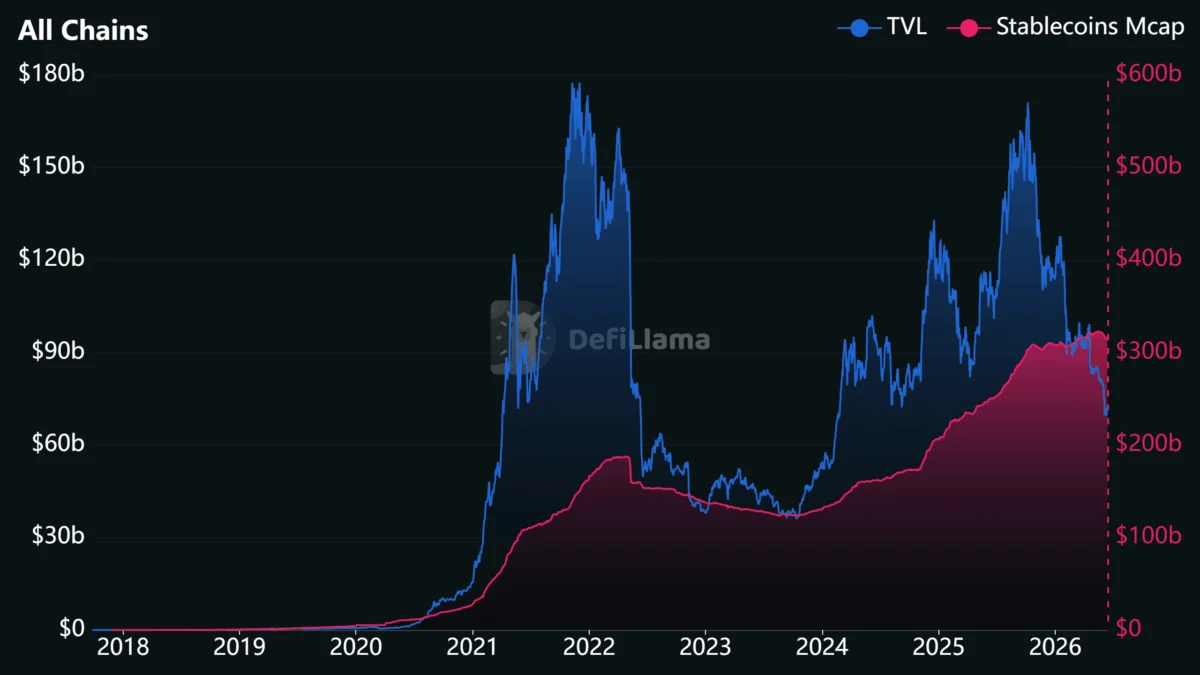
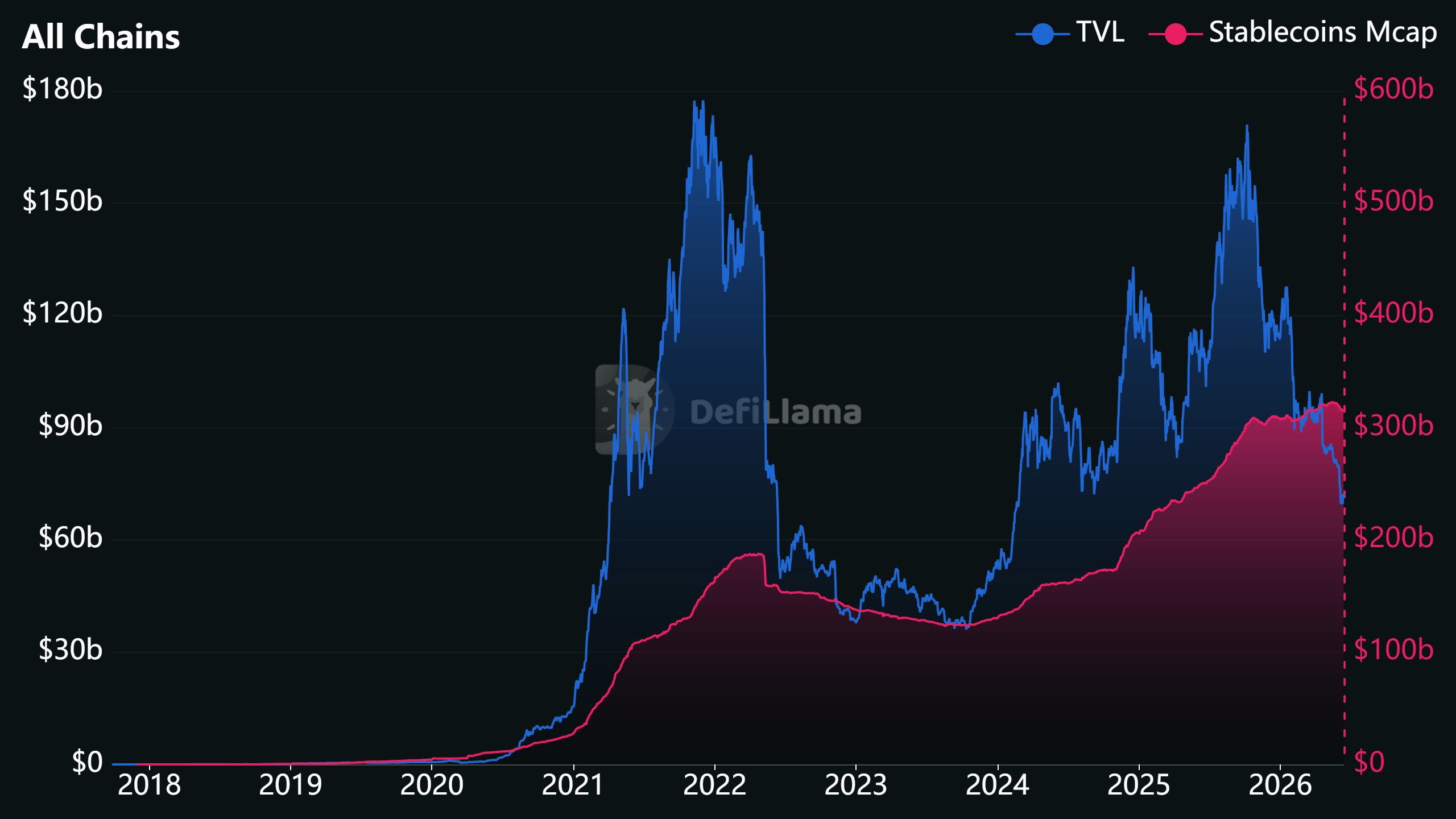
The landscape of Decentralized Finance (DeFi) is undergoing a profound transformation. Once the engine of explosive growth in the cryptocurrency ecosystem, the sector is currently navigating a period of significant capital flight. According to the latest data from DeFiLlama, the Total Value Locked (TVL) across the entire DeFi ecosystem has plummeted from a peak of nearly $178 billion in late 2025 to approximately $72.5 billion as of mid-2026. This stark decline represents more than just a market correction; it signals a fundamental shift in investor behavior and a reassessment of risk within the blockchain industry.
Main Facts: A Sector in Retreat
The decline in TVL is not isolated to a single niche or protocol. The weakness is systemic, spanning across lending platforms, liquid staking protocols, and cross-chain bridge services. This broad-based contraction suggests that the issue is not a failure of specific technological models, but rather a universal reduction in the willingness of market participants to deploy liquidity into decentralized protocols.
While the "headline" TVL figure has suffered, a paradoxical trend has emerged: stablecoin supply remains robust, hovering near $315 billion. This discrepancy is crucial for understanding the current market. The presence of such a massive amount of "dry powder" indicates that liquidity has not exited the cryptocurrency ecosystem entirely; rather, it is sitting on the sidelines, waiting for more favorable risk-adjusted returns. Investors have shifted their focus from maximizing yield to prioritizing capital preservation, signaling that the "DeFi summer" ethos of high-yield farming has been replaced by a more cautious, defensive strategy.
Chronology of the Contraction
The descent from the $178 billion peak did not happen overnight. It has been a steady, persistent erosion that began shortly after the late-2025 market highs.
- Q4 2025: The DeFi ecosystem reached its zenith, fueled by speculative fervor and high-interest-rate environments across various yield-farming protocols.
- Q1 2026: As market volatility increased, early signs of capital rotation became apparent. Users began moving funds out of high-risk "degen" pools and into more stable assets.
- April 2026: A wave of security incidents hit the industry. Reports indicated that over 70 protocols suffered exploits, leading to a cumulative loss of approximately $746 million. This period served as a turning point, severely denting institutional and retail confidence.
- Q2 2026: The decline accelerated as interest rates on stablecoin lending platforms compressed to between 3.5% and 9%. This compression made the risks of smart contract failure and liquidity insolvency appear disproportionately high compared to the potential rewards.
Supporting Data and The Risk-Reward Mismatch
To understand why capital is fleeing, one must look at the math behind the protocols. The current environment has created a persistent mismatch between risk and reward.
In previous years, DeFi users were often compensated with double-digit APYs for providing liquidity. Today, with stablecoin lending rates struggling to break the single-digit barrier on major platforms, the "carry trade" has lost its luster. When an investor calculates the risk of a potential exploit—especially given the $746 million in losses recorded in the second quarter of 2026—the 3.5% to 9% yield is no longer perceived as sufficient compensation.
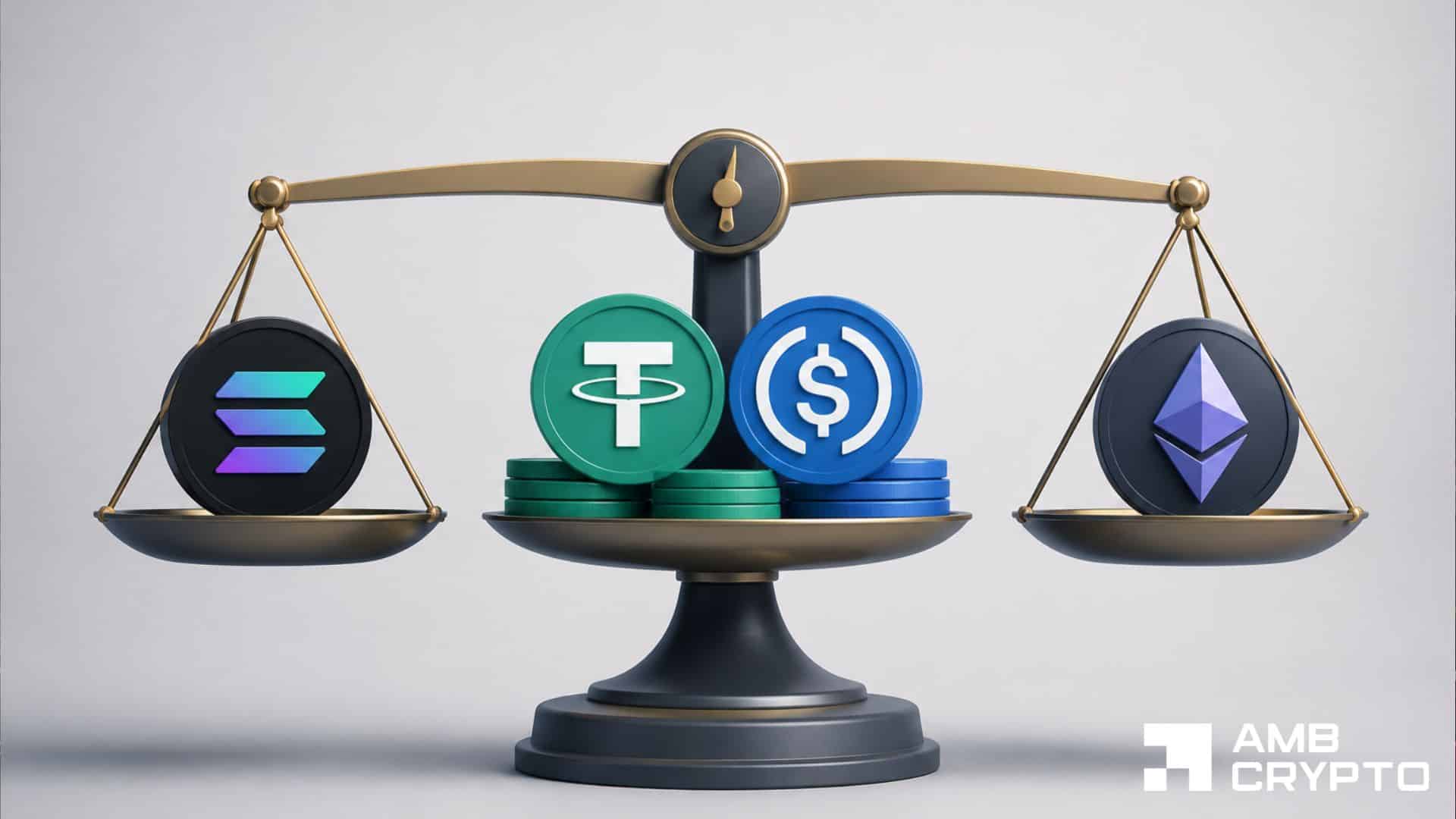
Furthermore, the data regarding staking participation on major networks like Ethereum and Solana provides a vital counter-narrative. While protocol-level TVL has plummeted, "native" staking remains remarkably resilient. Ethereum continues to see roughly one-third of its total supply staked, while Solana’s staking participation rate remains near 68%. This indicates that the decline in TVL is not a rejection of blockchain technology, but a rejection of the application layer of DeFi. Investors are choosing to hold and secure the base layer rather than risking assets in third-party lending or yield protocols.
Official Perspectives and Industry Implications
Industry analysts and security experts view this trend as a maturation of the market. During the initial boom years, the industry was characterized by rapid innovation at the expense of rigorous security audits. Now, the tide has turned.
"The current contraction is a necessary ‘flight to quality,’" noted one industry analyst. "Investors are no longer willing to gamble their capital on unproven smart contracts for the sake of yield. The ecosystem is currently being filtered; only protocols with high security standards, transparent governance, and sustainable economic models are likely to survive this period of austerity."
This sentiment is echoed by institutional observers who argue that the shift toward capital preservation is a hallmark of an industry moving from a "speculative experiment" phase to a "utility and security" phase. The $746 million in losses suffered in Q2 2026 acted as a catalyst for this shift, forcing developers to prioritize security over the rapid deployment of new, high-risk features.
Implications: What Lies Ahead for DeFi?
The implications of this shift are far-reaching.
1. The Consolidation of Protocols
We are likely to see a period of intense consolidation. Smaller protocols with limited liquidity and subpar security audits will likely disappear, while blue-chip DeFi protocols that have demonstrated long-term resilience will attract the majority of the remaining capital.
2. A Focus on Security-First Infrastructure
The era of "move fast and break things" is effectively over for DeFi. Future development will be defined by formal verification, decentralized insurance, and more stringent auditing standards. Protocols that can provide verifiable proof of security will hold a competitive advantage in attracting the massive stablecoin liquidity currently sitting on the sidelines.
3. The Rise of "Safe Yield"
As the market matures, we may see a rise in institutional-grade yield products—options that provide lower, but more predictable and safer, returns. The "yield" of the future will be backed by real-world assets or highly efficient, battle-tested protocols, rather than the inflated token emissions that characterized the 2024-2025 period.
4. A Separation of Network and Application
The divergence between Ethereum/Solana staking rates and broader DeFi TVL suggests that the value of the network is becoming decoupled from the value of the applications built on top of it. This creates a more sophisticated market where users are discerning between the "infrastructure" (the blockchain) and the "services" (the DeFi protocol).
Conclusion: A Temporary Contraction or a Structural Reset?
The decline of DeFi’s TVL from $178 billion to $72.5 billion is a sobering statistic, but it is not a death knell. Instead, it represents the cooling of a market that had become overheated and overly focused on speculative yield.
The existence of $315 billion in stablecoins proves that the capital is still there, waiting for the right moment to re-enter. The future of DeFi will be built on the back of this capital, but only once the ecosystem proves it can offer a risk-adjusted return that justifies the dangers of the decentralized landscape. As the sector moves through the second half of 2026, the focus will undoubtedly remain on security, sustainability, and the restoration of investor trust. The "DeFi Winter" may be cold, but for those building durable infrastructure, it is a period of critical refinement.
