

The landscape of Decentralized Finance (DeFi) is currently witnessing a stark departure from the frenetic activity that defined the previous eighteen months. As the broader cryptocurrency market grapples with volatility and macroeconomic uncertainty, the volume on Decentralized Exchanges (DEXs)—the bedrock of the DeFi ecosystem—has entered a period of sharp contraction. According to the latest data from DeFiLlama, the sector is experiencing a significant liquidity drain, prompting market observers to once again pose the provocative question: Is DeFi dying?
While the industry has historically proven resilient, the current trajectory is impossible to ignore. From a staggering $22 billion in daily volume recorded in late January 2026, the sector has plummeted to roughly $6.047 billion as of May 28, 2026. This downward spiral is not an isolated incident but a manifestation of a deeper, structural shift in investor behavior and market sentiment.
The Chronology of Contraction: From Peak to Plummet
To understand the current malaise, one must look at the meteoric rise and subsequent correction of the market. The DeFi sector reached a fever pitch in October 2025, with daily DEX volumes hitting an unprecedented $159 billion. At that time, the confluence of retail exuberance, a surging memecoin market, and institutional interest in liquid staking provided the perfect storm for record-breaking activity.
However, the "October Crash" served as a definitive turning point. Following the market-wide correction, the sector failed to recapture its former highs. The decline has been methodical and, at times, precipitous. Weekly volumes, which once boasted figures nearing $150 billion, have withered to approximately $40 billion. This represents a staggering 76% decline from the peak levels observed in early 2025.
The descent has not been linear. Intermittent rallies provided false dawns for traders, but the overarching trend has been one of capital flight. By April 2026, as reported previously, DEX volumes touched a local low of $55.5 billion, signaling that the "cooling off" period was rapidly becoming a deep freeze.
Supporting Data: The Market Leaders in a Shrinking Pool
Despite the overall reduction in market participation, the hierarchy of power within the DEX ecosystem remains largely intact. The dominance of established protocols suggests that while liquidity is exiting the space, the "blue-chip" platforms are maintaining their grip on the remaining capital.
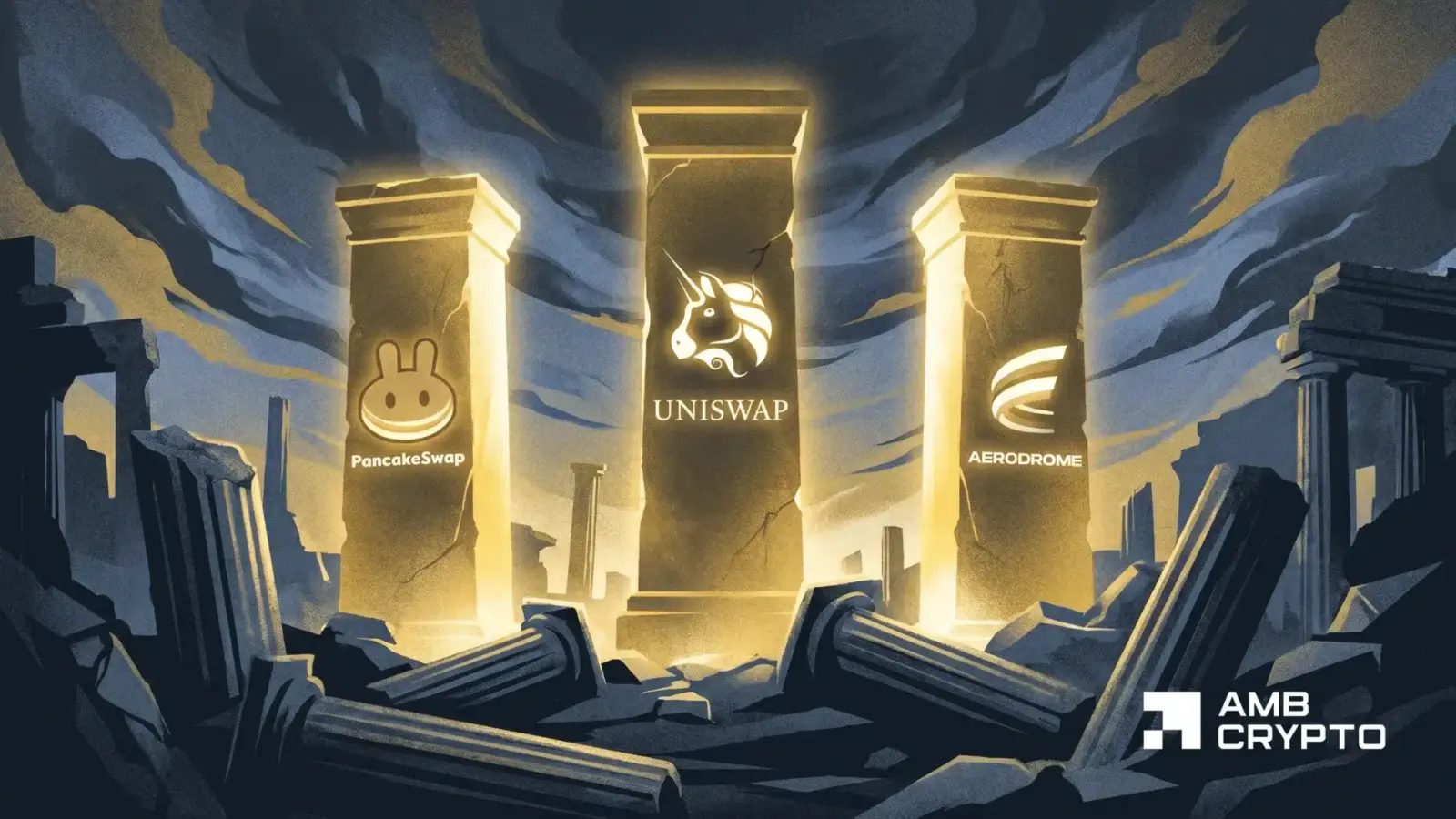
As of the latest press time, the market is led by:

- Uniswap (UNI): Maintaining its position as the industry standard, Uniswap continues to facilitate the lion’s share of activity, recording $1.428 billion in volume.
- PancakeSwap (CAKE): Despite the broader downturn, the BNB Chain titan retains significant retail traffic, posting figures of $805.97 million.
- Aerodrome Finance (AERO): A notable outlier that has gained significant ground, Aerodrome currently sits in third place with $798.11 million, highlighting the continued relevance of specialized liquidity pools.
These figures, while impressive in isolation, reflect a fragmented market where liquidity is concentrated in a few "fortress" protocols, leaving smaller, emerging DEXs to struggle for survival. The disparity between these giants and the long tail of smaller exchanges is widening, suggesting a period of consolidation is likely ahead.
Why the Exodus? Decoding the Shift in Sentiment
The collapse in DEX activity is rarely the result of a single factor; rather, it is a symptom of a broader shift in market psychology. Analysts point to several key drivers behind the current exodus from DeFi:
1. Flight to Safety and Stablecoins
As market volatility spikes, the risk-adjusted returns of yield farming and liquidity provision often fail to outweigh the risks of impermanent loss and smart contract exposure. Consequently, many investors have opted to park their capital in stablecoins, effectively removing it from the high-velocity churn of DEX trading.
2. Institutional De-risking
Institutional players, who were instrumental in the 2025 bull run, have notably lowered their exposure to altcoins. With uncertainty surrounding regulatory frameworks and the broader macroeconomic climate—marked by interest rate fluctuations and geopolitical tension—the "smart money" has retreated to the sidelines or opted for centralized, regulated venues over permissionless ones.
3. The End of "Speculative Mania"
Much of the 2024 and 2025 activity was fueled by the memecoin cycle and the explosive growth of the Base ecosystem. As the novelty of these cycles wanes, the speculative volume that previously inflated DEX statistics has vanished, revealing a more sober reality for DeFi utility.
Official Responses and Industry Perspectives
While the community sentiment on platforms like X (formerly Twitter) suggests a "death of DeFi," industry leaders offer a more nuanced perspective. Critics argue that the industry has simply entered a "cleansing" phase.
"Lower volumes are not a death knell; they are a necessary adjustment," says one prominent DeFi analyst. "When you have massive, unsustainable speculation, you get bloated volumes. What we are seeing now is the removal of that bloat. The protocols that provide real value—lending, borrowing, and efficient asset exchange—are still functioning perfectly. The pipes aren’t broken; the water flow has just returned to normal levels."

Others, however, express concern that the lack of new, innovative "narratives" is hindering growth. DeFi has historically relied on thematic booms: 2020’s yield farming, 2021’s NFT integration, 2023’s liquid staking, and the memecoin mania of 2024. The absence of a "next big thing" in 2026 is leaving investors without a compelling reason to commit capital to the ecosystem.
Implications: The Path Forward for DeFi
The current state of DeFi carries significant implications for the future of decentralized finance.
Consolidation and Survival of the Fittest:
Smaller, under-capitalized protocols that were built on the assumption of infinite growth are likely to face insolvency or acquisition. We are entering an era where only the most capital-efficient and secure platforms will survive.
Regulatory Pressures:
The decline in volume may ironically provide regulators with more ammunition to argue that the sector is shrinking or lacks systemic importance, potentially leading to more restrictive oversight. Conversely, it provides a window for developers to focus on compliance-friendly DeFi (DeFi 2.0) without the pressure of constant, high-speed traffic.
Redefining Value:
The industry is being forced to pivot from "growth at all costs" to "sustainability." Protocols that offer real-world asset (RWA) integration, lower slippage, and superior user experiences (UX) are the ones likely to emerge from this winter stronger than before.
Final Summary: A Temporary Hibernation or Permanent Decline?
The data is undeniable: the DeFi sector is undergoing a period of intense contraction. With volumes down over 70% from their 2025 highs, the sector is currently a shadow of its former, hyper-inflated self. However, characterizing this as "the death of DeFi" ignores the cyclical nature of the industry.
DeFi has survived multiple "winters" before, each time shedding the speculative excess of the previous cycle and emerging with more robust infrastructure and clearer utility. The current phase represents a transition from the speculative, memecoin-driven growth of 2024-2025 to a more mature, albeit quieter, ecosystem. Whether this period serves as a necessary consolidation before the next wave of innovation or a protracted decline remains to be seen. For now, the DeFi space is in a state of hibernation, waiting for the next spark of innovation to reignite the engines of decentralized liquidity.
