

The decentralized finance (DeFi) landscape is currently witnessing a pivotal moment as Uniswap, the industry’s leading decentralized exchange (DEX), initiates a sweeping move to overhaul its economic model. Through the submission of three landmark governance proposals, the protocol is seeking to activate fee structures across multiple versions and blockchain ecosystems. This ambitious shift is designed to redirect a portion of swap fees toward the protocol itself, with the explicit goal of bolstering the UNI token’s burn mechanism.
As Uniswap navigates this transition, the move has ignited a fiery debate between those who prioritize long-term protocol sustainability and liquidity providers (LPs) who fear that reduced margins could compromise the platform’s competitive edge.
The Core Proposals: Scaling Revenue Across the Multi-Chain Horizon
Uniswap’s latest governance filings represent a significant expansion of its monetization strategy. The primary proposal targets fee activation for versions 2 (V2) and 3 (V3) on the recently launched Robinhood chain. This new Ethereum Layer-2 (L2) network has become a focal point for the DEX, with Uniswap recording over $1 billion in trading volume within just ten days of its debut—a testament to the high demand for efficient, scalable trading environments.
Beyond the Robinhood chain, the protocol is setting its sights on a comprehensive rollout for its flagship V4 iteration. The proposed fee activation covers an array of prominent networks, including Ethereum, Base, Arbitrum, Robinhood, the BNB Chain, Polygon, and Optimism. Hayden Adams, CEO of Uniswap, has confirmed that a third proposal targeting the remaining V4-compatible chains is currently in the pipeline and expected to be submitted in the near term.
The strategic intent behind these proposals is clear: to transition from a model that primarily rewards liquidity providers to one that simultaneously captures value for the protocol’s governance token, UNI. According to Adams, the influx of revenue from these fees will be funneled directly into the existing UNI burn mechanism, potentially creating a deflationary pressure that could reshape the token’s market dynamics.
Chronology of Development: From Launch to Governance Action
The path to this governance overhaul has been marked by rapid innovation and a constant push for cross-chain expansion.
- Initial Growth: Since its inception in 2018, Uniswap has dominated the DEX space, facilitating billions in trading volume and providing a robust infrastructure for liquidity providers.
- The Robinhood Catalyst: The launch of the Robinhood L2 earlier this month served as a major catalyst. By capturing significant volume in record time, it provided the necessary justification for the protocol to test new fee models on a high-velocity chain.
- The Proposal Phase: Mid-July marked the formal submission of the governance proposals. These documents were meticulously crafted to address the technical nuances of fee collection across both legacy (V2/V3) and modern (V4) architectures.
- The Current Standstill: Following the announcement, the market has entered a phase of intense deliberation. Governance participants, including major stakeholders and liquidity providers, are currently debating the merits of the proposal against the backdrop of an increasingly saturated DeFi market.
Supporting Data: The Economic Reality of Uniswap
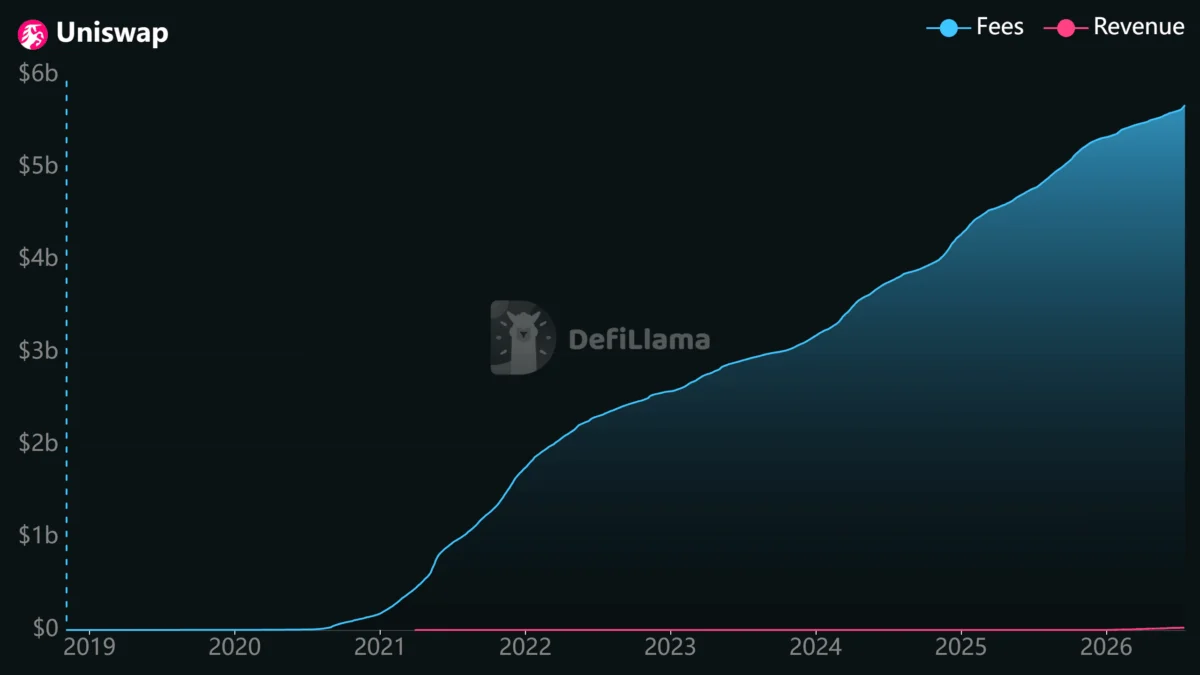
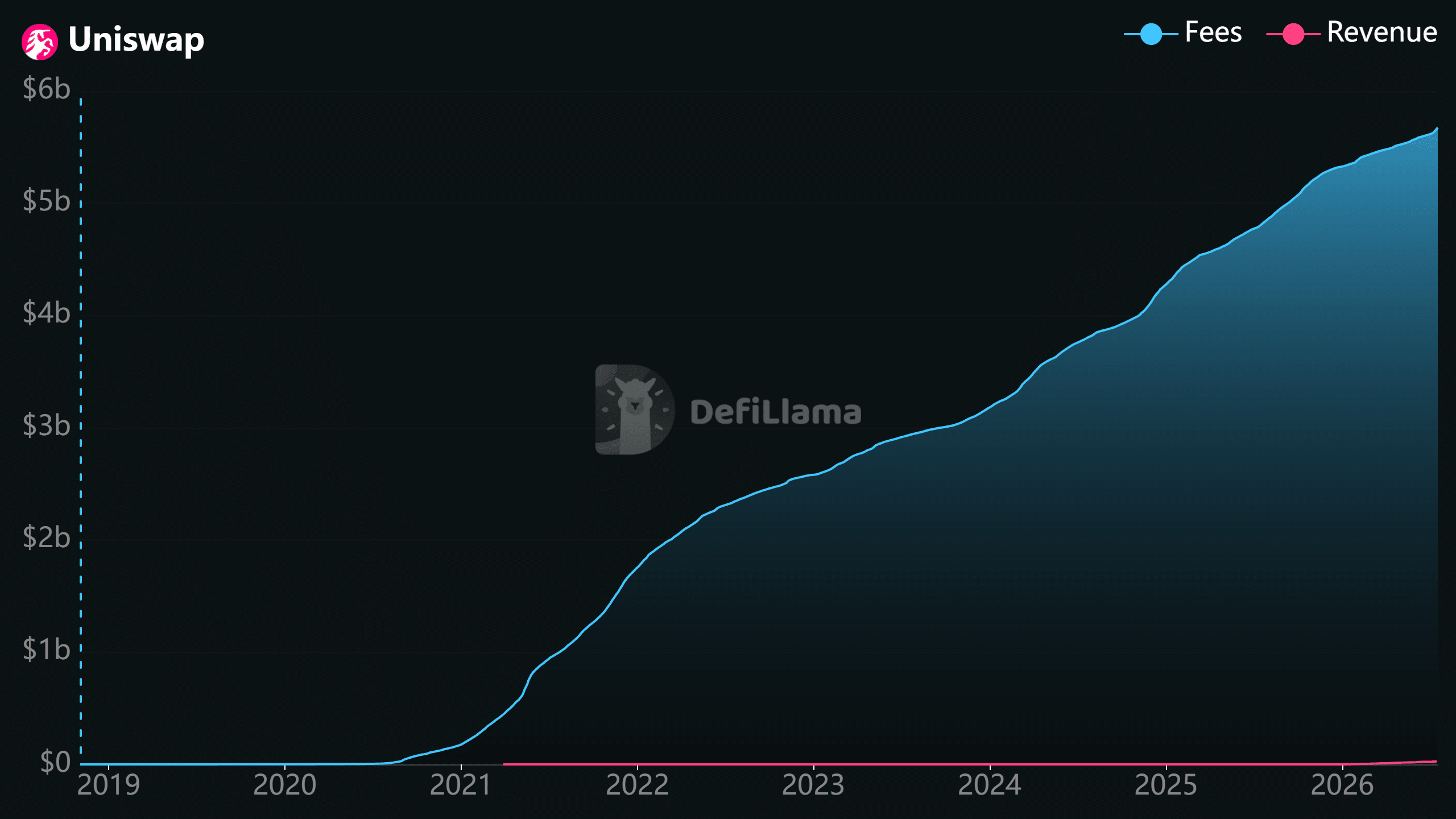
The economic data surrounding the platform provides the clearest rationale for these proposals. Since 2018, liquidity providers have earned a cumulative total exceeding $5 billion in swap fees. In stark contrast, the Uniswap protocol itself has generated only $25 million in cumulative revenue. This massive disparity has long been a point of contention among those who argue that the protocol is under-monetized given its central role in the crypto ecosystem.
The impact of the proposed changes on the UNI token is already being modeled by analysts. The protocol has already burned approximately 107.49 million UNI tokens to date. Notably, in the last week alone, the burn rate surged by 300%, jumping from $51,000 to over $160,000. These figures suggest that even incremental fee activations can have a compounding effect on the token’s scarcity, a prospect that has excited long-term investors.
Official Responses and Stakeholder Dissent
The reception to these proposals has been far from monolithic. While leadership at Uniswap views the fee activation as a necessary step toward long-term sustainability, the move has faced significant pushback from the liquidity provider community.
The Argument for Sustainability
Hayden Adams and other proponents of the change emphasize that the protocol’s survival and future development depend on its ability to generate its own treasury. "Both [proposals] direct all new protocol fees into the existing UNI burn mechanism," Adams stated. "Based on current volumes, especially on the Robinhood chain, we expect the impact on UNI burn to be substantial."
The Liquidity Provider’s Dilemma
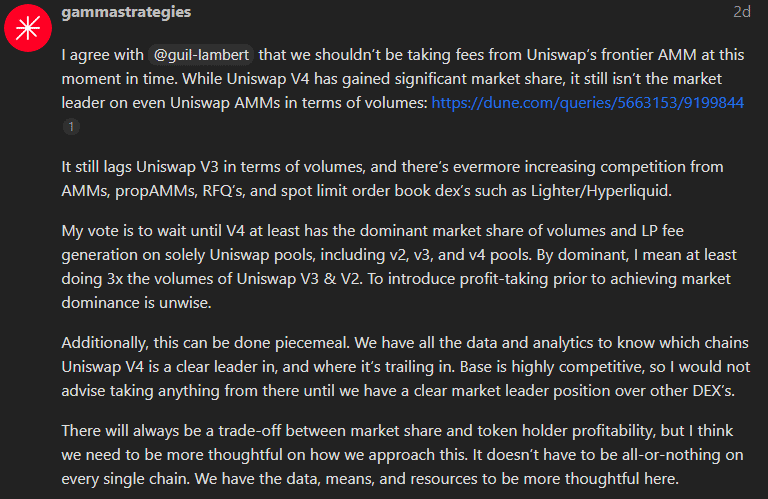
Conversely, organizations like Gamma Strategies have voiced strong opposition. The primary concern is that by siphoning off a percentage of swap fees, the protocol will inadvertently make it less profitable for LPs to provide liquidity. This, they argue, could trigger a liquidity drain.
Gamma Strategies, in a formal critique, noted that Uniswap V4 currently lags behind V3 in terms of volume. They argued that imposing additional fees at this stage would leave the platform vulnerable to more agile competitors. Their statement highlights a growing fear in the sector: "It (V4) still lags Uniswap V3 in terms of volumes, and there’s evermore increasing competition from AMMs, propAMMs, RFQs, and spot limit order book DEXs such as Lighter/Hyperliquid."
Market Implications: Price Action and Future Outlook
The financial markets have reacted with characteristic volatility. The anticipation surrounding the Robinhood integration fueled a 41% rally in the price of UNI throughout July, with the asset climbing from $2.70 to a peak of $3.80. This "front-running" of the news underscores the market’s high expectations for the protocol’s new revenue stream.
However, the bullish momentum has recently cooled. The UNI price is currently struggling to breach the 200-day Moving Average, a key technical resistance level. Analysts suggest that the price may consolidate in the $3.50 range or, if the initial excitement fades, test the $3.00 support level.
The future trajectory of the token is now inextricably linked to the governance process. Should the proposals pass and be implemented without triggering a significant migration of liquidity to rival platforms, the resulting increase in burn rate could provide the fundamental support required for a sustained upward trend. Conversely, if the implementation leads to a decline in volume or a fractured community, the token may face downward pressure.
Conclusion: The Balancing Act
Uniswap stands at a crossroads. The transition toward a fee-generating model is a mature, necessary evolution for any protocol aiming to move beyond a "utility-only" phase and toward a sustainable business model. However, the protocol faces the difficult challenge of balancing the needs of its treasury with the incentives required to maintain its status as the world’s most liquid DEX.
As the governance debate unfolds, the industry will be watching closely. The outcome of these proposals will not only dictate the future of the UNI token but will likely set a precedent for how decentralized organizations manage the tension between profitability and decentralization. For now, the protocol continues to iterate, with the community left to decide whether the path to sustainability is worth the risk of alienating the very providers who built the exchange’s success.
