The decentralized finance (DeFi) sector witnessed a whirlwind of activity this week as dYdX Labs—the development powerhouse behind the prominent perpetuals-focused decentralized exchange (DEX), dYdX—officially unveiled its newest platform: Arcus. Built on the Robinhood Chain, Arcus represents a significant, albeit separate, expansion into the intersection of traditional equity markets and blockchain infrastructure. However, what was intended to be a milestone announcement quickly devolved into a textbook case of "sell-the-news" volatility, leaving the native DYDX token reeling.
The Core Concept: What is Arcus?
At its heart, Arcus is designed to bridge the gap between legacy financial instruments and the decentralized web. By leveraging the deep liquidity and technical architecture of the Robinhood Chain, the platform offers a 24/7 trading environment for users looking to access both tokenized stocks and perpetual contracts.
The platform distinguishes itself through a zero-fee structure, a bold move aimed at reducing the friction that typically deters retail participants from active trading. According to project documentation, the initial rollout includes 95 unique assets, comprising a mix of tokenized stocks and perpetuals.
"We built Arcus to reduce these barriers," representatives from dYdX Labs noted in the launch announcement. "Arcus gives traders 24/7 access to 95 tokenized stocks and perpetuals backed by Robinhood Chain’s deep liquidity."
For Robinhood, the integration is a tactical play to solidify its position as a multi-chain financial hub. Seong Seog Lee, Director of Product Management at Robinhood Crypto, emphasized that this partnership aligns with the firm’s long-term vision of market democratization. "Robinhood has always believed that the financial system should work for everyone," Lee stated. "Arcus is the natural extension of that mission into the onchain world."
The roadmap for Arcus is ambitious. While the platform is launching with standard perpetuals and tokenized equities, the development team has already signaled plans to incorporate pre-IPO offerings and the innovative use of tokenized stocks as collateral, which would theoretically allow users to unlock liquidity without selling their underlying equity positions.
A Chronology of Anticipation and Execution
The market’s reaction to the Arcus news was not an overnight phenomenon but the culmination of five days of intense speculation.
The Five-Day Run-Up
Following initial rumors and "leaks" regarding an ecosystem-shifting announcement from the dYdX team, market participants began aggressively positioning themselves. Between late June and early July, the DYDX token embarked on a parabolic ascent, nearly doubling in value as speculative traders "front-ran" the impending news. Social sentiment metrics spiked, and discussions across crypto-native platforms were dominated by the potential for a massive integration that would directly benefit the DYDX tokenomics.
The Announcement Day
The official announcement arrived on July 2, 2026. While the news confirmed the existence of Arcus, the fine print contained a crucial detail that the market had seemingly ignored during the hype cycle: Arcus is an independent platform. It does not share the same chain or tokenomics as the existing dYdX exchange.
The Immediate Aftermath
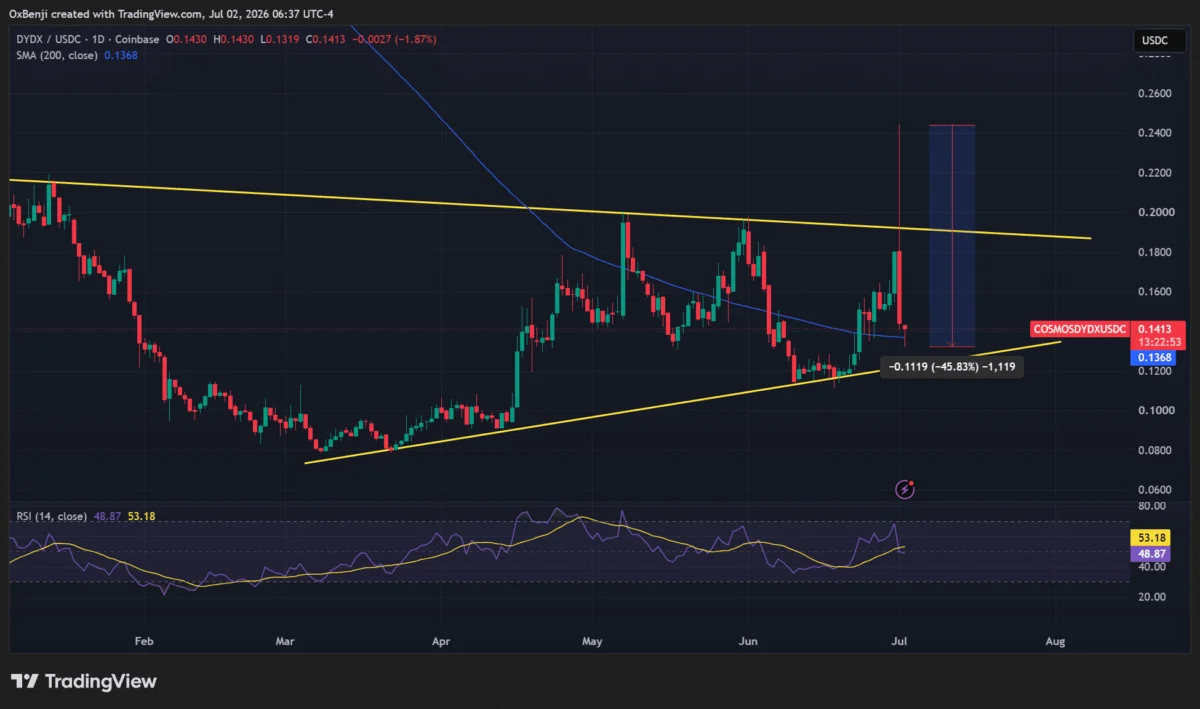
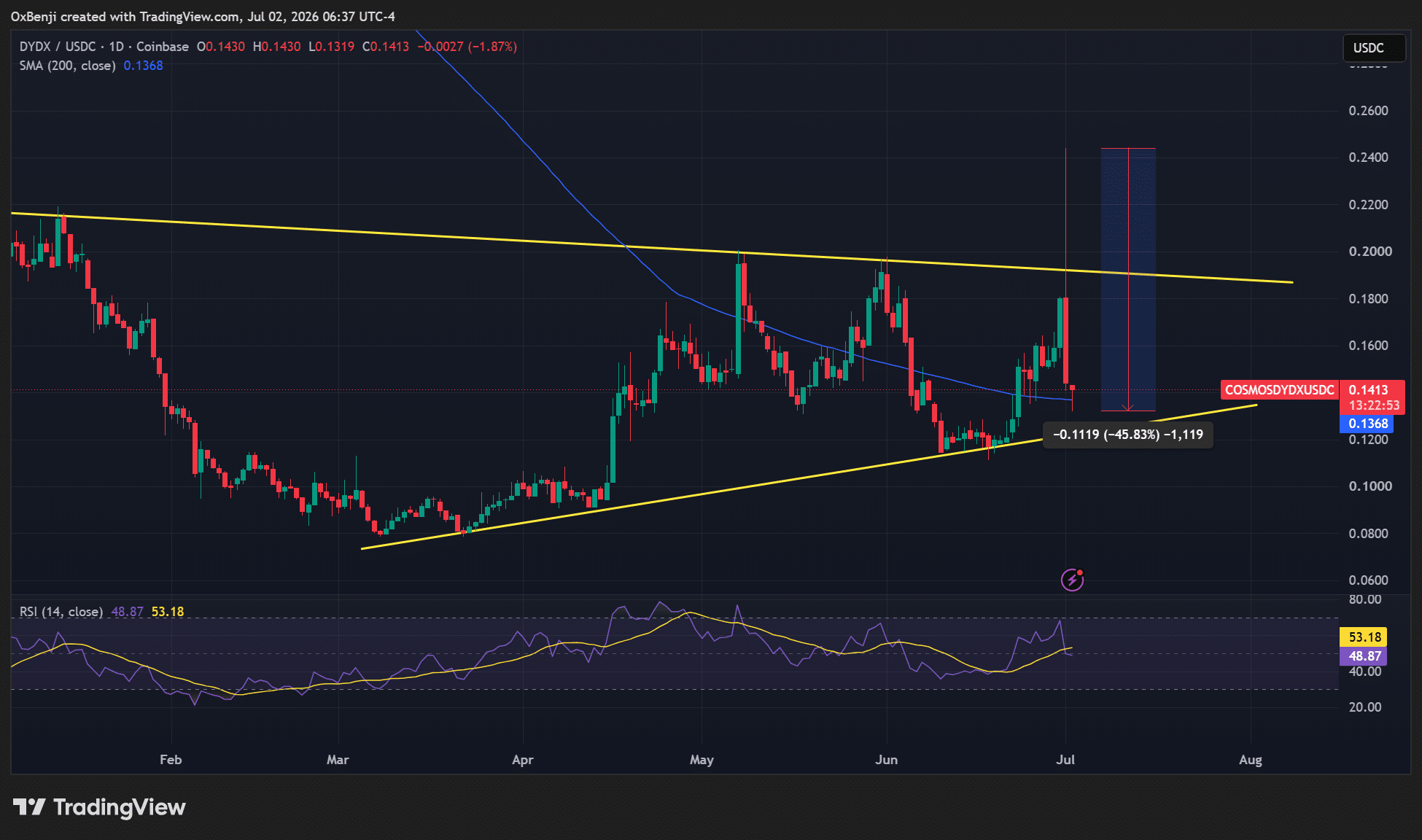
Within hours of the official reveal, the speculative bubble burst. The DYDX token, which had been priced for a "game-changing" integration, faced a wave of profit-taking. By the time the dust settled, the token had cratered by approximately 45%, effectively wiping out all the gains accumulated during the week of anticipation.
Supporting Data: Sentiment vs. On-Chain Reality
A deeper look at the on-chain data provided by analytics platforms like Santiment reveals why the crash was so severe.
While the "Weighted Sentiment" surrounding dYdX hit record highs during the teaser phase, the underlying accumulation data told a different story. Throughout the five-day rally, there was a noticeable spike in the "Supply on Exchanges" metric. This indicates that long-term holders and institutional players were moving their assets to exchanges, likely preparing to offload them into the liquidity provided by the incoming retail "hype" buyers.
Crucially, the "Tokens Outside of Exchanges" metric remained largely stagnant. This divergence is a classic bearish signal: it suggests that the price surge was driven purely by speculative spot trading rather than a fundamental shift in demand or long-term accumulation by "HODLers." Traders were not looking to build a long-term position in the dYdX ecosystem; they were looking to scalp the volatility surrounding the Arcus announcement.
Official Responses and Clarifications
The severity of the market dump forced the dYdX Foundation to issue a swift clarification to manage investor expectations and maintain the integrity of the project’s governance structure.
In a formal statement, the Foundation sought to decouple the native token from the Arcus platform, stating:
"DYDX is, and remains, the governance and staking token of dYdX Chain. Its mechanics, supply, and operational characteristics remain unchanged."
This statement was vital, as it aimed to quell rumors that Arcus might necessitate a token migration or a dilution of existing DYDX utility. By explicitly stating that Arcus operates as a separate entity, the Foundation inadvertently confirmed that the recent price action was based on a fundamental misunderstanding of the project’s architecture.
Implications for the Future of dYdX
The Arcus launch provides several critical lessons for both the dYdX development team and the broader crypto market.
1. The Dangers of Speculative Hype
The 45% correction highlights the extreme sensitivity of crypto markets to "news-based" trading. When a project teases an update without providing specifics, it leaves the door open for retail investors to construct their own narratives—often ones that overestimate the impact of the news on the project’s native token.
2. The Separation of Brand and Token
The case of Arcus demonstrates that a brand’s expansion does not always equate to value accrual for its native token. While Arcus may become a highly successful platform in its own right, the lack of a direct link to the DYDX token means that the success of one does not necessarily dictate the price performance of the other. For investors, this serves as a reminder to perform rigorous due diligence on how product updates actually integrate with tokenomics.
3. Technical Support and Potential Recovery
Looking forward, market technicians are pointing to the 200-day Moving Average (MA) and historical trendline support as the most likely floors for the DYDX token price. If the token can consolidate around these levels, the current "massive dump" could be reinterpreted as a healthy correction, provided the broader crypto market environment improves. However, any recovery will likely require a shift in sentiment—from speculative trading to genuine project utility and long-term ecosystem growth.
Conclusion
The debut of Arcus on the Robinhood Chain is undeniably a significant technical achievement for dYdX Labs. By expanding into tokenized stocks and zero-fee perpetuals, the team is positioning itself at the forefront of the inevitable merger between DeFi and traditional finance.
However, the chaotic price action of the DYDX token serves as a stark reminder of the "sell-the-news" reality that defines modern digital asset markets. While the long-term potential for Arcus remains high, the short-term fallout has left investors wary. Moving forward, the success of dYdX will likely depend on whether they can prove that their innovation can survive outside the shadow of speculative market hype, building a user base that cares more about the platform’s utility than the immediate price of its governance token.