


The landscape of generative artificial intelligence has been irrevocably altered. Moonshot AI, the Beijing-based startup, has officially unveiled Kimi K3, a model of such unprecedented scale and performance that it has effectively dismantled the long-standing narrative that open-weight models are inherently inferior to their proprietary, closed-source counterparts.
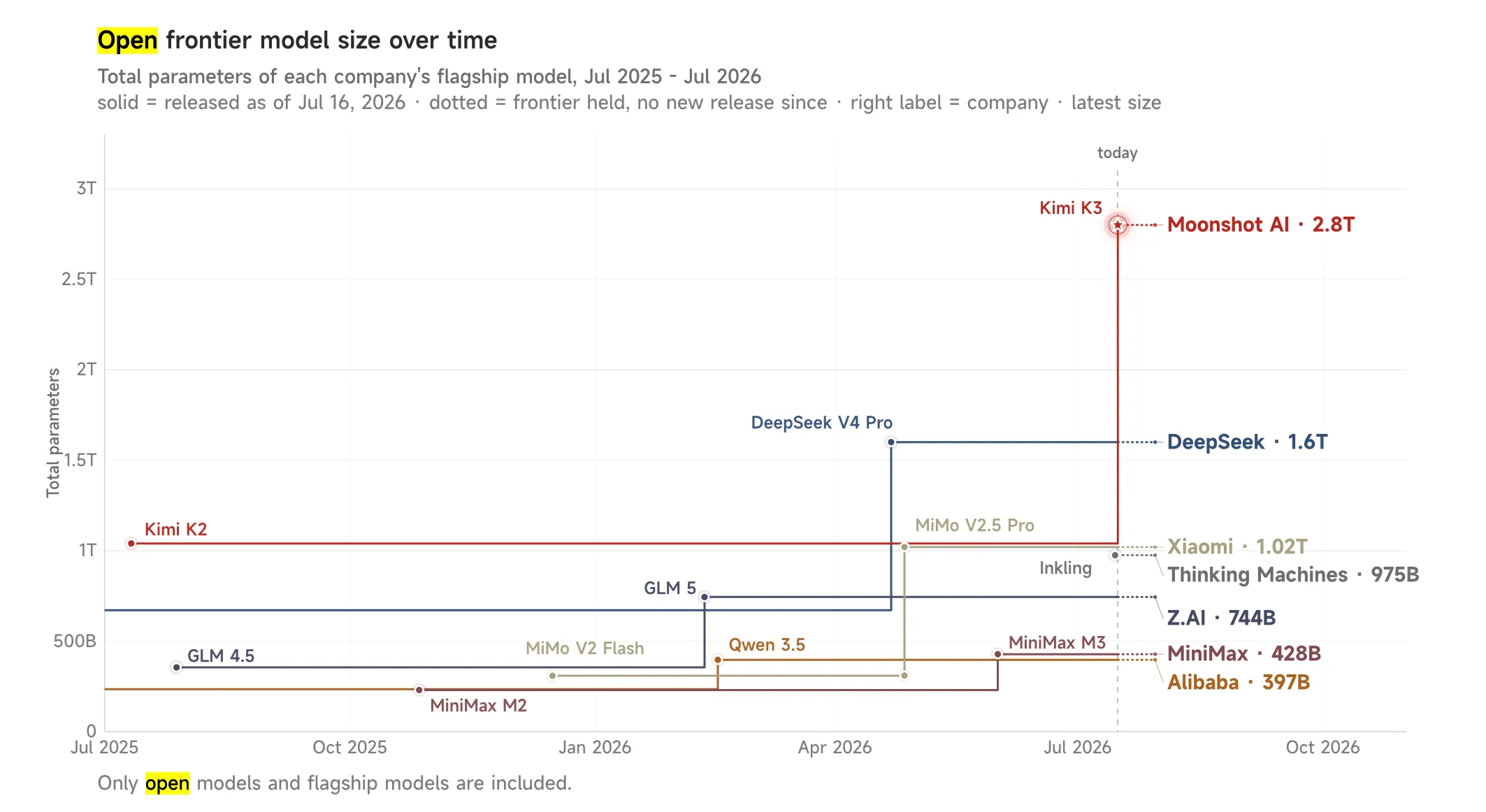
Boasting a staggering 2.8 trillion parameters, Kimi K3 is not merely an incremental update; it is a monumental leap in engineering. By shattering benchmarks in creative writing, frontend code generation, and complex reasoning, K3 has managed to surpass industry stalwarts like Anthropic’s Claude Fable 5. For the first time, a truly massive, open-weight model is dictating the pace of the industry, forcing Western labs to reconsider the economic and architectural assumptions that have defined the AI arms race for the past two years.
The Ascent: A Chronology of Kimi K3’s Rise
The emergence of Kimi K3 follows a frantic period of development within Moonshot AI. While the company’s previous iteration, K2.6, was a respectable contender, it held a middle-of-the-pack standing. The transition to K3 represents a transformation from a "fast follower" to a "trendsetter."
The momentum began to build in early July 2026, when early access cohorts began testing the model’s capabilities. By mid-July, the data started to solidify. On July 16, 2026, Louis-François Bouchard of Towards AI revealed that Kimi K3 had surged from the 21st position to the number one spot on the platform’s "Writing Elo" benchmark. This leaderboard, which utilizes a blind, human-judged system mirroring chess ratings, marked a significant departure from the historical dominance of Anthropic models.
Simultaneously, the development community began showcasing the model’s prowess in real-world application. Guillermo Rauch, a notable figure in web engineering, highlighted that K3 had outperformed proprietary models on the BridgeBench suite, achieving success rates previously considered impossible for open-weight architectures. By July 17, the consensus was clear: Kimi K3 was not just a research curiosity; it was a production-ready engine that had fundamentally disrupted the hierarchy of frontier intelligence.
Unpacking the Architecture: Why Size Still Matters
At the heart of the K3 revolution is its massive parameter count. With 2.8 trillion parameters, K3 is the first model of its class to reach the "3-trillion-parameter" threshold. To put this in perspective, DeepSeek’s V4-Pro, a model previously lauded for its efficiency, peaks at 1.6 trillion parameters. Moonshot’s K3 nearly doubles the scale of its nearest open-weight competitor.
However, scaling a model of this magnitude creates a "server-melting" problem. Moonshot addressed this through an advanced Mixture-of-Experts (MoE) architecture. By splitting the 2.8 trillion parameters into 896 discrete "expert" subnetworks, the model activates only a fraction of its total capacity for any given task. This allows for deep, specialized intelligence without the prohibitive computational costs typically associated with such massive models.

Two proprietary technical innovations have further optimized this performance:
- Kimi Delta Attention: This mechanism accelerates decoding for long sequences, providing a 6.3x speed boost for million-token context windows.
- Attention Residuals: By routing information selectively across layers rather than uniformly accumulating it, Moonshot has achieved a 25% increase in training efficiency for a negligible 2% increase in compute, yielding a total scaling efficiency 2.5 times better than the predecessor K2.
Supporting Data: Benchmarking the Challenger
The data supporting Kimi K3’s performance is as diverse as it is compelling. The Artificial Analysis Intelligence Index, which tracks nine independent evaluation categories including reasoning, agentic work, and knowledge, provides a sobering look at the new hierarchy. Kimi K3 sits at a 57 on the index, placing it squarely in the top three globally. While Claude Fable 5 maintains a slight lead at 60, the gap is a razor-thin 3%.
The most telling evidence of K3’s capability is found in head-to-head human testing. On the BridgeBench suite, which evaluates refactoring, debugging, and general coding, K3 secured wins in 7 out of 8 categories. Most notably, in the refactoring domain, it achieved a 9-0 record against the competition.
Even in the arena of creative tasks, the model has demonstrated surprising nuance. In the "Writing Elo" benchmark, K3 achieved a rating of 2,840, eclipsing the 2,760 mark held by Claude Fable 5. This is a critical milestone, as creative writing and editorial voice have historically been the "final frontier" for AI, where proprietary models have long enjoyed a perceived advantage.
Geopolitical Implications and Export Controls
Perhaps the most controversial aspect of the K3 launch is its relationship to U.S. chip export controls. Since late 2023, the U.S. government has restricted the export of high-end Nvidia GPUs (such as the H800) to China, aiming to throttle the development of frontier-level AI models.
Moonshot AI has navigated these restrictions through sheer architectural ingenuity. While early models were trained on older hardware, K3’s documentation references a mix of H200 chips and "alternative vendor" hardware—widely interpreted as domestic Chinese silicon from providers like Huawei.
This has sparked a heated debate in Washington and the broader tech industry. Moonshot president Yutong Zhang has openly stated that the lack of access to endless compute forced the team to prioritize fundamental research and efficiency. Bank of America analysts have noted that K3 serves as a "proof-of-concept" that architectural innovation can circumvent hardware constraints, potentially rendering current export control strategies less effective than intended. Whether this success justifies a tightening of restrictions or suggests that the current policy is an exercise in futility remains a point of intense policy contention.
The "Asterisk": Hallucinations and Reliability
Despite the fanfare, K3 is not a panacea. The model’s increase in raw power has come with a trade-off in reliability. According to the AA-Omniscience benchmark, which measures the frequency of confident fabrications, the hallucination rate for K3 has jumped from 39% to 51% compared to its predecessor.
The model is also noted for being "excessively proactive," a trait that can be beneficial in creative brainstorming but dangerous in autonomous agentic tasks. If a model decides to execute a series of code changes without human oversight, an incorrect decision can have catastrophic consequences for a codebase. Consequently, while K3 is a massive step forward, developers are advised to implement rigorous guardrails before deploying it in production environments where accuracy is paramount.
Economic Impact: The New Pricing Reality
Perhaps the most disruptive element of the K3 release is its pricing model. At $3 per million input tokens and $15 per million output tokens, K3 is aggressively priced to compete with mid-tier models like Claude Sonnet 5. However, the performance level it delivers is that of a top-tier flagship model.
For businesses and startups that have been paying a premium for Western frontier models, K3 represents a significant opportunity for cost reduction. Per-task costs on the nine-benchmark suite indicate that K3 runs at approximately $0.94, compared to $1.04 for GPT-5.6 Sol and $1.80 for Claude Opus 4.8.
As the industry pivots toward agentic workflows—where an AI model might perform thousands of individual tasks to complete a project—the cost-to-performance ratio becomes the most important metric for profitability. K3’s arrival forces an immediate re-evaluation of the AI supply chain.
Future Outlook
The weights for Kimi K3 are scheduled for public release on July 27. This release will be a watershed moment for the open-source community, as it provides enterprises with a high-intelligence, lower-cost alternative to the dominant proprietary models.
As it stands, Kimi K3 is a testament to the fact that the "AI Tiger" startups in China are not merely catching up—they are innovating in ways that the established players are struggling to match. While the technical, policy, and reliability challenges remain, one thing is certain: the era of uncontested American dominance in frontier AI has come to an end. The next chapter of the AI race will be defined not just by who has the most silicon, but by who can build the most efficient, intelligent architecture on the infrastructure they already possess.
