

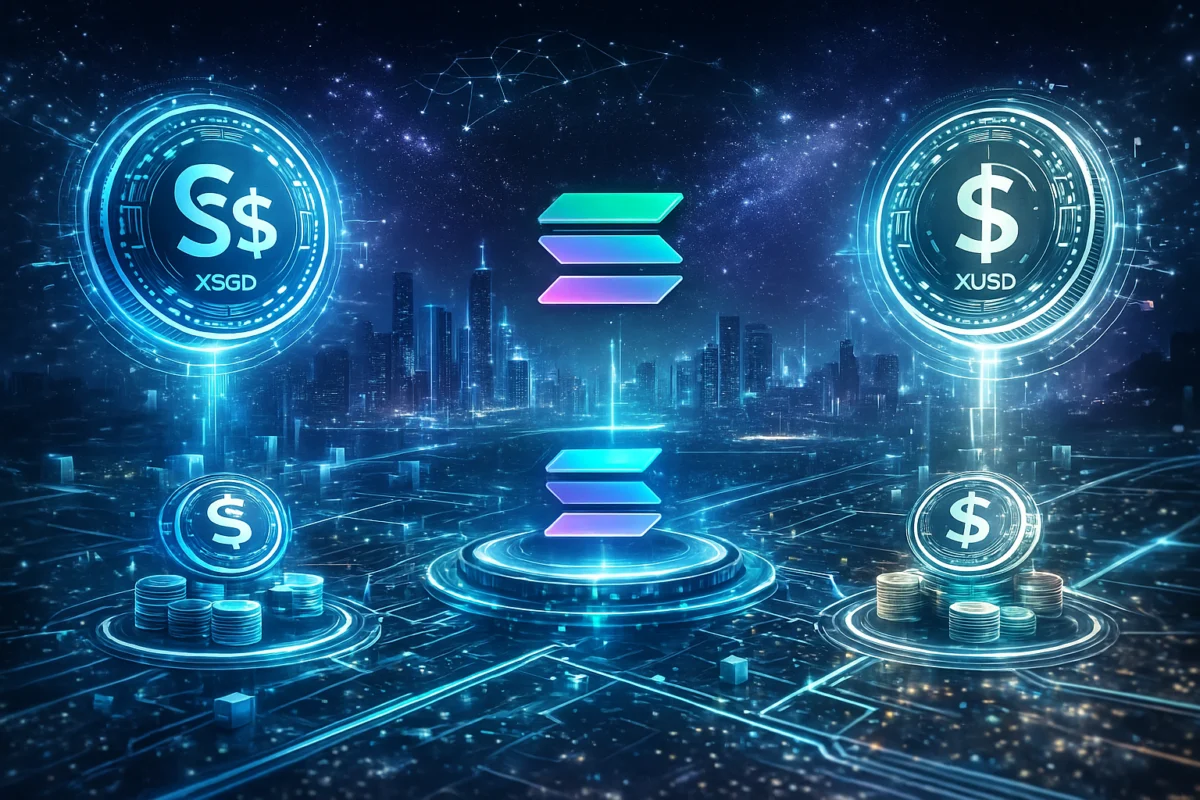
SINGAPORE — StraitsX, a premier Singapore-based digital asset infrastructure provider and regulated stablecoin issuer, has announced strategic plans to extend its flagship fiat-backed stablecoins—the Singapore dollar-backed XSGD and the US dollar-backed XUSD—onto the Solana blockchain by early 2026.
The integration represents a major milestone in the evolution of regulated digital currencies. By combining Singapore’s stringent financial compliance standards with Solana’s high-throughput, low-latency network architecture, StraitsX aims to position regulated stablecoins at the absolute center of high-speed global blockchain settlement. The expansion is engineered specifically to cater to burgeoning use cases across institutional finance, decentralized applications (dApps), everyday cross-border payments, and the rapidly expanding frontier of artificial intelligence (AI)-driven micro-transactions.
Main Facts: Bridging Strict Compliance and High-Performance Infrastructure
The upcoming deployment on Solana is more than a simple multichain expansion; it is a calculated effort to marry institutional-grade trust with software-native speed and cost efficiency.
- The Assets: StraitsX will bring both its Singapore Dollar-backed stablecoin (XSGD) and its US Dollar-backed stablecoin (XUSD) to the Solana public blockchain.
- Target Timeline: The integration is slated to go live by early 2026, pending final technical deployments and ecosystem integrations.
- Collaborative Effort: The rollout is being developed in direct collaboration with the Solana Foundation, highlighting the network’s increasing appeal to regulated fintech institutions seeking reliable, high-performance base layers.
- Core Advantages: Moving to Solana will allow users to settle transactions within fractions of a second while paying fractions of a cent in fees, drastically reducing the friction inherent in traditional foreign exchange and cross-border settlement.
- Ecosystem Synergy: The deployment will bridge centralized exchanges, decentralized finance (DeFi) protocols (such as automated market makers and lending markets), and consumer-facing Web3 applications onto a unified, highly scalable infrastructure.
Chronology of Expansion: From Local Pioneer to Multi-Chain Powerhouse
To fully understand the gravity of the Solana integration, one must look at the systematic growth trajectory of StraitsX and its parent technological footprint over the past several years.
The Foundation and Multi-Chain Proliferation
StraitsX first built its reputation by creating compliant, fiat-backed digital money designed to foster digital asset economies in Southeast Asia and beyond. XSGD steadily expanded its footprint across multiple industry-leading blockchains, establishing deep liquidity pools and cross-chain utility on Ethereum, Polygon, Avalanche, Arbitrum, Zilliqa, Hedera, and the XRP Ledger. Meanwhile, XUSD established its primary presence on Ethereum and BNB Smart Chain.
Regulatory Milestones Under the MAS
A defining chapter in the chronology of StraitsX is its rigorous alignment with regulatory bodies. Operating as a licensed Major Payment Institution regulated by the Monetary Authority of Singapore (MAS), StraitsX has meticulously structured its offerings to align with Singapore’s forward-thinking stablecoin regulatory framework. Notably, both XSGD and XUSD have been formally acknowledged in their respective white papers as fully compliant with the upcoming MAS stablecoin standards, setting a global benchmark for regulatory clarity.
The Grab Partnership (November 2025)
Just weeks prior to the Solana announcement, StraitsX took a massive leap into consumer-facing mass adoption. In November 2025, Southeast Asian super-app giant Grab signed an exploratory memorandum of understanding (MoU) with StraitsX. The strategic alignment aims to develop a Web3-enabled settlement layer spanning Southeast Asia. Subject to final regulatory clearances, this partnership sets the stage for millions of Grab users to seamlessly hold, manage, and spend XSGD and XUSD directly within the daily consumer application ecosystem, anchoring digital wallets and stablecoins directly into routine commerce.
The Solana Horizon (Early 2026)
Culminating these milestones, the December 2025 announcement formally set the timeline for the early 2026 deployment on Solana, marking the next logical step in the company’s mission to make fiat-denominated digital currency universally accessible and effortlessly programmable.
Supporting Data: Volume, Market Capitalization, and Technical Footprint
StraitsX stablecoins are not speculative instruments; they are heavy-duty liquidity conduits processing billions of dollars in real economic activity.
- Circulating Supply and Market Caps:
- XSGD currently commands a market capitalization of approximately $13 million, underpinned by a circulating supply of 16.7 million tokens. Because it maintains a 1:1 peg with the Singapore Dollar, its valuation shifts in tandem with foreign exchange rates, but its utility as a bridge asset in Asian digital asset markets remains robust.
- XUSD boasts a significantly larger market capitalization of roughly $52 million, serving as a primary dollar-denominated settlement asset for institutional and retail users alike.
- Onchain Volume Milestone: Combined, XSGD and XUSD have collectively processed over $18 billion in cumulative onchain transaction volume. This staggering figure underscores the deep trust and recurring utilization of StraitsX assets across various decentralized exchanges, cross-border remittance routes, and enterprise settlement flows.
- The x402 Payment Standard: Both XSGD and XUSD natively support the x402 standard—an emerging interoperability framework tailored specifically for machine-to-machine payments. By bringing this native compatibility to Solana, StraitsX ensures that developers can immediately leverage the stablecoins for automated, software-native financial interactions without custom bridging or complex middleware.
Official Responses and Strategic Vision
Leadership from both StraitsX and the broader digital asset community have emphasized the transformative potential of marrying regulated fiat stablecoins with high-throughput networks like Solana.
Industry analysts and institutional observers have noted that financial institutions are increasingly growing weary of the high gas fees and network congestion historically associated with legacy smart contract platforms. By selecting Solana, StraitsX provides a direct escape valve for institutions that demand high transaction volumes, instant finality, and predictable, ultra-low operating costs.
In official statements released alongside the announcement, StraitsX highlighted that the integration is explicitly tailored to support the explosive growth of digital commerce platforms and AI-native applications. As autonomous software agents begin to execute micro-transactions, execute programmatic arbitrage, and manage liquidity pools independently, they require an underlying asset and network that can clear payments instantly and securely at a fraction of a cent per transfer.
Furthermore, the Solana Foundation welcomed the integration, noting that bringing MAS-compliant, highly liquid stablecoins like XSGD and XUSD onto the network massively expands the institutional toolkit available on Solana, driving deeper liquidity for regional Asian trade corridors.
Implications: What the Solana Integration Means for DeFi, AI, and Global Commerce
The integration of StraitsX’s stablecoins onto Solana carries profound implications across multiple verticals of the global digital economy.
1. Catalyzing AI-Driven and Automated Commerce
One of the most forward-looking aspects of the expansion is its alignment with AI agent economies. As artificial intelligence systems evolve from passive analytical tools to active economic participants capable of buying data, paying for API calls, and executing trades autonomously, they require native financial rails. The combination of Solana’s sub-second finality, the x402 payment standard, and StraitsX’s regulated stablecoins creates an ideal sandbox for autonomous, software-native micro-economies.
2. Revolutionizing Cross-Border and FX Settlement in Asia
Singapore serves as the financial nexus of Southeast Asia. By coupling XSGD—a proxy for one of the world’s most stable and heavily traded fiat currencies—with Solana’s lightning-fast network, institutional players gain unprecedented efficiency in executing onchain foreign exchange (FX) swaps between SGD and USD. This eliminates traditional banking hour bottlenecks, settlement delays, and the high intermediary fees traditionally associated with legacy correspondent banking networks.
3. Scaling Decentralized Finance (DeFi) in Southeast Asia
For the Solana DeFi ecosystem, the arrival of deeply integrated, regulated fiat stablecoins opens up fresh avenues for yield generation, lending markets, and automated market maker (AMM) liquidity pools. Users and institutions across Asia can now participate in high-yield decentralized finance strategies denominated in familiar, government-compliant regional currencies, lowering the psychological and regulatory barriers that often deter traditional corporate treasuries from entering Web3.
4. Paving the Way for Super-App Mass Adoption
When viewed in tandem with the ongoing exploratory efforts alongside Grab, the expansion onto Solana demonstrates that StraitsX is building a comprehensive, multi-layered financial stack. Whether a user is paying for a ride-hailing service via a mobile super-app in Southeast Asia or an institutional algorithmic trading desk is rebalancing liquidity pools on Solana, the underlying infrastructure is designed to make blockchain technology completely invisible to the end user—delivering the speed, security, and compliance required for the next generation of global commerce.
