


Ethena Labs, the protocol behind the synthetic dollar USDe, has announced a significant expansion in the collateral backing its yield-bearing product. By integrating "real-world asset" (RWA) tokenization perpetuals—often referred to as equity perps—into its collateral reserve, Ethena is making a calculated move to decouple its yield generation from the highly volatile, cyclical nature of the broader cryptocurrency market. This shift represents one of the most ambitious diversification efforts in the decentralized finance (DeFi) sector to date.
Main Facts: The Evolution of USDe Collateral
The core innovation of Ethena’s USDe is the "basis trade," which involves capturing the spread between the spot price of an asset and its corresponding perpetual futures contract. Historically, this strategy relied heavily on crypto-native assets. However, Ethena is now pivoting toward equity-based perps, which the project notes have seen a meteoric rise, growing 10x to reach $6 billion in Open Interest (OI) since March.
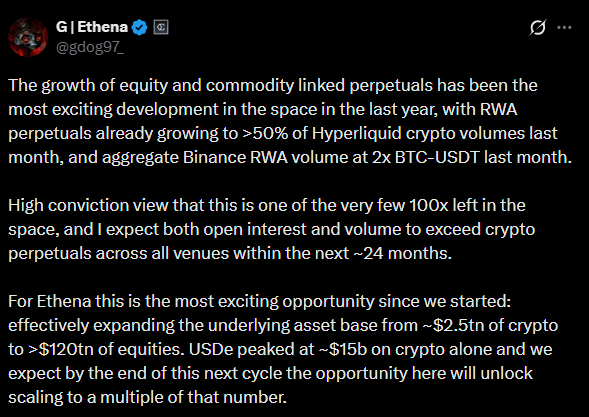
The protocol envisions an even more expansive future for this asset class. According to internal projections, the RWA perpetuals market has the potential to grow 100x, tapping into an underlying asset base exceeding $150 trillion—a figure that dwarfs the roughly $2.5 trillion crypto-native market. Ethena anticipates that within the next 12 to 24 months, RWA-backed perpetuals will eclipse crypto-native allocations in its reserves, effectively making this the most scalable extension of the basis allocation strategy in the history of the protocol.
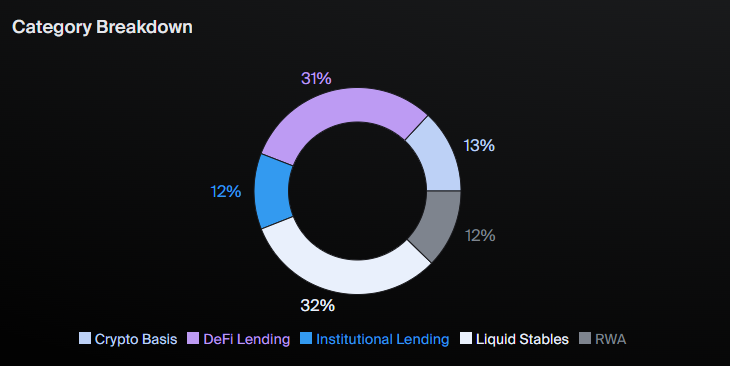
Currently, Ethena’s collateral composition is diversified across several buckets:

- Liquid Stablecoins: 32% (e.g., USDT, USDC).
- DeFi Lending: 31% (distributed across protocols like Aave and Morpho).
- Traditional Credit: 12% (facilitated by partnerships with firms like Janus Henderson).
Chronology of a Protocol: From Bull Run to Diversification
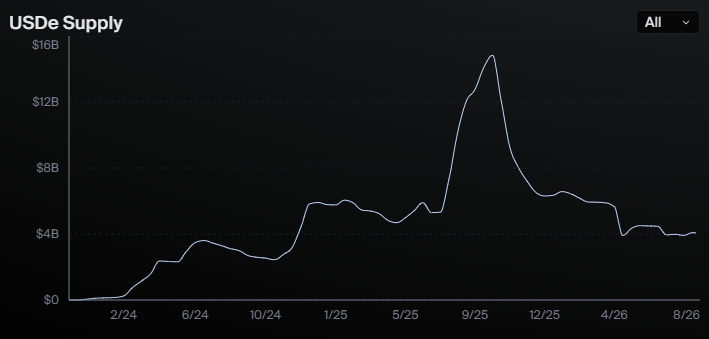
To understand the necessity of this shift, one must look at the historical performance of USDe. During the height of the 2024-2025 crypto bull market, the supply of USDe surged, peaking at approximately $15 billion. During this period, the protocol was able to offer yields exceeding 80%, drawing significant liquidity from yield-hungry investors.
However, the "crypto winter" that followed provided a sobering stress test for the model. As market sentiment cooled and capital fled, USDe supply contracted to $4 billion, and yields slipped below 0%. This contraction underscored the inherent risks of relying solely on crypto-native basis trades, which are tethered to the exuberance of market participants.
Recognizing these structural limitations, Ethena began its diversification journey earlier this year by integrating traditional credit products. The upcoming deployment of RWA perps, scheduled for the coming weeks, represents the second—and arguably most significant—wave of this strategic pivot.
Supporting Data: Why RWA Perpetuals?
The decision to move into RWA perpetuals is supported by rigorous data analysis. Unlike crypto assets, which are prone to extreme volatility and regulatory uncertainty, traditional equity perpetuals offer a stable, scalable yield profile that is not correlated with the performance of Bitcoin or Ethereum.
The primary advantage of this integration is the sheer size of the addressable market. While the crypto market remains a niche, albeit rapidly growing, ecosystem, the $150 trillion equity market offers a depth of liquidity that could stabilize USDe’s yield even during prolonged market downturns.
Furthermore, when comparing USDe’s yield potential to traditional benchmarks, the protocol maintains a competitive edge. Currently, USDe offers a 1.6% spread over short-term U.S. Treasury bonds. Even after accounting for the inherent risks associated with DeFi smart contracts and collateral management, the yield spread provides an attractive value proposition for institutional and retail users seeking alternatives to standard treasury yields.
Official Responses and Strategic Rationale
Ethena founder Guy Young has been transparent about the cautious nature of this expansion. Addressing the delay in implementing RWA perps, Young explained that the protocol prioritized stability and empirical validation over speed.
"We took a cautious approach to what was a nascent market and waited until we saw deep, liquid markets with a data history we could study before moving into the opportunity at scale," Young stated. This sentiment highlights a shift in Ethena’s philosophy from "growth at all costs" to a more institutional-grade approach, focusing on long-term sustainability.
Young remains bullish on the segment, characterizing it as "one of the very few 100x opportunities left" in the financial landscape. He reiterated his firm belief that the volume and Open Interest in RWA perpetuals will eventually surpass those of the crypto-native perpetual market within the next two years, positioning Ethena as a bridge between traditional finance and the decentralized ecosystem.
Implications: A New Era for Synthetic Dollars
The implications of Ethena’s strategy are profound for the broader DeFi space. By actively shifting its collateral backing away from volatile crypto assets, Ethena is attempting to solve the "trilemma" of stablecoins: maintaining decentralization, capital efficiency, and stability simultaneously.
1. Reducing Systemic Risk
The primary benefit of this pivot is the reduction of systemic risk. By diversifying into RWA, the protocol creates a "cushion" that protects the value of USDe during crypto-market volatility. If the crypto market experiences a "flash crash," the RWA portion of the collateral remains unaffected, theoretically providing a smoother yield and redemption experience for users.
2. Institutional Adoption
This move is clearly designed to attract institutional investors. Traditional asset managers, who may be wary of the volatility associated with crypto-native yields, are more likely to engage with a protocol that incorporates familiar, traditional assets like equity-linked perps. This could lead to a new wave of capital inflow into the USDe ecosystem.
3. The Competitive Landscape
Ethena’s aggressive diversification puts pressure on other stablecoin protocols. As the yield spread between USDe and traditional U.S. Treasuries becomes a core talking point, competitors may be forced to adopt similar RWA-backed strategies to maintain their market share. The ability of a protocol to offer "safe" yield outside of the crypto ecosystem is rapidly becoming the new "gold standard" for success.
4. Regulatory Scrutiny and Opportunity
While the integration of RWAs introduces more stability, it also brings the protocol closer to the traditional financial regulatory perimeter. Ethena will likely need to navigate complex compliance landscapes as it interacts more deeply with traditional credit and equity markets. However, if managed correctly, this could provide the protocol with a level of legitimacy that many of its peers currently lack.
Conclusion: The Path Ahead
As Ethena prepares for the next market cycle, its focus on RWA integration signals a maturing project. The shift from a purely crypto-native yield generator to a multi-asset, RWA-backed synthetic dollar protocol is a testament to the project’s ambition. Whether this diversification will successfully boost demand and provide the "all-weather" yield that users desire remains the defining question for the coming year.
By bridging the $150 trillion traditional market with the agility of DeFi, Ethena is positioning itself at the center of the next generation of financial infrastructure. For investors and developers alike, the success of this transition will be a key indicator of whether synthetic dollars can truly compete with, and eventually surpass, the legacy financial instruments of the past.
