

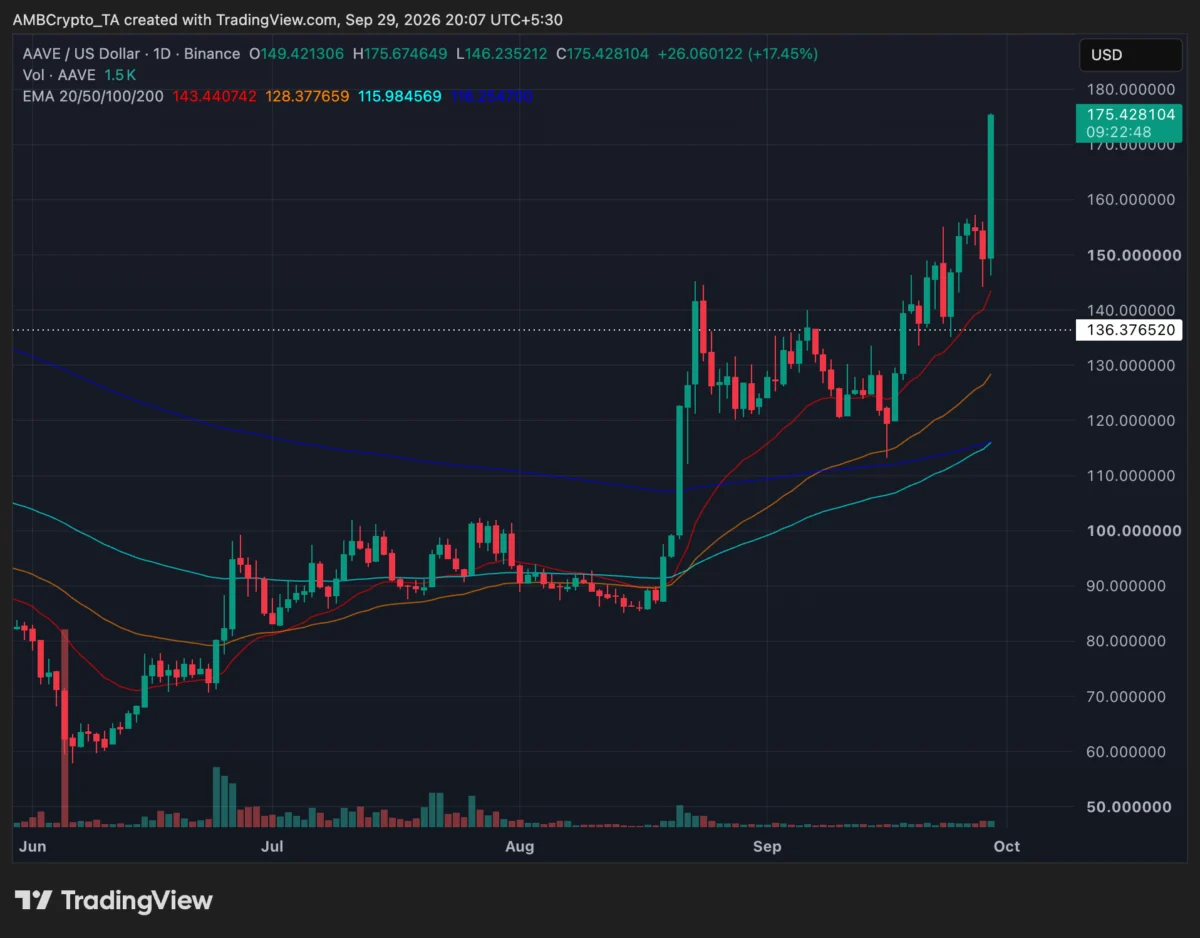
In a display of remarkable market strength, Aave [AAVE], one of the decentralized finance (DeFi) sector’s primary lending protocols, staged an impressive breakout on September 29. The token surged over 17%, rallying from a price floor of approximately $149 to pierce the $175 resistance level. This movement is not merely a transient price spike; it represents a significant shift in market sentiment, positioning AAVE well beyond its previous September highs and signaling a potential structural change in its technical trajectory.
The rally is particularly noteworthy given the current macroeconomic climate. With US government Treasury yields hovering above 5%—levels not seen since the pre-crisis era of 2007—the traditional "risk-free" rate has placed immense pressure on the DeFi ecosystem. Historically, as Treasury yields climb, capital flows out of volatile crypto assets toward the perceived safety of government bonds. Aave’s ability to buck this trend suggests that the protocol’s internal utility and its expanding footprint in Real-World Assets (RWAs) are decoupling it from broader macro-sensitivity.
Chronology: A Calculated Ascent
The recent price surge did not occur in a vacuum. A retrospective look at Aave’s price action reveals a methodical recovery that has been building momentum for over a month.
Mid-August: The Foundation
In mid-August, AAVE was struggling to find its footing, trading well under the $90 price point. At the time, market participants were skeptical of DeFi’s recovery potential, given the prevailing bearish sentiment. However, the protocol began a series of incremental climbs, systematically shattering psychological and technical resistance levels at $120, $140, and $150.
The September Breakout
Throughout early and mid-September, the $150–$155 region acted as a formidable "ceiling" for the token. Time and again, upward movements were met with sell-side pressure that pushed the price back down. The breakthrough on September 29, which saw the token catapult past this ceiling to reach $175, indicates a fundamental shift in supply and demand. By moving decisively above its major moving averages, Aave has confirmed a bullish trend that is supported by both short-term momentum and long-term accumulation.
Supporting Data: Technical and Market Metrics
The technical strength displayed by AAVE is corroborated by its trading patterns and on-chain activity. The transition of the $150–$155 zone from a point of rejection to a potential support floor is a classic bullish signal. If the asset experiences a moderate pullback in the coming days, market analysts are closely watching whether this previous ceiling will hold as a support level. A successful retest of this zone would provide the necessary consolidation for a push toward the next major psychological milestone: $180.
Beyond technical charts, the protocol’s recent initiatives—such as the integration of tokenized stocks as collateral for USDC loans on the Base network—underscore why institutional and retail users remain attracted to Aave. By bridging the gap between traditional finance (TradFi) and DeFi, Aave is creating new utility for its native token that goes beyond simple speculation.
Official Responses and Governance Dynamics
On September 28, just one day prior to the breakout, the Aave governance community engaged in a critical discussion regarding risk management. A proposal was introduced to adjust the borrowing conditions for several assets, specifically targeting the borrowing rate for USDe, which was recommended to rise from 6.3% to 6.6%.

This proposal was not a reaction to a market crisis, but rather a proactive optimization strategy based on current borrowing activities, liquidity levels, and the overall health of existing open positions. While some observers might look for a direct correlation between governance proposals and price spikes, there is no evidence that this specific adjustment was the primary catalyst for the 17% surge. Instead, the move reflects a robust, responsive governance model that keeps the protocol solvent and competitive even as borrowing rates fluctuate.
Implications: The Battle for Yield
The core challenge facing Aave and the wider DeFi sector is the "yield competition" posed by the US Treasury market. When investors can secure a return of 5% on a ten-year US Treasury note—an asset class with negligible market risk compared to crypto lending—the incentive to provide liquidity in DeFi protocols diminishes.
The "Risk-Free" Mirage
For many investors, the current 5% yield offered by the US government serves as a benchmark for capital allocation. When DeFi protocols offer similar or only slightly higher yields, the risk-adjusted return profile of crypto-lending often fails to justify the potential for smart contract failure, protocol exploits, or extreme volatility.
Aave’s Strategic Pivot
Aave’s resilience suggests that it is successfully positioning itself as more than just a place to park idle stablecoins. By diversifying into RWA-backed collateral, Aave is evolving into a more complex financial layer that offers unique benefits—such as 24/7 global liquidity and near-instant settlement—that even high-yield Treasury bonds cannot replicate.
Furthermore, the demand for new tokens and the continued expansion of DeFi-native ecosystems suggest that the market is beginning to segment. Investors are now differentiating between "passive yield" seekers (who are fleeing to Treasuries) and "DeFi power users" (who are utilizing protocols like Aave for leveraged positions and complex financial strategies).
Strategic Outlook: What Lies Ahead?
As Aave eyes the $180 resistance level, market participants must weigh the excitement of the recent rally against the reality of potential profit-taking. Round numbers, such as $180, historically act as "magnetic" points where traders tend to close out positions, which could lead to a temporary increase in volatility.
Key Scenarios for Investors:
- The Support Rebound: If Aave pulls back to $150–$155 and finds support, it would confirm that the breakout was genuine. This would be a highly bullish indicator, suggesting that the token has established a new base from which to launch a sustained rally.
- The Volatility Trap: If the price falls back below the $150 level, it may indicate that the recent rally was "overheated" and driven by speculative fervor rather than fundamental adoption.
- Macro-Decoupling: If Aave continues to rise despite further climbs in Treasury yields, it will provide proof that the protocol has successfully achieved a degree of independence from traditional interest rate cycles.
Final Thoughts
The rise of Aave in the face of 5% Treasury yields is a testament to the maturation of the DeFi sector. While macro-economic pressures are undoubtedly forcing a reconfiguration of capital flows, protocols that offer genuine utility and responsive risk management are proving that they can retain value.
As the crypto market enters the final quarter of the year, all eyes will be on whether Aave can solidify its position above $175. For now, the protocol remains a bellwether for the health of the lending sector, demonstrating that even when the "risk-free" rate is high, there is significant demand for the speed, transparency, and innovation that only decentralized finance can offer. Investors should remain vigilant, monitoring not only the price action of the AAVE token but also the ongoing governance proposals that continue to shape the protocol’s future.
